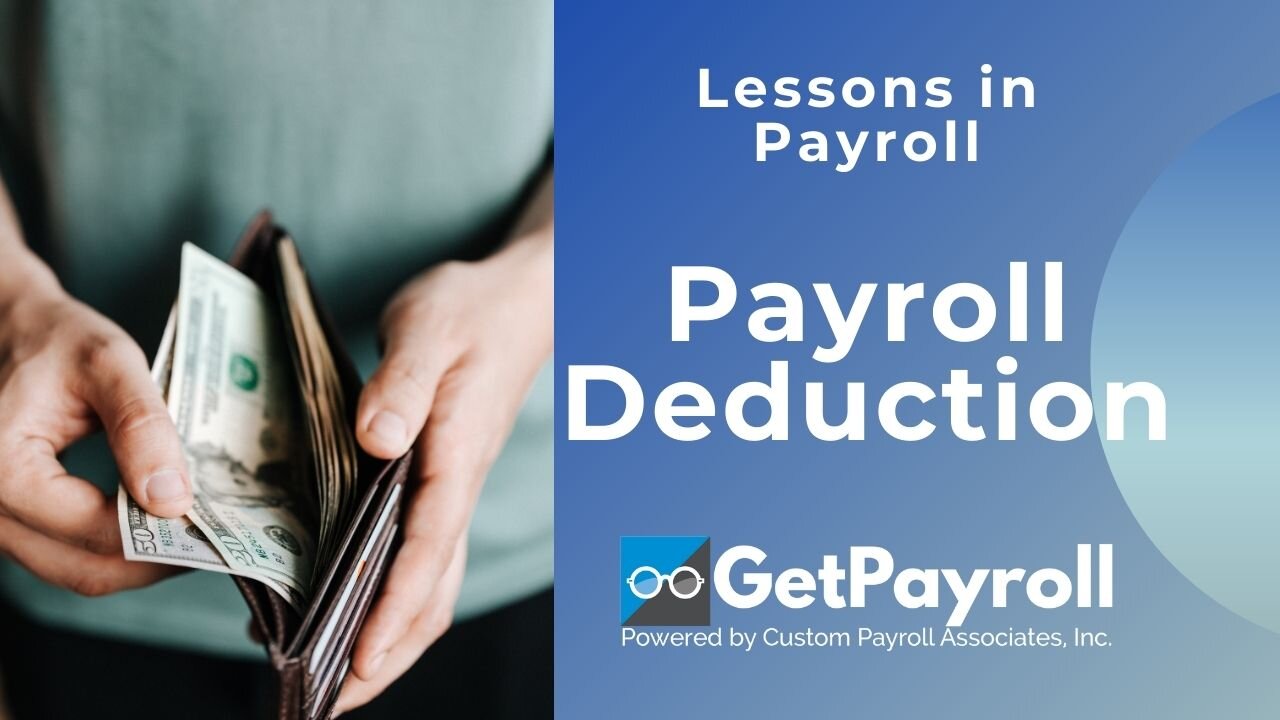
PAYROLL DEDUCTIONS: Lessons in Payroll with Charles Read
GetPayroll President Charles Read shares his years of knowledge of the payroll landscape to the masses. today's lesson: Deductions.
www.getpayroll.com
www.thepayrollbook.com
TRANSCRIPT:
When it comes to payroll there is one word that no one likes seeing on their paystub: DEDUCTIONS. However, it is important to know what these deductions are to understand where the money is going. Although, it’s very likely your employees still won’t be happy.
There are two types of deductions: The first is Voluntary Deductions:
An employee can voluntarily agree to wage deductions that must be implemented by the payroll department. These deductions may include voluntary wage assignments to repay a debt, charitable deductions, wages withheld to purchase U.S. savings bonds, and credit union loan repayments, to name a few.
calculating taxes. These are called Pre-Tax deductions.
Since they reduce the employee’s taxable income, they reduce the required contributions that the employee and employer must make for Social Security and Medicare taxes. They also reduce the employee’s federal income tax withholding because less TAXABLE income means less income tax.
The other type of deductions are Involuntary Deductions:
Involuntary Payroll Deductions are those over which an employer or employee has little or no control. The employer is required by law to deduct a specific dollar amount of the employee's pay and remit it to a person or agency to satisfy the law. If the employer fails to deduct and remit that amount, the employer will generally be subject to a penalty equal to the amount that was required to be deducted plus possible fines and interest.
These involuntary deductions may include federal taxes, state taxes, local taxes, child support, tax levies, unpaid student loans, creditor garnishments, and more. A common problem for employers is determining deduction amounts when several orders for involuntary deductions are received against an employee's wages.
A certain amount of the employee’s wages is exempt from involuntary deduction orders. If there is not enough payroll available, after amounts are exempted, to pay all the orders, the employer must understand which orders to pay and how much to pay on each order. There are methods to prioritize all of the various types of orders received by the employer.
If you would like to learn more about payroll, check out our website at getpayroll.com or my new book:
The Payroll Book: A Guide for Small Businesses and Startups.
Available at thepayrollbook.com, Amazon, or wherever fine books are sold.
Thanks for listening.
-
 23:54
23:54
Jasmin Laine
2 hours agoCarney’s WORST Day EVER—BOOED, Fact-Checked, and Forced to FLEE the House
2783 -
 1:59:47
Redacted News
2 hours agoDeep State Coup Coming for Trump? New JFK Files Released and NATO Preparing Attack on Russia
111K40 -
 LIVE
LIVE
Dr Disrespect
7 hours ago🔴LIVE - DR DISRESPECT'S TRIPLE THREAT CHALLENGE - ARC RAIDERS • BF6 • FORTNITE
1,236 watching -
 1:00:57
Russell Brand
4 hours agoThe Vaccine Ideology Unmasked | Dr Peter McCullough - SF658
88.5K33 -
 1:11:25
vivafrei
3 hours agoKash Patel's Jacket-Gate! Pfizer Whistleblower Qui Tam on Appeal! Meanwhile in Canada! AND MORE!
42.7K27 -
 16:30
16:30
Clintonjaws
7 hours ago $2.30 earnedEntire Room Speechless as Pete Hegseth Snaps Destroying All Media To Their Face
12.9K7 -
 22:12
22:12
Dad Saves America
3 hours agoHow Greek Philosophers Created Western Civilization: The Death of Debate - Pt 2
3.28K -
 LIVE
LIVE
LFA TV
20 hours agoLIVE & BREAKING NEWS! | WEDNESDAY 12/03/25
1,261 watching -
 1:05:46
The Quartering
4 hours agoNew Epstein Video Drops! The US Economy Has SCARY Numbers Released & More
116K26 -
 1:07:11
The White House
6 hours agoPresident Trump Makes an Announcement, Dec. 3, 2025
32K15