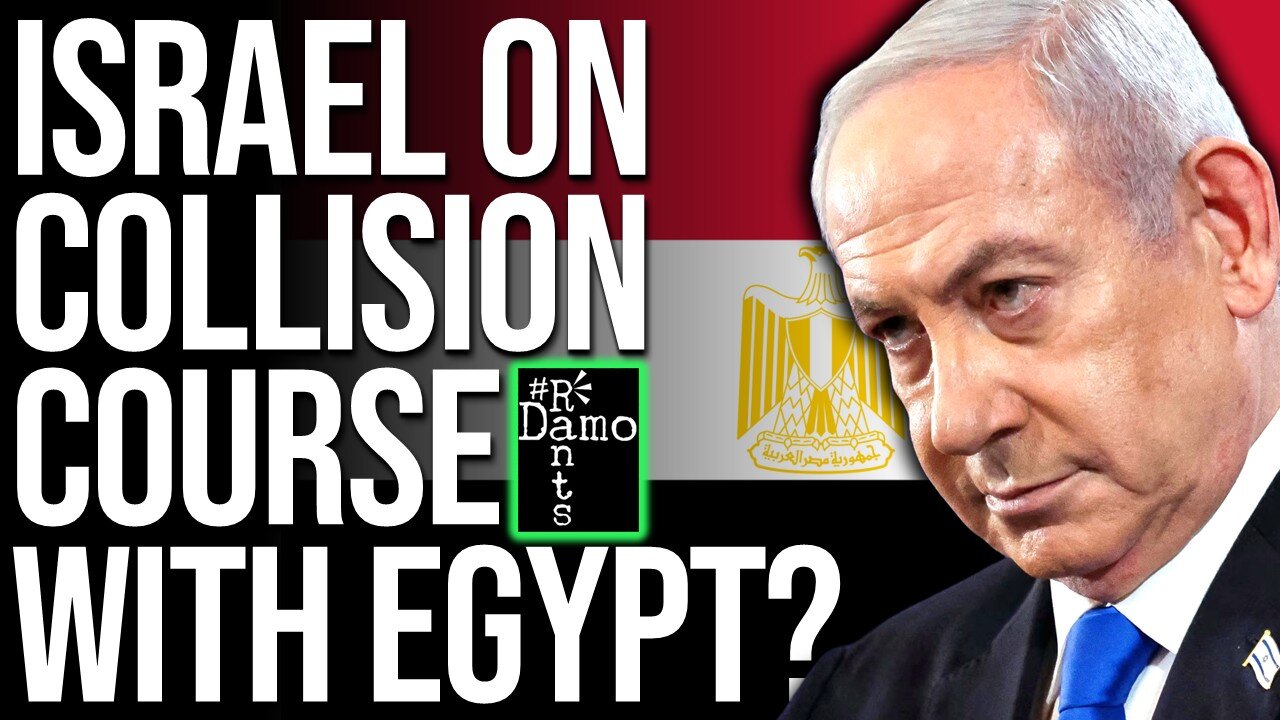
Israel Tried To Corner Egypt Over Rafah — And Cornered Itself Instead
Right, so Israel has announced it’s about to open Rafah “in the coming days,” and Egypt has apparently replied with the diplomatic equivalent of “don’t even start,” and the fact both sides can say completely opposite things with a straight face tells you more about this situation than the announcement itself ever will. Israel says the gate will open exclusively for exit, which is convenient when you’re the one controlling the gate, and Egypt says it hasn’t agreed to a thing, which is also convenient when you’ve spent the past year digging trenches and parking tanks along that same frontier. So you can already see the game. Israel gets the headline, Egypt gets the panic, Gaza gets the uncertainty, and none of it requires a single door hinge at Rafah to actually move.
Right, so what Israel has done here is announce that the Rafah crossing will open “in the coming days” to let Gazans exit into Egypt, and they’ve done it with the kind of confidence that usually means the groundwork is already laid, except the one government they claim to be coordinating with has immediately said the opposite, and that contradiction is the whole point of the story. Israel says there will be an exit, Egypt says there will not, and you can already see how easily a border can become a political weapon long before a single person ever walks through it. Israel has said this crossing will open exclusively for people to leave Gaza. Egypt has said it has agreed to nothing, and Egypt has said it because of the fear that sits under every one of its statements on Gaza: the fear of being forced to absorb a displaced population. This is the red line Egypt has repeated for two years, and when you look at how they’ve acted, not just what they’ve said, you see that isn’t rhetorical posturing at all because Egypt has reinforced its side of Rafah with berms, trenches, concrete, and tanks, and you don’t build that unless you believe someone might try to move people across that frontier without your consent.
So the starting point is this: Israel has announced an opening that the receiving country has publicly rejected, and when you’re dealing with a border as sensitive as Rafah, an announcement alone is enough to create political consequences. Israel knows that, Egypt knows that, and the public denial is part of the choreography because Egypt cannot simply play along, even if discussions behind the scenes are ongoing, because the domestic cost of being seen as a release valve for Gaza is catastrophic for Cairo. Egypt can accept small numbers of medical evacuations, and it has done so, but a one-way, exit-only corridor controlled by Israel is exactly the scenario Egypt has been preparing to stop. So when Israel makes an announcement like this, you have to look past the text and examine the mechanics. Israel controls the northern side of Rafah. Israel controls who gets to the gate. Israel defines the categories of “approved” people. Israel says this movement will take place under a revived European monitoring mechanism. Israel also says this is humanitarian. Egypt, meanwhile, has basically said it has no knowledge of any of this. This clash tells you something more important than whether the gate opens. It tells you that Israel is willing to use the announcement itself as a pressure tool.
And here’s the thing: Israel does not need the gate to open for the announcement to work. It needs the world to hear that Israel is prepared to let people leave and that Egypt is not. That’s the political inversion here. Israel shifts the optics of responsibility by saying the humanitarian route is available. Egypt then has to justify its refusal, even though that refusal comes from a perfectly rational fear of permanent displacement. None of this proves intent on Israel’s part. It proves the usefulness of an announcement. Because when people are trapped in Gaza under bombardment and siege, the mere suggestion of an escape corridor reframes the crisis, and Israel knows that, and it uses announcements like these repeatedly to test diplomatic boundaries, particularly with the United States. You can see the pattern. Israel makes a unilateral statement. Other states scramble to clarify. The US stays vague. The announcement does its job, even if it never ends up actually materialising.
Egypt’s reaction tells you the other half of the story. Cairo has said for over a year that it will not allow a mass influx of Palestinians into the Sinai, and it has reinforced the border as if expecting someone to try. This isn’t posturing for the cameras. It’s regime-survival politics. Egypt cannot be seen to facilitate anything that looks like demographic transfer because the fear of that scenario is ingrained in Egyptian political identity, military doctrine, and public opinion. Displacement into the Sinai would destabilise Egypt domestically. Crossings into the Sinai have implications for security in a region of the country already hit by years of insurgency. And Egypt also knows that once people cross, they rarely ever return because the politics of return are always harder than the politics of exit, which is why exit-only corridors create such alarm. They do not need to be designed as displacement routes to function as displacement routes. They only need to prevent return.
This is why the wording matters so much. Israel has said the crossing will open exclusively for exit. Nothing about return. Nothing about two-way movement. Nothing about guarantees. Nothing about Palestinian Authority involvement. Egypt then says the opposite. Egypt says the crossing must be two-way. Egypt says return is essential. Egypt says coordination is not happening. And Egypt says it because it has already built walls and trenches to keep that border sealed unless it is prepared to open it on its own terms. So when Israel says “in the coming days”, and Egypt says “no we didn’t agree to this”, what you are watching is not confusion. It is a real-time clash between two states trying to shift the humanitarian and political burden of Gaza onto the other.
At this point you have to ask whether Israel genuinely intends to open Rafah for mass civilian movement. Nothing in the reporting shows that. What we have is an announcement with no operational detail, no list of categories, no defined mechanism beyond a reference to an earlier year’s monitoring system, and no clarity from Egypt, which must receive these people. That is why we are talking about a risk, not a plan. A risk grounded in the structure Israel has outlined. A risk grounded in the fear Egypt has acted upon. A risk grounded in the fact that one-way corridors have historically resulted in permanent population movement. And a risk grounded in the international warnings issued over the past two years about the possibility of forced displacement from Gaza into Sinai.
So the matters sits on that risk. Israel’s announcement, Egypt’s denial, and the question of what this means in practice. Because even if Israel never opens the gate, the announcement creates a diplomatic environment where Israel can say the humanitarian option exists and Egypt is the obstacle. That’s the move. Shift the optics. Shift the pressure. And put Egypt in a position where it must defend a morally reasonable position — refusing to become an emptying ground for Gaza — as if it is the unreasonable one.
Think about how this plays internationally. Israel is under intense pressure over conditions in Gaza, and under that pressure, an announcement that civilians may leave reframes the debate, even if the mechanics do not exist. Egypt then becomes the story. Egypt’s refusal becomes the story. Egypt’s tanks become the story. And Gaza’s suffering, which Israel is trying to manage diplomatically, becomes less centred in the narrative. This is the politics of announcements. They do not need to lead to action. They need to lead to headlines, statements, diplomatic hesitations, and pressure redirection.
None of this means the gate will not open. It means we do not know. And that uncertainty itself is the political tool. Israel leaves itself an out. If Egypt refuses, Israel can blame Egypt. If Egypt later negotiates a limited opening — medical evacuations, small lists, external monitoring — Israel can claim it created the space. And if the gate never opens at all, Israel still gets the political benefit of saying it tried. It is a low-cost, high-leverage move, and Egypt responds accordingly because it knows what game is being played here.
Egypt’s denial is immediate and absolute because it must be. If Egypt leaves any ambiguity, Israel fills that ambiguity with policy. If Egypt says nothing, Israel presents silence as consent. And because Egypt cannot afford to look complicit in any mechanism that could lead to permanent relocation of Palestinians into the Sinai, it must reject the announcement completely, even if the announcement was never intended to lead to arrivals. This is why Egypt builds the physical barriers. They are not just for defence. They are for demonstration. They show Egypt’s public and the region that Cairo has created a physical veto over any attempt to push civilians across the border. It is the kind of signalling states use when the possibility they fear is not theoretical.
This situation also exposes a deeper point about borders in conflict. Borders are not neutral lines. They are tools of pressure. When Israel announces Rafah will open, it doesn’t matter whether the gate is ready. The statement alone moves diplomatic weight. When Egypt denies coordination, it doesn’t matter whether quiet discussions are happening. The denial protects Egypt politically. And when international observers warn about displacement risks, it doesn’t matter whether anyone intends to force movement. The risk exists because the power structures exist. This is the part of the analysis you cannot ignore. Intent is not the only measure of danger. Structural vulnerability is. One-way corridors are structurally dangerous whether they are used or not.
And you can see why Palestinians fear this so intensely because they have lived through decades of displacement mechanisms dressed as humanitarian routes. Once you leave, you may never come back. Once you cross, you lose legal and political leverage. And once a population is fragmented, it becomes harder to return it to its land. Egypt knows that too. That is why the border is treated not as a humanitarian passage but as a political frontier whose control determines whether Gaza remains Gaza or becomes a question of where its people ended up.
So this is what the Rafah story shows. An announcement from Israel that may or may not materialise. A denial from Egypt that must be issued regardless of what happens next. A structure of movement that is one-way on paper. A history of displacement that makes that structure alarming. A regional context where Egypt cannot carry the consequences of a mass influx. And a political context where Israel can benefit from an announcement that shifts pressure without opening anything.
Whether the gate stays closed or whether it opens for a handful of cases, the announcement has already done its work. It has created uncertainty. It has forced Egypt into a defensive posture. It has allowed Israel to present itself as facilitating humanitarian movement. It has raised the question of displacement without Israel having to declare it. And it has reminded everyone that borders in war are not just barriers. They are instruments. They can be opened rhetorically and closed physically. They can be used to shift responsibility. And they can turn a humanitarian crisis into a diplomatic contest over who must bear the consequences of a territory no one wants to be responsible for yet everyone wants to control.
Israel’s announcement does not prove an intent to drive Gazans into Egypt, but the structure they describe creates that risk. Egypt’s denial does not solve that risk. And until the mechanism is defined, guaranteed, and agreed by both sides, every announcement like this carries the shadow of displacement, which is why Egypt responds the way it does, and why Gaza sits once again at the mercy of states using their borders as bargaining chips rather than lifelines.
For more on the background to this story, including the 40,000 troops Egypt sent to the Rafah Crossing only a few months ago, you can find more on this here.
Please do also hit like, share and subscribe if you haven’t done so already so as to ensure you don’t miss out on all new daily content as well as spreading the word and helping to support the channel at the same time which is very much appreciated, holding power to account for ordinary working class people and I will hopefully catch you on the next one. Cheers folks.
-
 LIVE
LIVE
ShivEmUp
4 hours ago🔴LIVE🔴🔵Battlefield 6🔵Game Changing Updates?🔵Grumpy Bird🔵
60 watching -
 LIVE
LIVE
Grant Cardone
6 hours agoHow to Find Your First $1million Profit In Real Estate
1,086 watching -
![[ FF7 Remake] | Cloud doing what he does best [ PART 6 ]](https://1a-1791.com/video/fwe2/a6/s8/1/Y/8/Y/F/Y8YFz.0kob.1-small--FF7-Remake-Cloud-doing-wha.jpg) 5:00:59
5:00:59
CHiLi XDD
5 hours ago[ FF7 Remake] | Cloud doing what he does best [ PART 6 ]
144 -
![Mr & Mrs X - [DS] Pushing Division, Traitors Will Be Exposed, Hold The Line - EP 18](https://1a-1791.com/video/fwe2/96/s8/1/w/U/W/F/wUWFz.0kob-small-Mr-and-Mrs-X-DS-Pushing-Div.jpg) 54:40
54:40
X22 Report
8 hours agoMr & Mrs X - [DS] Pushing Division, Traitors Will Be Exposed, Hold The Line - EP 18
118K37 -
 LIVE
LIVE
FusedAegisTV
18 hours agoFUSEDAEGIS | Confronting the Paintress | Expedition 33 PART VIII
31 watching -
 LIVE
LIVE
ReAnimateHer
21 hours ago $1.49 earnedScreams in the Fog | DBD Live
157 watching -
 2:33:21
This is the Ray Gaming
2 hours ago $0.17 earnedNew Shirt SaturRAY | Rumble Premium Creator
8.72K1 -
 LIVE
LIVE
PenguinSteve
2 hours agoLIVE! The Return of the Battlefield 6!
45 watching -
 54:54
54:54
iCkEdMeL
4 hours ago $54.34 earned🔴 BREAKING: Gunman Opens Fire at Tim Pool’s Home
84.7K48 -
 3:27:43
GamingWithHemp
4 hours agoPlaying Metroid Prime 4 episode 1 A new beginning
12.1K