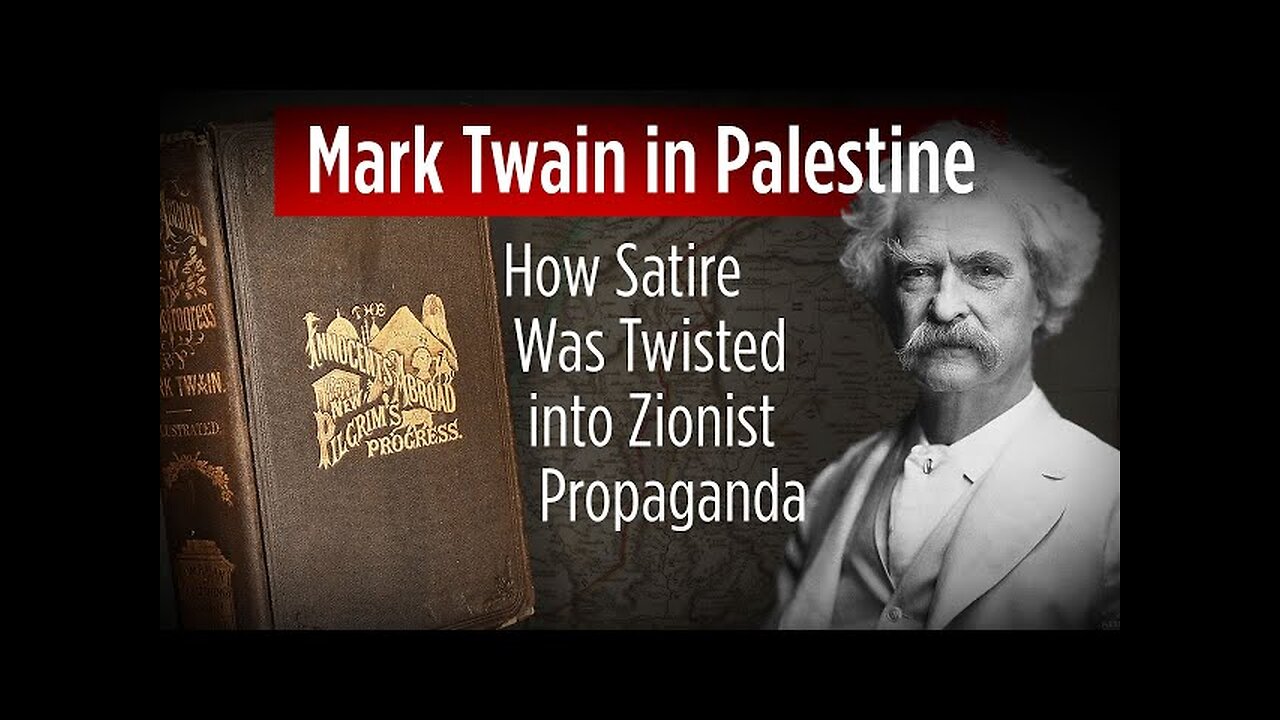
Mark Twain in Palestine: How Satire Was Twisted into Zionist Propaganda
Zionists often selectively quote Mark Twain’s Innocents Abroad to claim 19th-century Palestine was “a land without a people.” In reality, Twain also described fertile and verdant valleys circled by villages, and groves of olives, figs and pomegranates. But Twain wasn’t doing fieldwork—he was a satirist hired by a newspaper to entertain readers' back home. Contemporary travelers, researchers and Ottoman records show a populated, cultivated land exporting millions of oranges and liters of olive oil. This video exposes how satire was cherry-picked and twisted into propaganda—and restores the truth of a living, working Palestine.
Sources:
Primary economic data
Alexander Schölch, “European Penetration and the Economic Development of Palestine, 1856–1882,” Studies in the Economic and Social History of the Middle East (Oxford, 1981).
↳ Data tables on Jaffa port exports
“Agricultural Exports via Jaffa (1856–1882),” Interactive Encyclopedia of the Palestine Question, Palestinian Studies Digital Archive.
↳ Reproduces Schölch’s series and consular data showing a trade-balance surplus.
Citrus statistics
Schölch, ibid.; summarized in consular reports cited by The Oxford Handbook of Palestine and the Palestinian Diaspora (2020) and regional press data (Haifa and Jaffa ports).
Travel sources
Mark Twain, The Innocents Abroad (1869)
Edward Robinson, Biblical Researches in Palestine (1838).
Victor Guérin, Description géographique, historique et archéologique de la Palestine (1868-1880).
Bayard Taylor, The Lands of the Saracen (1854).
Laurence Oliphant, Haifa, or Life in Modern Palestine (1887).
Population & land use
Beshara Doumani, Rediscovering Palestine: Merchants and Peasants in Jabal Nablus, 1700–1900 (1995).
Justin McCarthy, The Population of Palestine: Population Statistics of the Late Ottoman Period and the Mandate (1990).
-
 55:12
55:12
We The People - Constitutional Conventions
1 day agoHow to Steal 7,000,000,000,000 Dollars. From Robber Barron's to the Coming Tech Bro Dictatorship
2561 -
 1:57:48
Game On!
17 hours ago $5.25 earnedHAPPY FOOTBALL FRIDAY! NFL Week 14 Betting Preview!
23.1K2 -
 1:05:41
Crypto Power Hour
12 hours ago $6.42 earnedBlockchain Solutions w/ U.S. Healthcare Featuring Solum Global
49.4K9 -
 1:18:24
The Illusion of Consensus
1 month ago“Your Math Is WRONG” - Mark Cuban GRILLED Over His NBA COVID Vaccine Mandate | Part 2
23.7K15 -
 14:17
14:17
RTT: Guns & Gear
18 hours ago $3.77 earnedBest Budget RMR Red Dot 2025? Gideon Optics Granite Review
25.1K5 -
 2:05:05
BEK TV
1 day agoTrent Loos in the Morning - 12/05/2025
23.3K -
 4:02:10
The Bubba Army
1 day agoWill Michael Jordan TAKE DOWN NASCAR - Bubba the Love Sponge® Show | 12/05/25
53.9K -
 35:55
35:55
ZeeeMedia
17 hours agoPfizer mRNA in Over 88% of Human Placentas, Sperm & Blood | Daily Pulse Ep 156
30.9K115 -
 LIVE
LIVE
Pickleball Now
7 hours agoLive: IPBL 2025 Day 5 | Final Day of League Stage Set for Explosive Showdowns
134 watching -
 9:03
9:03
MattMorseTV
19 hours ago $22.08 earnedIlhan Omar just got BAD NEWS.
52.4K112