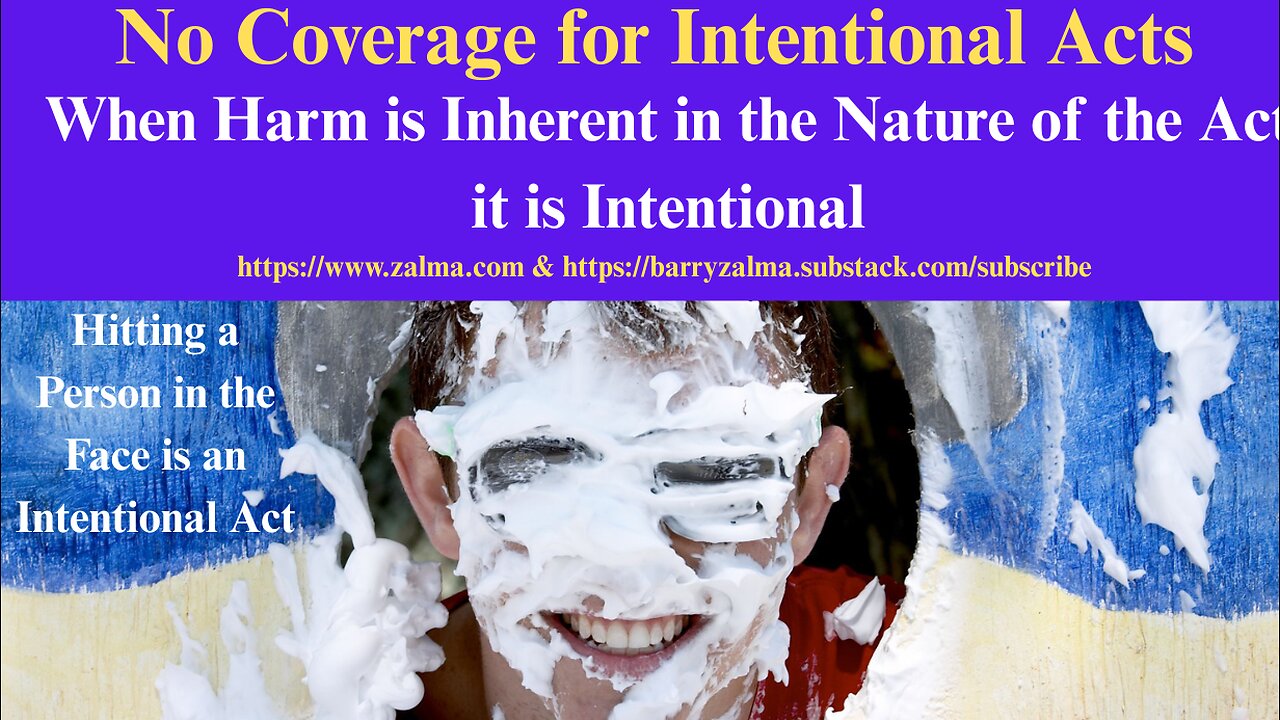
No Coverage for Intentional Acts
When Harm is Inherent in the Nature of the Act it is Intentional
Post 5237
Hitting a Person in the Face is an Intentional Act
In Unitrin Auto and Home Insurance Company v. Brian C. Sullivan, et al., George A. Ciminello, No. 2022-01607, Index No. 21632/14, Supreme Court of New York, Second Department (November 19, 2025) George A. Ciminello was injured when struck in the face by a cup filled with liquid, thrown from a moving vehicle operated by Brian C. Sullivan, with Robert Harford as the passenger who threw the cup. The vehicle approached Ciminello at about 30 mph, from 2 to 10 feet away, and Harford extended his arm to make contact. The cup splintered upon impact.
Ciminello sued Sullivan and Harford (among others) in Supreme Court, Suffolk County (Index No. 21023/05), alleging intentional torts (willful, wanton, and intentional acts). Sullivan and Harford later conceded liability on the intentional tort claim before a damages trial.
Insurance Policy:
Unitrin Auto and Home Insurance Company insured Sullivan. The policy covered "occurrences," interpreted as accidents.
Declaratory Judgment Action (2014): Unitrin sued Sullivan, Harford, and Ciminello seeking a declaration of no duty to indemnify Sullivan, arguing the incident was intentional, not an accident.
Procedural History:
Sullivan and Harford defaulted (failed to appear or answer). Unitrin moved for summary judgment in 2015; granted in 2016 but reversed on appeal in 2020 (Unitrin Auto & Home Ins. Co. v Sullivan, 179 A.D.3d 970), finding a triable issue on whether harm was inherent in the act.
Nonjury trial held on whether the incident was an "accident." Trial court (March 1, 2022) ruled it was not an accident and declared no indemnification obligation. Ciminello appealed; the Appellate Division, Second Department, affirmed on November 19, 2025.
Evidence of Intent:
Sullivan testified he and Harford planned to fill a cup with liquid and throw it at "somebody." They executed the plan intentionally. Post-incident reactions by Sullivan and Harford indicated the contact was not unintentional.
Key Legal Principles Applied
An insurer must indemnify only if the insured is liable for a covered loss under the policy. Here, coverage required an "occurrence," meaning an accident.
Viewed from the insured's (Sullivan's) perspective, an accident is something unexpected, unusual, and unforeseen. Accidental results can stem from intentional acts if the harm was unintended.
Inherent Harm Exception:
If harm is "inherent in the nature of the intentional act," the act is deemed to have intentionally caused the harm, negating accident status. The court found the harm (facial injury from close-range cup throw) was inherent in the planned assault.
Burden of Proof:
As the party seeking declaratory relief, Unitrin bore the burden to prove no coverage.
COURT'S CONCLUSION
Unitrin met its burden; the intentional planning, execution, and inherent risk of harm meant the incident was not an accident, relieving Unitrin of indemnification duty. The judgment was affirmed with costs.
ZALMA OPINION
When Sullivan testified he and Harford planned to fill a cup with liquid and throw it at "somebody " and fulfilled their plan that caused damage to Ciminello the admitted there was no "occurrence" as defined by the policy and the court concluded that the insurer had no obligation to defend or indemnify Sullivan and/or Harford who managed to avoid arrest for battery, a felony.
(c) 2025 Barry Zalma & ClaimSchool, Inc.
Please tell your friends and colleagues about this blog and the videos and let them subscribe to the blog and the videos.
Subscribe to my substack at https://barryzalma.substack.com/subscribe
Go to X @bzalma; Go to Barry Zalma videos at Rumble.com at https://rumble.com/account/content?type=all; Go to Barry Zalma on YouTube- https://www.youtube.com/channel/UCysiZklEtxZsSF9DfC0Expg; Go to the InsuranceClaims Library – https://lnkd.in/gwEYk.
-
 10:28
10:28
Insurance Law
2 days agoUnmitigated Gall to Abuse an Elderly Bishop and His Church
32 -
 LIVE
LIVE
Grant Cardone
1 hour agoHow to Find Your First $1million Profit In Real Estate
8,330 watching -
![Mr & Mrs X - [DS] Pushing Division, Traitors Will Be Exposed, Hold The Line - EP 18](https://1a-1791.com/video/fwe2/96/s8/1/w/U/W/F/wUWFz.0kob-small-Mr-and-Mrs-X-DS-Pushing-Div.jpg) 54:40
54:40
X22 Report
3 hours agoMr & Mrs X - [DS] Pushing Division, Traitors Will Be Exposed, Hold The Line - EP 18
78.9K12 -
 LIVE
LIVE
LumpyPotatoX2
42 minutes agoDestiny Rising: Gameplay - Partnered Creator
526 watching -
 1:10:32
Wendy Bell Radio
6 hours agoPet Talk With The Pet Doc
20K15 -
 LIVE
LIVE
ttvglamourx
38 minutes agoHAPPY SATURDAY !DISCORD
163 watching -
 18:53
18:53
Wrestling Flashback
23 days ago $7.88 earned10 WWE Wrestlers Who Ruined Their Bodies Wrestling Too Long
14.1K4 -
 LIVE
LIVE
Amarok_X
1 hour ago🟢LIVE ARC RAIDERS | TOPSIDE FOR SCRAPPY | PREMIUM CREATOR | VETERAN GAMER
189 watching -
 27:03
27:03
The Kevin Trudeau Show Limitless
3 days agoThey're Not Hiding Aliens. They're Hiding This.
49.4K72 -
 22:17
22:17
MetatronGaming
6 days agoI spent 7 days in the 1980s
10K6