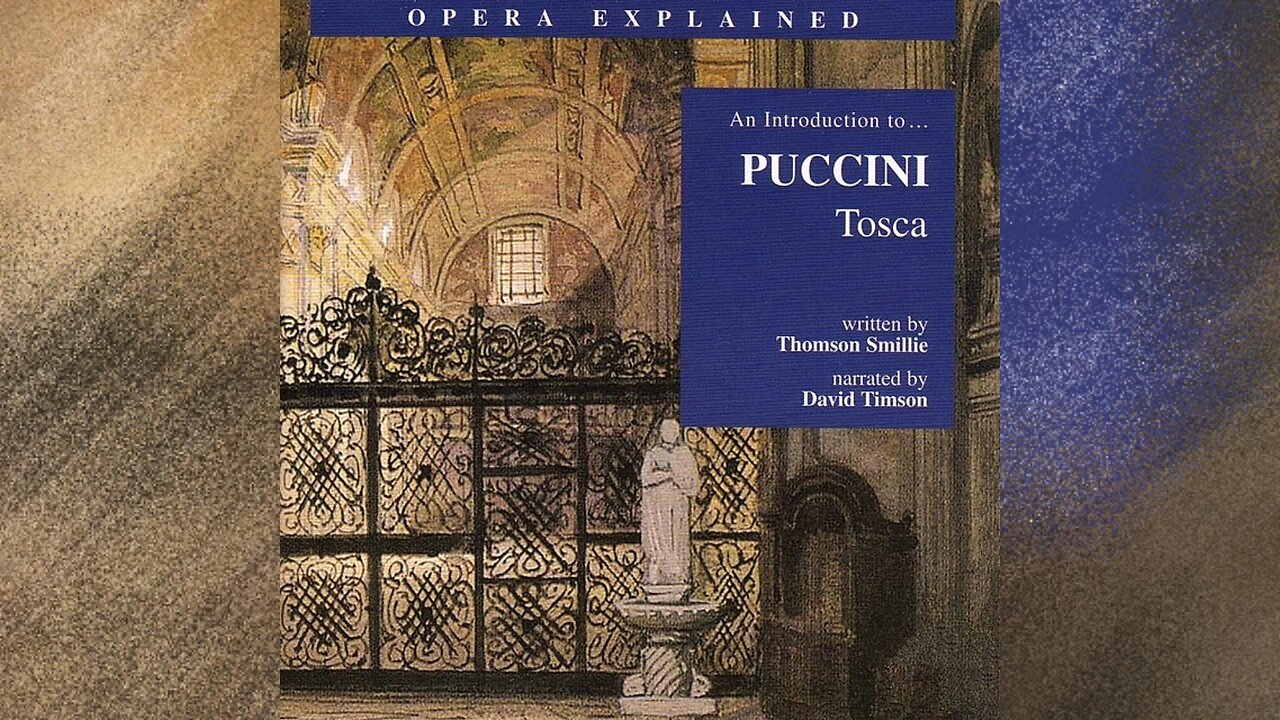
Opera Explained | Tosca by Puccini (Audio)
"An introduction to....Puccini - Tosca" written by Thomson Smillie, narrated by David Timson.
Tosca is Puccini at the peak of his theatrical power. The story of the jealous, impassioned opera singer Floria Tosca and her doomed love for the painter Mario Cavaradossi is played out against backgrounds both historically and geographically overwhelming. It is set in three great and historical locations of Rome during the Napoleonic era. Spectacle, sensuality and cruelty battle for our attention in one of the most truly ‘action-packed’ works of theatre.
It centres of course on the title character, Floria Tosca, who was in real life an opera singer. She is a glamorous figure, variously kittenish yet tiger-like, warmly affectionate yet intensely jealous, devout yet murderous. In fact, everything one hopes for in a prima donna. It is no small wonder that the role became associated with Maria Callas, its greatest exponent, whose own passionate and scarred life mirrored Tosca’s tragedy.
But Tosca is no one-woman show. Cavaradossi, the tenor hero, is a powerful character, and has wonderful music including two show-stopping arias, and in Baron Scarpia, chief of Rome’s secret police, Puccini orchestrated one of opera’s great villains. It is an irony that in some ways Scarpia is the most lifelike of the three principals, yet he is the only one who is a complete creation of the playwright Victorien Sardou, on whose play, La Tosca, Puccini based his opera.
Tosca scores also in its historical and geographical setting. The action takes place in the year 1800 at the height of the Napoleonic era, when General Bonaparte, as he still was, favourite son of the French Revolution, was striking terror into the hearts of the reigning classes including, maybe especially, the Pope, whose vast temporal empire was still based, like the opera, in Rome.
Any tourist to Rome can visit the actual settings of Tosca in a morning: the vast baroque church of St Andrew in the Valley, the Palazzo Farnese (then the Neapolitan, now the French Embassy) and that glorious antique pile, the Castle of the Holy Angel, from whose battlements Tosca makes her final, fatal exit. But it takes a master like Puccini to fashion from the politics and the topography such brilliant set pieces as the great ‘Te Deum’ which ends the first act, the intensely dramatic confrontation between Scarpia and Tosca which is at the heart of the opera’s second act, and the atmospheric and deeply touching last scene with the ‘mock execution’ of Cavaradossi atop the Castel Sant’Angelo.
Love, jealousy, passion, politics, torture and executions, spectacle, duplicity and menace are woven together into a superb tapestry, and then coloured by a great Italian master of melody.
Tracklist:
1. Introduction
2. Puccini's Operas
3. Historical background to Tosca
4. Opening bars
5. Act I
6. Entrance of Tosca
7. caravadossi and Angelotti – Scarpia’s entrance
8. End of Act I
9. Act II
10. Scarpia and Tosca – Caravadossi’s torture
11. Tosca’s response to Scarpia – ‘Vissi d’arte’
12. Act III
13. Caravadossi writes to Tosca – ‘E lucevan le stelle’
14. The firing squad – The tragic end
-
 2:57:04
Adaneth - Arts & Literature
9 days agoMozart: Die Entführung aus dem Serail | Ruiten, Peter - Mehta, Strehler (La Scala 2017-MULTISUB)
25 -
 LIVE
LIVE
Lofi Girl
2 years agoSynthwave Radio 🌌 - beats to chill/game to
1,248 watching -
 7:51
7:51
Comedy Dynamics
6 days agoLife on Lake Erie - Bill Squire stand-up comedy
58.2K3 -
 5:08:20
FreshandFit
13 hours agoArt Basel IRL Stream
210K14 -
 LIVE
LIVE
Akademiks
4 hours ago50 cent Declares War on Diddy. Drake #1 streamed artist of 2025. Candace vs TPUSA. YB 19 bodies?
1,189 watching -
 4:51:31
Drew Hernandez
1 day agoKASH DENIES FOREIGN INVOLVEMENT IN CHARLIE KIRK MURDER & CANDACE WILLING TO MEET WITH ERIKA KIRK?
31.8K23 -
 1:19:49
Adam Does Movies
5 hours ago $20.08 earnedLive Taping! Reviewing Five Nights At Freddy's 2, Marty Supreme, Fackham Hall - Live!
31.9K -
 0:43
0:43
Gaming on Rumble
5 hours ago $2.67 earnedLvl UP (Raids)
23.8K -
 7:50:40
SpartakusLIVE
9 hours agoBUYBACKS Have RETURNED || #1 Gamer w/ Most HEALTHY and VIBRANT Hairline
31.8K -
 2:13:41
TimcastIRL
7 hours agoCNN SLAMMED For Claiming BLACK J6 Bomb Suspect IS A WHITE MAN w/ Milo & George Santos | Timcast IRL
243K372