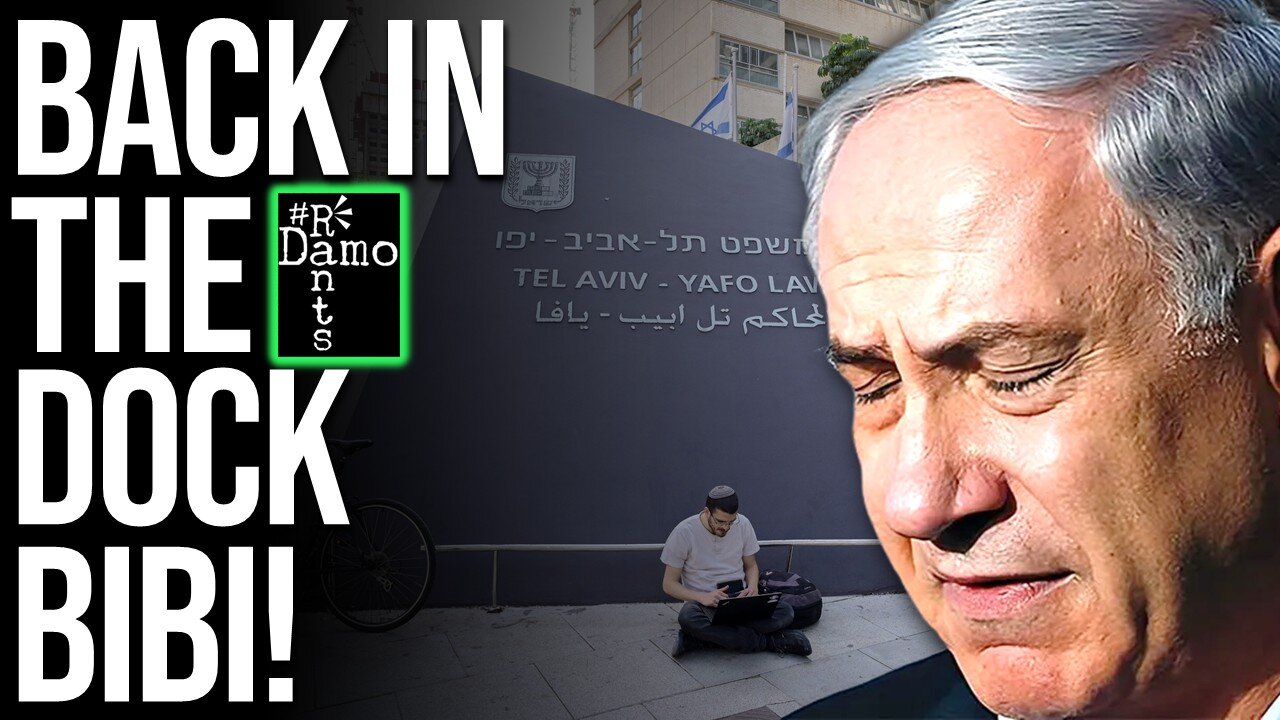
Netanyahu Reached for a Pardon — And Triggered a Collapse He Can’t Stop
Right, so you always know a government has gone past the point of embarrassment and into full-blown panic when the man running it tries to escape his own trial while still standing in the dock, and that’s exactly what Benjamin Netanyahu has just done. A sitting prime minister, still facing three corruption cases, still denying every charge, still telling the country the courts will vindicate him, suddenly decides the safest place to be is nowhere near a verdict and asks the president to make the whole thing disappear. And you don’t get clearer than that do you? People confident in acquittal don’t beg for pardons. People who trust the process don’t try to dodge it and protests outside the president’s house before breakfast tell you everything you need to know. If Netanyahu thought this was the way out at this point, he’s got it catastrophically wrong.
Right, so you always know a political era is creaking when the people running it start trying to escape the very systems they’ve spent years insisting still work, and that’s exactly what has happened with Benjamin Netanyahu’s decision to request a presidential pardon while still on trial, because this isn’t a routine legal step or some procedural tidying-up, it’s a sitting prime minister trying to end his own corruption trial before the court has finished hearing it, still without admitting guilt, without accepting responsibility, and without even pretending the process has reached a point where clemency would normally be considered. It lands as a moment where the system feels it twitch, because a move like this tells you he no longer trusts the process to deliver the outcome he has spent five years telling his supporters is inevitable, and that’s the point where you can see the politics through the legal paperwork, because nobody confident of acquittal asks for the trial to suddenly disappear.
And what makes this so stark is that the legal facts are plain. He’s been on trial since 2020 for fraud, breach of trust and bribery across three separate cases, charges brought in 2019, arguments running for years, evidence still being tested, witnesses still being weighed, and you’d think that after all that insistence that the cases are weak or politically motivated he’d be walking into court demanding a verdict, but instead he’s walked past the court altogether and gone straight to the president, which is why the political ground shook immediately. The moment the request hit the public record, protests began forming outside the president Herzog’s residence, slogans accusing the state of sliding into banana republic territory, people showing up before the political class had even agreed on the talking points, because the public understood what they were looking at. They were looking at a prime minister trying to pull the plug on the legal system that’s meant to hold him accountable.
And here’s the thing, because this is where the mechanics matter. The president does have the legal power to grant a pardon before a conviction. That’s written into Israel’s Basic Law, and its no use pretending otherwise. But law is one thing and political legitimacy is another, and Israeli political stability has always depended on that unwritten space between the legal minimum and the democratic expectation, which is why this request has exploded the way it has. The presidency isn’t an executive power base; it’s a legitimacy office. The pardon power works because nobody abuses it. It survives because it isn’t touched in anger. The public trusts it because it has been used sparingly and almost always after guilt has been admitted or conviction has been handed down. When someone tries to use that power to pre-empt the judiciary, you hit the limits not of the law, but of the system’s patience.
And this is where Isaac Herzog gets dragged into the crisis, because he now has to respond not to a legal question but to a constitutional one, and yes, that’s the correct word even though Israel doesn’t have a single codified constitution, because the presidency sits at the centre of a constitutional expectation: that the law applies to everyone, that judicial processes are not toys for the executive, and that political leaders cannot simply step out of the dock because they feel the case is inconvenient. If Herzog grants the pardon, the presidency collapses into partisanship. If he denies it, he triggers the fury of a leader who has spent years treating the judiciary as a rival centre of power. And if he stalls, which is the only real option he has, he stretches out the crisis, deepening the uncertainty inside a government already running on crisis narratives and coalition fragility.
And what makes this more revealing is the speed of the political reaction, because it wasn’t just protesters who moved quickly. Political commentators, legal scholars, and even normally cautious establishment voices were calling the request extraordinary, unprecedented and dangerous, and none of them were exaggerating. Pre-conviction pardons barely exist in Israeli history, and the only notable case people can point to happened decades ago in a completely different context involving admitted wrongdoing and national security considerations, the 1980 Barzilai Affair if you care to look it up. That’s why this moment lands differently therefore. It doesn’t sit in that framework. It sits in a framework all of its own, untested, where the defendant insists he is innocent, insists the trial is illegitimate, insists the courts are biased, and then tries to bypass the same courts altogether.
And here is where the politics tighten, because Netanyahu has spent two years pushing a judicial overhaul designed to bring the courts under tighter political control, reshaping judicial appointments, testing the boundaries of the attorney general’s independence, trying to shift the balance of power between the executive and the judiciary, and telling the country that all of this is necessary to restore balance or democracy or accountability depending on which speech he’s giving. And when someone who has spent that long saying the courts have too much power suddenly demands the power of the courts be taken away entirely, nobody misses the point. The request doesn’t sit outside the judicial overhaul; it exposes its intent.
Because the truth is simple enough. Leaders confident in the rule of law don’t try to rewrite it. Leaders confident in their innocence don’t try to avoid verdicts. Leaders confident in their political strength don’t risk the legitimacy of the presidency to solve their own personal legal crisis. And that’s why this request has landed as the worst strategic move he could have made. It tells his supporters he’s afraid. It tells his opponents he’s cornered. It tells his coalition partners he’s vulnerable. And it tells the judiciary he’s still trying to bend the system around himself, even now, even after years of institutional confrontation, even after the public pushed back so hard against his earlier reforms.
And you can see how fragile this moment is for Herzog, because if he refuses the request, Netanyahu and his allies will frame it as more evidence that the system is rigged, as they’ve done repeatedly. If he even considers the request too long, he faces accusations of enabling an assault on judicial independence. And if he grants it, the presidency loses the only thing it has ever really had — public trust — because the presidency doesn't govern, doesn’t legislate, doesn’t command the army; it embodies the idea that there is at least one office in the system that sits above the daily sludge of Israeli factionalism – questionable as even that take is. Take that away though, and you leave the state with nothing but power blocs trying to outrun each other.
And yes, I’ll come back to that point, because this is where the whole thing turns from a legal question into a state-level stress test. The pardon request comes at the worst possible time for Netanyahu, because the trial has been dragging, the public patience has been thinning, and the coalition he leads is built on the thinnest of glue, with partners who see his weakness as their leverage and who will extract every political concession they can while he’s exposed. When a leader is seen as fighting for his own survival, not the state’s stability, everyone around him becomes a threat or a bargaining chip, and that dynamic is already unfolding. A move this desperate isn’t interpreted as strength. It’s interpreted as collapse.
And that’s why the reaction inside Israel has felt so immediate and so raw. People aren’t just reacting to the legal oddity; they’re reacting to the sense that the final restraint on political power is now being tested, and that if this restraint falls, the judiciary will be the next casualty. The protests weren’t polite. They weren’t slow. They were a signal that the public has already drawn the line: the prime minister can fight the courts, he can rant against the attorney general, he can push legislation to weaken judicial review, but he cannot ask the head of state to cancel the trial he is still standing inside. And that line exists because without it, nothing about accountability holds.
And once you recognise that line, you can see why the political class has panicked the way it has, because a pardon request at this stage is not just a message to the president; it’s a message to the entire institutional network that the prime minister is no longer playing inside the boundaries they thought still existed. And when one actor decides the rules no longer bind him, every other actor has to decide whether to defend the system or capitulate to the new normal, which is why the reactions from legal experts have been so terse. They’re not confused about the legal power involved. They’re concerned about institutional collapse, because the pardon mechanism only works as long as nobody uses it to delete accountability, and that’s exactly what’s being attempted here.
And this is where it becomes even clearer that this is the worst move Netanyahu could have made, because it forces every institution he still needs to make a choice he didn’t want them to make. Herzog now has to choose between the presidency’s legitimacy and the prime minister’s demand. The judiciary now has to carry a trial under the shadow of a leader trying to escape it. Coalition partners now have to calculate whether they want to be tied to a prime minister seen to be trying to evade the law. And the public, which has already lived through the judicial overhaul crisis, now reads this as confirmation that the prime minister’s goal has never been balance or reform or independence; it’s been protection.
And I’ll say this plainly, because the politics here aren’t subtle. When a leader in a corruption trial tries to halt the process by appealing to the head of state, the presumption is not that he is innocent; the presumption is that he expects the trial to end badly. That’s not a legal judgement; that’s a political one, and it’s drawn from the logic of power rather than the content of the case. People don’t ask to be pardoned for things they believe the court will dismiss. They ask to be pardoned because they no longer trust the court to deliver the outcome they want. And for a man who has spent years presenting himself as Israel’s indispensable figure, the embodiment of stability, the only leader who can navigate crisis after crisis, this is the moment where the story he’s been pushing runs out of road.
Because it doesn’t matter how defiant the public statements are or how aggressive the talking points become; the request is itself the admission. Not of guilt in the legal sense — he still denies that — but of political vulnerability, institutional weakness, and personal fear. And fear is the one thing his political persona cannot survive, because the entire Netanyahu project has been built on the idea that he is the master of the game, always ten steps ahead, always the most experienced, always the one who sees the dangers others miss. But a pardon request before conviction is not a move of mastery. It’s a move of retreat. And retreats are rarely forgiven inside a coalition dependent on perceived strength.
And here’s the pressure point nobody is saying out loud but everyone understands. If Herzog denies the request, which is the only realistic outcome if he wants to keep the presidency intact, Netanyahu’s entire strategy shifts. He will not accept the refusal quietly. He will fold it into the narrative he has been building for years: that the institutions are biased, that the judiciary is hostile, that the elites are conspiring, that the system he governed for decades is somehow rigged against him. He will use a refusal as proof of persecution because persecution has become his shield. And that shields him politically in the short term, but it burns the remaining legitimacy of the system in the long term, because you cannot have a functioning legal order when the head of government encourages the public to see every independent institution as an enemy.
And that is the real danger of this moment. It isn’t that the pardon will be granted. It won’t be. I’ll go on record saying that here, I don’t believe it will be. It isn’t that the trial will suddenly collapse either. It won’t. It’s that the very act of asking for the pardon puts the system in a position where its refusal becomes another accelerant in a political strategy built on treating the state as a series of obstacles to be delegitimised whenever they fail to deliver a personal victory for Netanyahu. He will tear Israel apart to protect himself. And once you cross that threshold, once you treat judicial independence, presidential neutrality and public trust as disposable, you’re no longer dealing with a legal crisis; you’re dealing with a constitutional unravelling being carried out in plain sight.
And you can feel that unravelling already. The protests didn’t wait for Herzog’s answer. They erupted the moment the request became public, because society understood immediately that the rule of law was now being tested in a way that could not be dismissed as partisan theatre. This wasn’t legislation. This wasn’t rhetoric. This was a direct attempt to end a trial that has been running for years. And the public’s reaction tells you something important about where Israel is now. The institutions are strained, the politics are toxic, the coalition is unstable, and the public tolerance for political self-preservation masquerading as legal reform has collapsed. People have had enough of watching the law treated as a flexible instrument for whoever holds the top job.
And that brings me to the point that sits underneath everything else. This isn’t just about Netanyahu’s legal fate. It’s about the health of the state itself. Because a democracy cannot survive long if its leaders believe they can step outside the law whenever the law becomes inconvenient. A legal system cannot function if the most powerful individual in the country tries to opt out of it. A presidency cannot maintain its legitimacy if it is forced into a corner where either decision triggers constitutional damage. And a public cannot keep faith in a system that lets a defendant at the top of government try to escape the verdict that every ordinary citizen is bound by.
And that’s why this moment feels final, even though nothing has been decided yet. Because the request tells the whole story. It tells you the trial is not going the way Netanyahu wanted. It tells you the political base is not as solid as the press conferences suggest. It tells you the judicial overhaul was never about balance or democracy; it was about escaping accountability. And it tells you that the only remaining defence he sees is to try to leap over the judiciary entirely and hope the head of state is willing to carry the political cost. But presidents do not survive decisions like that, and Herzog knows it.
And when a leader puts the head of state in that position, it means he’s out of moves. And when he’s out of moves, all the bravado dissolves and the system shows what it really is: a set of institutions that, fragile as they are, still expect accountability even from the most powerful man in the country. And that’s the story here. Not that Netanyahu asked for a pardon, but that by asking, he showed the public exactly where he stands, exactly how cornered he feels, and exactly how dangerous this moment is for the state he claims to protect.
And this is where the verdict becomes unavoidable, because by the time you reach a moment where a sitting prime minister asks the president to erase a trial still in progress, you’ve already left the realm of legal argument and entered the realm of political self-preservation, and that’s the point the public understood instantly. They didn’t need a panel discussion to explain it. They didn’t need legal scholars to interpret it. They saw the request, they saw what it meant, and they moved, because a public that has spent years watching the state stretch its own limits knows exactly what it looks like when a leader tries to step outside them. And the fact that those crowds appeared so quickly tells you something important: people understand that this isn’t about guilt or innocence; it’s about whether the system still functions at all.
And if you trace the line through the last few years, the pattern is obvious. A judicial overhaul sold as democratic reform but designed to weaken judicial independence. A coalition built on fear and grievance rather than stability. Legislative pushes framed as balancing institutional power but aimed at consolidating executive control. And now this, a direct appeal to the presidency to end the trial before the court has reached a verdict. None of these moves stand alone. They only make sense when placed side by side, because together they show a leader trying to remodel the state's architecture around his own legal and political needs, and when that architecture pushes back, he tries to go around it instead of through it.
The pardon request is not an end point. It is a symptom. It shows the pressure inside the coalition. It shows the erosion of trust between branches of government. It shows the public’s exhaustion with a politics that treats accountability as optional. And it shows a prime minister who no longer believes the legal process will exonerate him, because if he did, he would let it run. The request is the giveaway. It’s the move you make when you’ve run out of moves.
And you can see why this hits the presidency the hardest, because Herzog did not choose this confrontation. He has been forced into it. His office relies entirely on legitimacy, not force. It depends on being above politics, not inside them. And now he is being dragged into a fight where every option damages the institution he leads. Granting the pardon destroys the presidency. Rejecting the pardon triggers a political assault on the presidency. Even delaying the decision prolongs the constitutional strain. It is the worst possible position for a head of state who is meant to embody unity rather than become a lightning rod.
But that’s the cost when a leader uses the state’s emergency valves as escape hatches for personal legal crises. And that’s why this moment feels like a turning point. Because this isn’t the judicial overhaul; this isn’t a legislative brawl; this isn’t rhetoric. This is a man facing a verdict he no longer trusts, trying to pre-empt the system that has carried him for decades, and discovering that even now, even with all the political weight he still holds, people will not let the rule of law be turned into a private negotiation between two powerful men.
And this is the part where I come back to the point that has hung over every paragraph. This request exposes the truth that has been sitting underneath Israeli politics for years: that power has been treated as a shield, that institutions have been treated as tools, and that accountability has been treated as a threat. But the rule of law only works when everyone, including the prime minister, stands inside it. The moment you try to step outside it, the whole thing shakes, because what keeps it standing is not the statute but the expectation that nobody is above it.
And that expectation is what erupted in the protests, in the commentary, in the immediate political recoil. It wasn’t just anger at Netanyahu. It was defence of the principle that the legal process has to run, even when it is inconvenient, even when it is slow, even when it reaches powerful people. And that is why this pardon request will be remembered as the worst move he could have made. Not because it will fail, although it will. Not because it reveals his weakness, although it does. But because it forced the entire country to confront what happens when a leader tries to move himself outside the boundaries of the system, and the system finally says no.
And that’s the verdict here. Netanyahu asked for a pardon, and in doing so, he exposed the political truth he has spent years trying to bury: that he is not the state, that he is not untouchable, and that the institutions he thought he could bend still have enough resilience left to resist him. This is the moment where the mask slipped, the moment where he showed the fear behind the theatrics, the moment where the public saw exactly how precarious his position really is. And when you strip everything else away, that’s the story. A leader trying to outrun the law, and a country deciding whether it will let him.
This is the endgame now as far as Netanyahu and this trial goes, he’s broken ceasefires to dodge it, claimed illness constantly, and started new wars – he was even prepared to have another crack at Iran not long ago and that was after the 12 days in June where Iran handed Israel its backside on a plate, so get the details of that story here.
Please do also hit like, share and subscribe if you haven’t done so already so as to ensure you don’t miss out on all new daily content as well as spreading the word and helping to support the channel at the same time which is very much appreciated, holding power to account for ordinary working class people and I will hopefully catch you on the next one. Cheers folks.
-
 LIVE
LIVE
Ouhel
6 hours agoSATURDAY | Battlefield 6 | Going for the Queen in Arc after | O'HELL LIVE |
47 watching -
 LIVE
LIVE
ShivEmUp
4 hours ago🔴LIVE🔴🔵Battlefield 6🔵Game Changing Updates?🔵Grumpy Bird🔵
68 watching -
 LIVE
LIVE
Grant Cardone
6 hours agoHow to Find Your First $1million Profit In Real Estate
1,108 watching -
![[ FF7 Remake] | Cloud doing what he does best [ PART 6 ]](https://1a-1791.com/video/fwe2/a6/s8/1/Y/8/Y/F/Y8YFz.0kob.1-small--FF7-Remake-Cloud-doing-wha.jpg) 5:00:59
5:00:59
CHiLi XDD
5 hours ago[ FF7 Remake] | Cloud doing what he does best [ PART 6 ]
144 -
![Mr & Mrs X - [DS] Pushing Division, Traitors Will Be Exposed, Hold The Line - EP 18](https://1a-1791.com/video/fwe2/96/s8/1/w/U/W/F/wUWFz.0kob-small-Mr-and-Mrs-X-DS-Pushing-Div.jpg) 54:40
54:40
X22 Report
8 hours agoMr & Mrs X - [DS] Pushing Division, Traitors Will Be Exposed, Hold The Line - EP 18
118K37 -
 LIVE
LIVE
FusedAegisTV
18 hours agoFUSEDAEGIS | Confronting the Paintress | Expedition 33 PART VIII
20 watching -
 LIVE
LIVE
ReAnimateHer
21 hours ago $1.49 earnedScreams in the Fog | DBD Live
162 watching -
 2:33:21
This is the Ray Gaming
2 hours ago $0.17 earnedNew Shirt SaturRAY | Rumble Premium Creator
8.72K1 -
 LIVE
LIVE
PenguinSteve
2 hours agoLIVE! The Return of the Battlefield 6!
42 watching -
 54:54
54:54
iCkEdMeL
4 hours ago $54.34 earned🔴 BREAKING: Gunman Opens Fire at Tim Pool’s Home
84.7K46