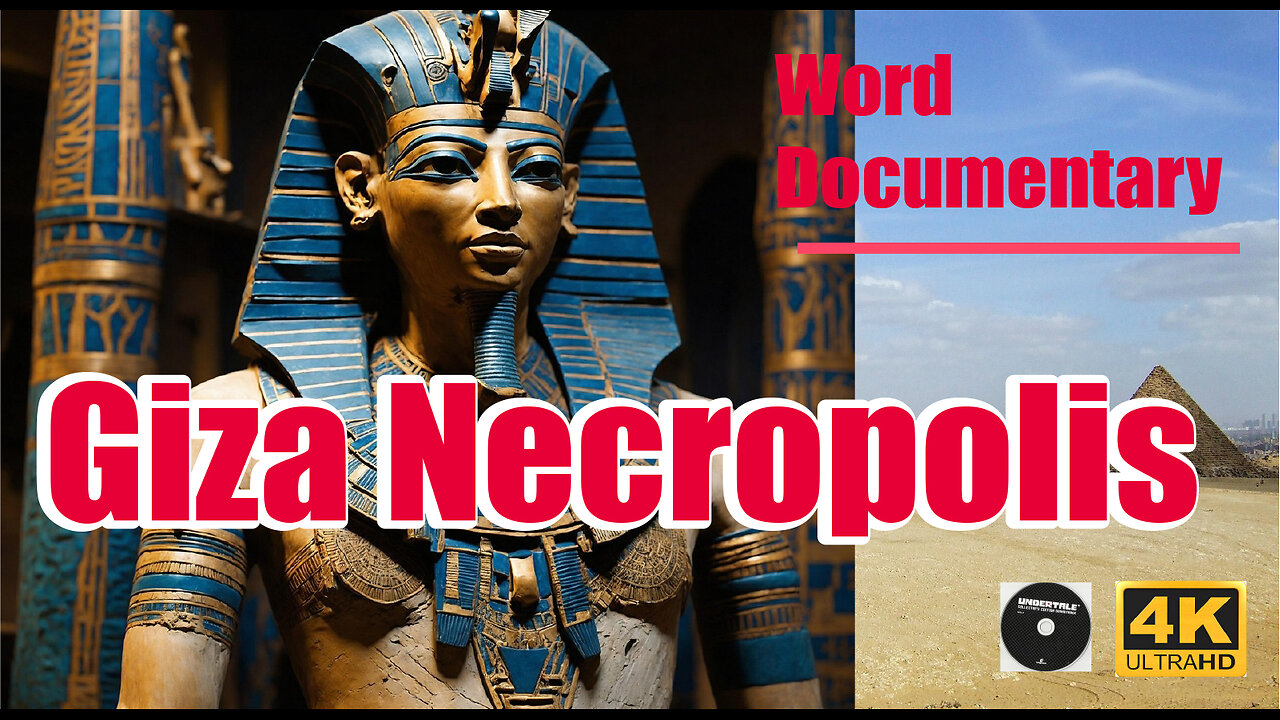
THE GIZA NECROPOLIS / SUSPENSEFUL DOCUMENTARY / 2025
In the blistering heat of the Egyptian desert, where the wind carries ancient whispers across golden sand, stands a landscape so old, so complex, and so mysterious that even today—after centuries of excavation, scanning, and study—it refuses to surrender all its secrets. This is the Giza Necropolis. A place where engineering defies time, where precision defies logic, and where every stone challenges the boundaries of what we believe ancient humanity was capable of.
For more than 4,500 years, the Giza plateau has watched empires rise and fall, religions shift, and civilizations rewrite their own histories. Yet the pyramids—and the silent stone guardians around them—have remained exactly where they were built, untouched by the chaos of time. But beneath this stillness lies a story charged with suspense, discovery, scientific breakthroughs, and questions that echo into the present.
This is not merely a tale of monuments. It is the story of a civilization whose engineering seems impossible even by today’s standards, a story of kings who believed death was only a beginning, and of modern researchers racing to uncover the truth hidden beneath layers of stone, sand, and centuries.
THE PYRAMIDS—ENGINEERING THAT CHALLENGES LOGIC
At the heart of the Giza Necropolis stand three primary pyramids:
Khufu, Khafre, and Menkaure. Each one is a masterpiece. Each one is a challenge to the imagination.
The Great Pyramid of Khufu—rising originally to 146 meters—held the title of tallest man-made structure on Earth for over 3,800 years. Even today, despite advanced machinery and modern architectural tools, engineers admit the structure’s precision is astonishing. Its base is almost perfectly level. The blocks—many weighing several tons—were cut with accuracy nearing industrial standards. Its internal shafts align with celestial bodies with a degree of astronomical knowledge that still provokes debate.
To the public, the pyramids may appear as simple geometric forms. But inside them lies an architectural complexity that modern scanning technologies—such as muon radiography, ground-penetrating radar, and 3D mapping—are still striving to decode. In 2017 and again in 2023, researchers detected previously unknown voids and corridors inside the Great Pyramid. Their purpose is unclear. Their construction defies simple explanation. And they hint that beneath the surface of this monument are chambers not yet touched by human hands in more than four millennia.
What makes the pyramids so valuable to the modern world is not just their size, but the message they carry: that ancient intelligence was far more advanced, far more deliberate, and far more precise than it is often credited for.
-
 18:42
18:42
Navy Media
7 hours agoHouthis ATTACK the Wrong U.S. Fighter Jet – Then THIS Happened…
36.6K37 -
 40:24
40:24
MetatronGaming
1 day agoSomething is REALLY Wrong with this apartment...
28.3K2 -
 LIVE
LIVE
SpartakusLIVE
6 hours agoHUGE NEW UPDATE - Aim Assist NERF, New META, New MOVEMENT || #1 King of Content
680 watching -
![battlefield 6 with the crew! [RGMT CONTENT Mgr. | RGMT GL | GZW CL]](https://1a-1791.com/video/fwe2/7f/s8/6/w/D/y/F/wDyFz.0kob.19.jpg) 2:32:26
2:32:26
XDDX_HiTower
5 hours ago $3.14 earnedbattlefield 6 with the crew! [RGMT CONTENT Mgr. | RGMT GL | GZW CL]
34.1K -
 2:28:57
Nikko Ortiz
6 hours agoVirtual Reality Milsim... | Rumble LIVE
38.1K4 -
 4:46:02
StevieTLIVE
5 hours agoNEW UPDATE Warzone WINS w/ The Fellas
18.3K -
 9:00:32
Dr Disrespect
15 hours ago🔴LIVE - DR DISRESPECT - WARZONE x BLACK OPS 7 - SEASON 1 INTEGRATION
152K7 -
 1:25:00
Sam Tripoli
7 hours ago $3.30 earnedPunch Drunk Sports LIVE!
24.1K2 -
 55:45
55:45
MattMorseTV
6 hours ago $16.32 earned🔴Trump scores 3 VICTORIES in ONE DAY.🔴
27.4K42 -
 2:28:12
Badlands Media
11 hours agoSITREP Ep. 137 – The J6 Pipe Bomber, Affidavit Red Flags, and the FBI’s Timeline Problem
26.7K14