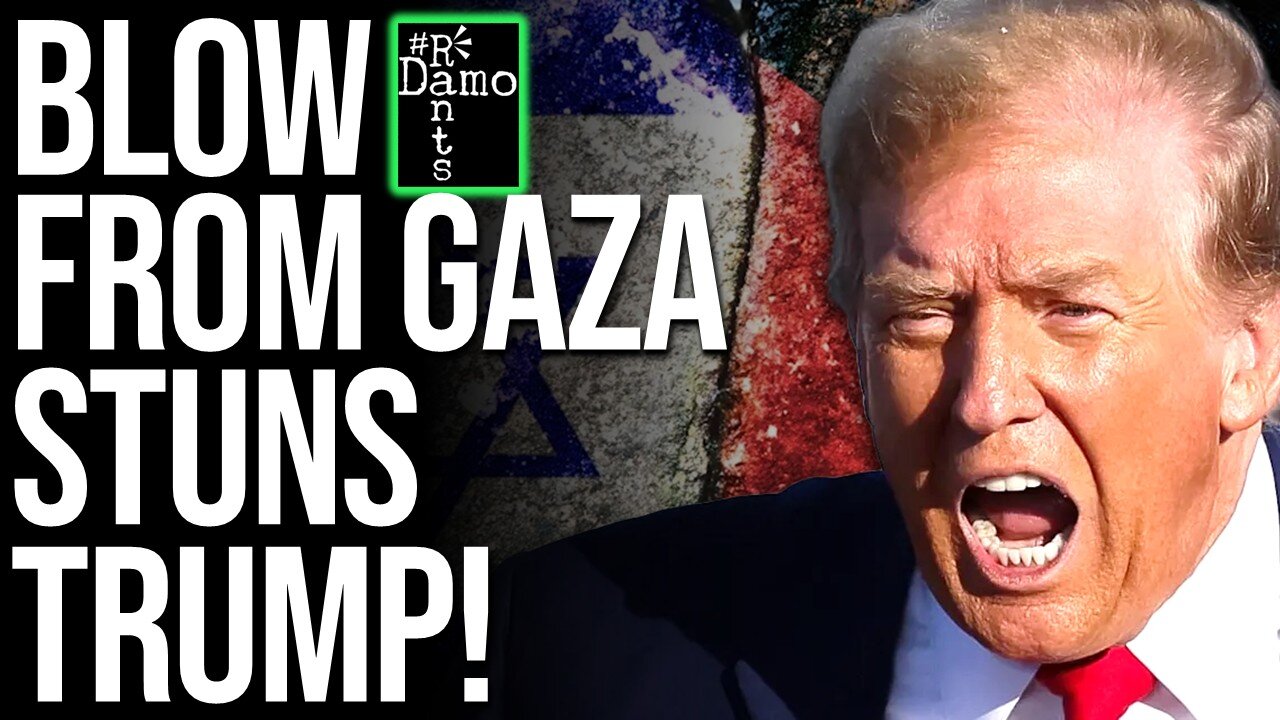
Trump’s Gaza Take Over Has Just Fallen Flat On Its Face – And it Gets Worse
Right, so here’s the thing about Trump’s grand Gaza plan: it’s only “historic” if you judge history by how fast a policy collapses under the weight of its own nonsense. The United States marched into the UN Security Council with a straight face and sold a blueprint that puts Trump in charge of Gaza’s transition, hands sweeping authority to a Board of Peace that still hasn’t been staffed, and demands an International Stabilisation Force that nobody is actually willing to send. And of course they told the world this was the path to order, because Washington always does, even when the plan depends on foreign soldiers enforcing a demilitarisation mandate that no Palestinian faction has agreed to and no contributing country is prepared to take on. So you look at the resolution, you look at the silence that followed, and you realise the truth: the takeover isn’t stuck, it never changed.
Right, so Trump’s Gaza plan has already hit the point where the only way you can describe it honestly is to say that the packaging looked impressive, the machinery looked complicated, the Council vote looked decisive, and none of it has changed the basic fact that you cannot impose a new order on Gaza if the countries you need to carry it don’t believe the mandate is workable, legitimate, or safe. The United States pushed through a resolution that creates a governing body chaired by Trump, installs a transitional administration with sweeping authority, and orders the formation of a multinational force to stabilise Gaza and begin demilitarising the territory. On paper this is a takeover. In the real world it is a blueprint that has been collapsing the moment anyone outside Washington tries to translate it into actual troop numbers, legal responsibilities or political realities.
The core of the plan is simple enough when you strip away the choreography. The Board of Peace is written in as the transitional authority over Gaza. It has the power to oversee reconstruction, manage borders in cooperation with neighbours, supervise the training of a new Palestinian police force and certify when Israel’s security thresholds are met. Sitting alongside it is an International Stabilisation Force with a mandate to secure the enclave, back up the police service once trained and begin the process of demilitarising the groups that still have weapons inside Gaza. Nothing about that structure is neutral. It is a trusteeship with an American chair and a military enforcement arm mandated through the end of 2027, extendable through further Council action. That is not a light footprint. That is a system designed to take control of Gaza during a period where Israel still holds its perimeter and refuses to give up its veto on what it considers “security”.
This is why the remit has been the problem from day one. A genuine peacekeeping mission only works when the parties involved have agreed to stop fighting and have consented to a neutral force sitting between them. This plan doesn’t follow that logic. It requires an international force to enforce a demilitarisation that no Palestinian faction has signed up to, while Gaza is still living with the consequences of a war that has shattered its institutions and displaced hundreds of thousands. There is no model in which a foreign force arrives in that context and is treated as neutral. The Israelis see them as a way to reduce the IDF’s visibility. Palestinian factions see them as an extension of the same pressure they’ve lived under for decades. And countries who might contribute troops see an impossible mandate where they become the referees of a conflict the actual parties haven’t agreed to end.
The reactions from potential troop contributors have made that clear. The country that first made headlines with a massive headline figure has started narrowing its role the moment the plan left the Council chamber. Indonesia’s leadership went to the General Assembly and said it could provide twenty thousand personnel. Its defence officials then qualified that, stressing that the force they were preparing was built around medical and engineering teams. And when regional reporting started digging into what was actually on the table, the number had shrunk to around twelve hundred, explicitly non-combat. The message is straightforward: Indonesia was prepared to support a peacekeeping mission that protects civilians and rebuilds infrastructure, but it is not prepared to send thousands of soldiers into Gaza to enforce a disarmament mandate on armed factions that view foreign soldiers as the new front line.
Another state, Azerbaijan, one that Washington regularly portrays as aligned with its regional security model, took the same line but with even sharper boundaries. Its deputy prime minister stepped forward and said clearly that while the country is ready to contribute to the force, it will not take on the task of disarming Gaza’s factions. That, he said, is the job of Palestinian law enforcement, not foreign troops. In his view, participation depends entirely on the terms of reference, because they are not going to risk their soldiers becoming a combat component in an occupation, and they are waiting for clarity that the mission is genuinely peacekeeping rather than peace enforcement. That is not an idle distinction. It is a legal firewall. Once you cross that line, you are no longer keeping peace; you are imposing a political order by force.
Even Jordan, whose leadership is normally cautious in its public phrasing, has drawn that same line with blunt language. King Abdullah has said the quiet part out loud: nobody is going to take on peace enforcement inside Gaza. Governments are willing to help support Palestinian police and keep order once there is a political agreement, but they are not going to march their soldiers into a territory still filled with fighters and become the new face of a conflict that has not ended. And if even Jordan is saying this, spine-deficient when it comes to Israel as they generally are, you can assume that every government Washington is courting is saying it even more bluntly behind closed doors. No government wants its troops dragged into street-level clashes with fighters who see them as enforcing someone else’s occupation.
Israel’s posture only hardens the contradiction. Under the plan, Israeli forces are meant to withdraw from large parts of Gaza once the new force deploys, but they retain a security perimeter inside the strip and continue to control the borders in coordination with the transitional authority. At the same time, Israeli leaders have insisted that some countries will not be acceptable participants. They have already ruled out certain states publicly, and they continue to make clear that if no foreign force is willing to carry out the disarmament, then Israeli forces will continue doing it themselves. Analysts inside Israel are openly acknowledging that no country is stepping forward to take on the responsibility of demilitarising Gaza, and that the understanding is settling in that the international force, if it materialises at all, will not be able to deliver the outcome the plan demands.
And that is the catch. The entire political architecture of the resolution assumes that foreign countries will do what Israel has been unable to do on its own terms without becoming a permanent occupier. It assumes that an external force can go into Gaza, begin disarming factions, keep order as a new police service is created and oversee the early stages of a transition that has no agreed political end point. But governments are looking at the legal and military realities and concluding that this is not just risky but structurally unsound. No foreign force can safely operate inside Gaza without local consent. No foreign force can disarm Palestinians without becoming a target. And no foreign force can run Gaza while Israel still maintains a military perimeter and a veto on who participates.
Once you see that contradiction, you begin to understand why the Board of Peace itself has stalled. This body is meant to be the central node of the plan. It appoints the Palestinian committee, oversees reconstruction, coordinates security benchmarks, and reports back to the Council every six months. But since the resolution was adopted, no members have been publicly named, no appointments have been confirmed, and even the figures most widely discussed for senior roles have not been announced. People close to the process expected it to be named within three days of the resolution. Instead, there has been silence. That is not a sign of quiet progress. It is the clearest possible evidence that the plan’s political core is not being built because the states that are supposed to populate it do not know what they would be signing up for and do not want to legitimise a structure that does not centre Palestinian political agency.
And this is the point where Russia and China’s moves at the UN Security Council start to make sense, and I freely admit at the time I didn’t see it, but its become more obvious now. Both abstained on the resolution. Both voiced concerns that the plan did not reaffirm the centrality of Palestinian statehood, that it bypassed existing frameworks and that it gave sweeping authority to a transitional body without adequate accountability. Russia had its own draft ready, one that would have removed the Board of Peace and grounded any stabilisation forces more directly in existing international law and the two-state framework, the UN would oversee it. But once Arab and Muslim states signalled that they wanted a resolution passed quickly to prevent the ceasefire collapsing, Moscow withdrew its draft and let the US plan go through. China’s ambassador voiced similar concerns but took the same path. They abstained, registered their objections, and left Washington to own the consequences.
And the consequences are now plain. The countries Washington needs to make the plan work are stepping backwards. They are redefining their offers to avoid combat roles. They are emphasising health, reconstruction, logistics and police-training, not demilitarisation, which is all Israel wants. They are saying outright that they will not carry out tasks that would effectively put them in the position of enforcing Israel’s security demands at the expense of Palestinian political rights. And the more this happens, the more obvious it becomes that the plan cannot function as designed because its design depends on conditions the real world will not supply.
The deeper truth is that the entire model treats Palestinian self-determination as a problem to be managed rather than the foundation of any viable political settlement. The Palestinian Authority is invited to participate but is not given central authority. Gaza’s own political factions are treated as obstacles to be neutralised or problems to be administratively re-engineered. The new Palestinian committee is appointed by the transitional board rather than elected by the population. Local legitimacy is treated as an optional extra. And the resolution gives the transitional authorities a timeline that can be extended indefinitely because the benchmarks for transition are vague and controlled by the same body that benefits from extending them.
This is why the plan is already buckling. It is not because countries are indifferent to Gaza’s suffering, or because they do not want to help rebuild. It is because they can see that the plan’s core purpose is not to deliver sovereignty or rights but to create an internationalised management structure that stabilises the status quo and moves the occupation into softer focus. Governments outside the US-Israel axis are unwilling to take part in that kind of political theatre. They want clarity, legality, and legitimacy, and the resolution does not offer it. It offers a mechanism for control, wrapped in the language of peace.
So yes, Trump’s Gaza takeover has fallen flat on its face in the ways that matter. The Security Council vote gave the appearance of consensus. The Board of Peace gave the appearance of governance. The stabilisation force gave the appearance of security. But the moment you ask any country to put soldiers on the ground, the mask slips. Nobody wants to enforce a demilitarisation that the people of Gaza have not consented to. Nobody wants to risk their soldiers in a territory where the lines of authority are unclear and the political framework is imposed rather than negotiated. Nobody wants to be the front line of someone else’s occupation.
And if the United States and Israel continue trying to push this plan without confronting that reality, they are not going to find that the world quietly falls into line. They are going to find the opposite: that the legitimacy they hoped to gather through the Council is already crumbling, that the transitional structures they designed are refusing to materialise, and that the resolution they wanted to be the foundation of a new order in Gaza is instead becoming the clearest evidence that you cannot build peace on force, bypass local agency, and expect the world to carry the cost.
This plan isn’t failing because the world is reluctant. It is failing because the plan was never designed for a political reality where Palestinians have rights and the international community refuses to become an occupying power in their place. The resolution has created a contradiction so obvious that it cannot hold: a peace enforced without consent, a transition without legitimacy, and a governance structure that only works if everyone pretends Gaza will accept trusteeship under an American chair.
You cannot internationalise an occupation and call it peace. And you cannot expect the world to send its soldiers to enforce a settlement that is neither just nor sustainable. The Council may have passed the resolution, but the world has already judged the plan. And the verdict is simple: this isn’t a path to peace. It’s a political fantasy, and the moment it touched reality, it collapsed.
For more on Russia’s alternative plan, which, if Trump’s plan does collapse as seems inevitable right now, can be brought back to the UN Security Council as an option, daring the US to veto it after their own plan collapses, check out the details of that story here.
Please do also hit like, share and subscribe if you haven’t done so already so as to ensure you don’t miss out on all new daily content as well as spreading the word and helping to support the channel at the same time which is very much appreciated, holding power to account for ordinary working class people and I will hopefully catch you on the next one. Cheers folks.
-
 1:12:43
TruthStream with Joe and Scott
5 days agoJason Van Blerk from Human Garage: Reset your life with Fascial Maneuvers,28 day reset, Healing, Spiritual Journey, Censorship, AI: Live 12/3 #520
10.4K4 -
 24:21
24:21
The Pascal Show
1 day ago $8.61 earned'CHALLENGE ACCEPTED!' TPUSA Breaks Silence On Candace Owens Charlie Kirk Allegations! She Responds!
32.7K19 -
 17:41
17:41
MetatronGaming
2 days agoI should NOT Have taken the elevator...
6.06K1 -
 LIVE
LIVE
Lofi Girl
3 years agolofi hip hop radio 📚 - beats to relax/study to
612 watching -
 1:20:23
Man in America
13 hours agoHow Epstein Blackmail & FBI Cover-Ups Are Fracturing MAGA w/ Ivan Raiklin
196K32 -
 2:13:49
Inverted World Live
8 hours agoSolar Storms Ground 1000 Planes | Ep. 151
112K10 -
 2:54:08
TimcastIRL
9 hours agoJ6 Pipe Bomb Suspect ARRESTED, Worked With BLM, Aided Illegal Immigrants | Timcast IRL
260K130 -
 3:59:02
Alex Zedra
7 hours agoLIVE! Bo7 Warzone
40.7K1 -
 4:37:35
Drew Hernandez
1 day agoCANDACE OWENS / TPUSA STALEMATE & DC PIPE BOMBER CAPTURED?!
64.1K38 -
 12:31
12:31
Robbi On The Record
9 hours ago $5.40 earnedWhy Nothing Feels Real Anymore | The Science, Culture, and Spiritual War Behind the Fog
48.5K11