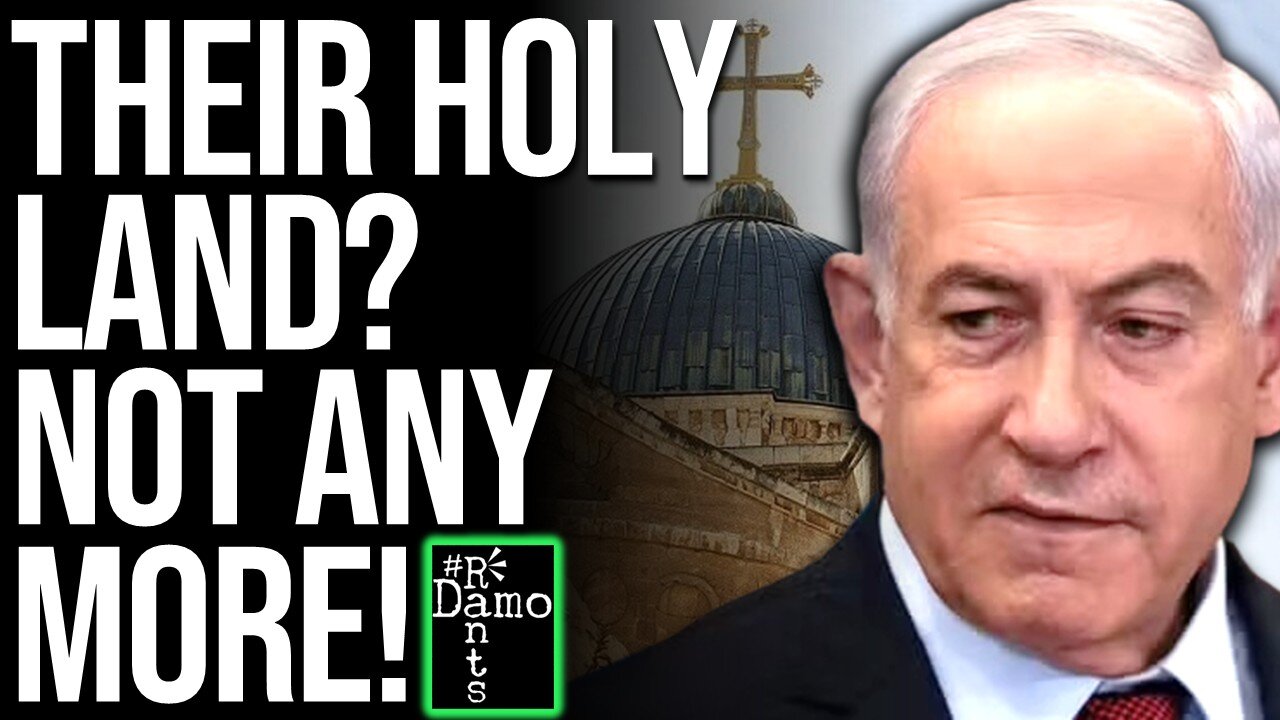
Israel Tried to Hide This — And Christian Visitors Blew It Open.
Right, so you can always tell when Israel’s spin machine is wobbling, because something leaks out through a source that normally acts like a government loudhailer. And that’s exactly what’s happened here: Christian tourists finally start trickling back into Jerusalem after a year of war and a ninety-per-cent tourism collapse, and what do they find? Not welcome, not safety, not the “shared civilisation” nonsense Western governments like to parrot — they find ultra-Orthodox men spitting at them, boys kicking them off bicycles, crosses being hidden because the police can’t be relied on. And when even a right-wing paper admits it, you know the problem isn’t isolated, it’s structural. Because this isn’t about one incident on the Via Dolorosa. It’s about what happens when a state that plays the eternal victim starts behaving like the unchallenged landlord of everyone else’s holy sites.
Right, so you can always tell when a state is losing control of its own story, because the mask slips in a place where it never meant to. That’s what’s just happened in Jerusalem. Christian tourists, the very people Israel claims as cultural allies, the very people Western governments tell themselves they are protecting when they defend Israel on the world stage, are being spat on, kicked, threatened and harassed as they return to the Old City. And the only reason the public even heard about it is because a right-wing paper that normally carries water for the government admitted it, which tells you straight away this was too big, too visible and too embarrassing to bury. It happens in broad daylight, in front of guides, in front of other tourists, in the very streets that Israel is supposed to safeguard as the “shared Holy Land.” And nobody in authority seems in a hurry to stop it.
We’re not dealing with something new here. The harassment of Christians in Jerusalem has been happening for years. You can trace it through the footage, the eyewitness accounts, the church statements, the vandalism of cemeteries and holy sites, the reports of priests being spat on by children and adults alike. You can see it in the numbers, because the Christian population of the Holy Land has dropped from a significant share of the community to a thin minority, squeezed out by a mixture of political pressure, economic strangulation, and physical intimidation. You can point to broken headstones, burned churches, graffiti calling Christians traitors or idolaters or worse. It’s all been there. The only difference now is the timing. Israel’s tourism industry is on its knees, the genocide of Gaza has driven visitor numbers down by more than ninety per cent in some months, airlines have pulled out, hotels have emptied, tour guides have lost almost all income, and the only tourists still willing to come are the deeply faithful, the emotionally committed, the people who feel compelled to walk the Via Dolorosa or pray at the Church of the Holy Sepulchre even during a time of war. And what they’re finding when they get there is hostility, not welcome.
That’s the part that exposes the contradiction. Israel sells itself as the bridge between the West and the Middle East, the defender of “Judeo-Christian civilisation,” the guardian of holy sites. That’s how it markets itself to American evangelicals, to European conservatives, to the governments that send it weapons, money and political protection at the UN. But the moment Christian pilgrims put their feet on the ground, the myth dissolves. Instead of protection, they get waiting boys spitting at their feet. Instead of respect, they get threats. Instead of a safe route through the Old City, they get harassment on the very street where Jesus is said to have carried the cross. And what makes this worse is the reaction of the authorities, because the pattern is always the same: a few arrests when a video goes viral, a few statements about “isolated incidents,” and then straight back to silence.
You can look at the pattern of documentation, because it tells you everything you need to know. There’s footage of ultra-Orthodox men spitting on Christian clergy walking processions. There are reports of schoolboys being filmed spitting on priests, laughing as they do it. There are headstones smashed in Christian cemeteries on Mount Zion. There are monks reporting that they’re verbally abused on their way to prayer. Churches have issued public statements, again and again, describing what they experience as a “systematic attempt” to weaken the Christian presence in the city. These are not exaggerations from isolated sources. They are the collected testimonies of the major Christian patriarchates in Jerusalem, who have tried to speak diplomatically until they can’t anymore.
When the heads of churches use words like “systematic,” you know they’re not describing a string of coincidences. They’re describing a culture. They’re describing a city where their clergy can’t walk through religious quarters without expecting harassment, where their churches and cemeteries are vandalised, where Christian presence is tolerated only as long as it stays quiet and invisible. This is happening in the same Jerusalem Israel claims as the global centre of Christian heritage, the same Jerusalem Western Christian leaders are told is safe and stable under Israeli sovereignty, the same Jerusalem used as justification for military and diplomatic support. The reality is nothing like the branding.
And that’s where the self-own becomes obvious. Israel’s tourism industry relies heavily on Christian pilgrims. They make up a huge share of incoming visitors, they spend money on guided tours, on hotels, on restaurants, on transport, on religious souvenirs, and for decades they’ve been some of the most reliable repeat visitors, the advantage Israel has with these sites of enormous religious significance under their administration. Yet just as those pilgrims begin to return after a year of genocide and war and near-total collapse of tourism, the news breaks that they’re being attacked in the streets. That’s not just gross behaviour; it’s economically suicidal. You can’t spit on the people who keep your industry alive and then complain when the industry doesn’t recover.
But the tourism angle is almost secondary to what’s really at stake here. The deeper story is the ideological one, because the harassment of Christian pilgrims is not an isolated grievance, it’s a symptom of a political and religious hierarchy that is built into the Israeli state. At the top of that hierarchy is Jewish identity as the state defines it, and beneath it are everyone else: Palestinians, Christian communities, African asylum seekers, migrant workers, and even secular Jewish Israelis if they happen to challenge the authority of the religious right. You can see this hierarchy in the way arrests are handled, in the way policing is carried out, in the way the government responds to violence by settlers in the West Bank, in the way the state talks about its own minorities.
When extremist settlers attack Palestinian villages, the consequences are almost always the same: the settlers go home, the Palestinians bury their dead or repair their homes, and the state shrugs. When African asylum seekers are detained and pressured to leave, the government calls it “voluntary departure.” When Christian sites are vandalised, officials condemn it briefly and then move on without structural change. This is how supremacy works in practice. It doesn’t always show up as grand declarations; it shows up as a pattern of tolerated cruelty, a pattern of indifference to harm done to people outside the dominant category.
That’s what makes the behaviour in Jerusalem so revealing. Because if the Israeli state genuinely believed in its own rhetoric — that Jerusalem belongs to all faiths, that it preserves religious freedom, that it is a civilisational ally of the Christian West — it would treat Christian pilgrims as valuable. It would treat their presence as important. It would run serious policing to stop harassment. It would enforce standards that protect the city’s reputation. Instead, the opposite is happening. The city is telling them, through the actions of extremists and the inaction of police, that they are tolerated only as long as they know their place.
There’s a historical dimension here that can’t be ignored either. Christian communities in the Holy Land have been shrinking for decades. Some of that is economics, some of that is political instability, but a significant part of it is the daily pressure created by occupation, settlements, checkpoints, discriminatory laws and social hostility. Bethlehem is the clearest example. Once overwhelmingly Christian, it is now a Christian minority city, in part because Israeli movement restrictions, economic strangulation, land confiscation and settlement expansion have pushed families to leave. Christian leaders have explained this openly, telling Western Christians that if they want a living Christian presence in the Holy Land, they need to look honestly at the conditions that are destroying it.
What’s happening to tourists now is in that same continuum. When pilgrims are harassed on the street, they get a tiny taste of what Palestinian Christians live with every day — the sense that you are an outsider on your own land, the sense that the authorities don’t care whether you feel safe, the sense that your presence is inconvenient to the people who believe the city is theirs alone. That’s the lived reality. And it’s jarring to Western Christians because they’ve been told a story about Israel as the protector of Christianity, when in fact Christians on the ground are steadily disappearing.
This is where the political contradictions come into full view. Western Christian-majority governments are the most enthusiastic defenders of Israel on the international stage. American evangelical churches are some of the most vocal backers of Israel’s military policies. European Christian democrats talk about Israel as a bulwark of Western civilisation. But the Christians who actually live in the Holy Land, or who visit it as pilgrims, do not experience the protection or solidarity that Western politicians talk about. They experience harassment, intimidation and demographic collapse. They experience a city where some of their holiest sites have been vandalised. They experience a state that sees them not as partners but as obstacles.
There is a reason these governments don’t draw attention to this contradiction. To acknowledge it would undermine one of the ideological pillars of their foreign policy. It would force them to admit that Israel’s claim to protect Christian heritage is, at best, overstated and, at worst, a convenient fiction. It would force them to confront the fact that they are actively supporting a state in which Christians are a shrinking, harassed minority. And it would force them to face uncomfortable questions about why Christians in the Holy Land are treated with such indifference compared to Christians under threat elsewhere.
You can see why the Israeli government would rather the harassment of pilgrims remain invisible, especially now. After a year of war, global outrage, and a near-total collapse of tourism, Israel needs the post-war narrative to be clean. It needs the story to be one of recovery, normalisation, and shared faith. It needs to tell Western audiences that Jerusalem is safe and stable, even if the reality is the opposite. Every act of harassment cuts directly against that narrative. Every story about spit on a pilgrim’s shoe is a reminder that the state is not in control, or worse, that it doesn’t care to be.
And that is what this moment really exposes. Not simply the cruelty of a few extremists, but the limits of a state’s claims about itself. Israel wants to be treated as the exceptional victim, as the moral inheritor of historic suffering, as the state that must always be indulged because of what the Jewish people have endured. But a state that claims exceptional moral rights has to be able to demonstrate exceptional moral behaviour. It has to show that it protects those who come to worship under its rule. It has to show that minorities matter. It has to show that history has taught empathy, not supremacy. When instead it shows the opposite — when it shows that pilgrims can be harassed with little consequence — it reveals a truth it would rather keep hidden: the exception it demands from others is not one it grants in return.
That’s the verdict sitting underneath all of this. Israel’s treatment of Christian tourists is not a random quirk of a chaotic moment; it is a window into a structure. It is a glimpse of the hierarchy of worth that runs through the system. It is proof that the story Israel tells the world about itself isn’t matched by how it behaves on the ground. And once you understand that, you understand why reports like this matter: they aren’t just anecdotes, they are cracks in the facade.
So yes, the harassment of Christian tourists is a blow to a tourism industry already almost destroyed by genocide. But more importantly, it’s a blow to the political story Israel has relied on for decades, the story of shared civilisation, shared values, shared heritage. Because shared heritage has to mean shared respect. It has to mean shared safety. It has to mean that a Christian can walk through Jerusalem without fearing spit or threats. And right now, according to the record of what is happening on the ground, that simply isn’t the case.
Speaking of Western Christian majority countries backing Israel to the hilt come hell or high water, it’s not just how Israel treats Christian tourists that are giving Germany in particular a headache right now, it’s the decision to start rearming them whilst they are doing it. No sympathy from me, get all the details here.
Please do also hit like, share and subscribe if you haven’t done so already so as to ensure you don’t miss out on all new daily content as well as spreading the word and helping to support the channel at the same time which is very much appreciated, holding power to account for ordinary working class people and I will hopefully catch you on the next one. Cheers folks.
-
 16:38
16:38
Nikko Ortiz
13 hours agoVeteran Tactically Acquires Everything…
6.35K -
 20:19
20:19
MetatronHistory
2 days agoThe Mystery of Catacombs of Paris REVEALED
3.69K -
 21:57
21:57
GritsGG
17 hours agoBO7 Warzone Patch Notes! My Thoughts! (Most Wins in 13,000+)
6.02K -
 2:28:08
PandaSub2000
10 hours agoMyst (Part 1) | MIDNIGHT ADVENTURE CLUB (Edited Replay)
4.23K -
 1:12:43
TruthStream with Joe and Scott
5 days agoJason Van Blerk from Human Garage: Reset your life with Fascial Maneuvers,28 day reset, Healing, Spiritual Journey, Censorship, AI: Live 12/3 #520
10.4K4 -
 24:21
24:21
The Pascal Show
1 day ago $8.61 earned'CHALLENGE ACCEPTED!' TPUSA Breaks Silence On Candace Owens Charlie Kirk Allegations! She Responds!
32.7K19 -
 17:41
17:41
MetatronGaming
2 days agoI should NOT Have taken the elevator...
6.06K1 -
 LIVE
LIVE
Lofi Girl
3 years agolofi hip hop radio 📚 - beats to relax/study to
590 watching -
 1:20:23
Man in America
13 hours agoHow Epstein Blackmail & FBI Cover-Ups Are Fracturing MAGA w/ Ivan Raiklin
196K33 -
 2:13:49
Inverted World Live
9 hours agoSolar Storms Ground 1000 Planes | Ep. 151
112K10