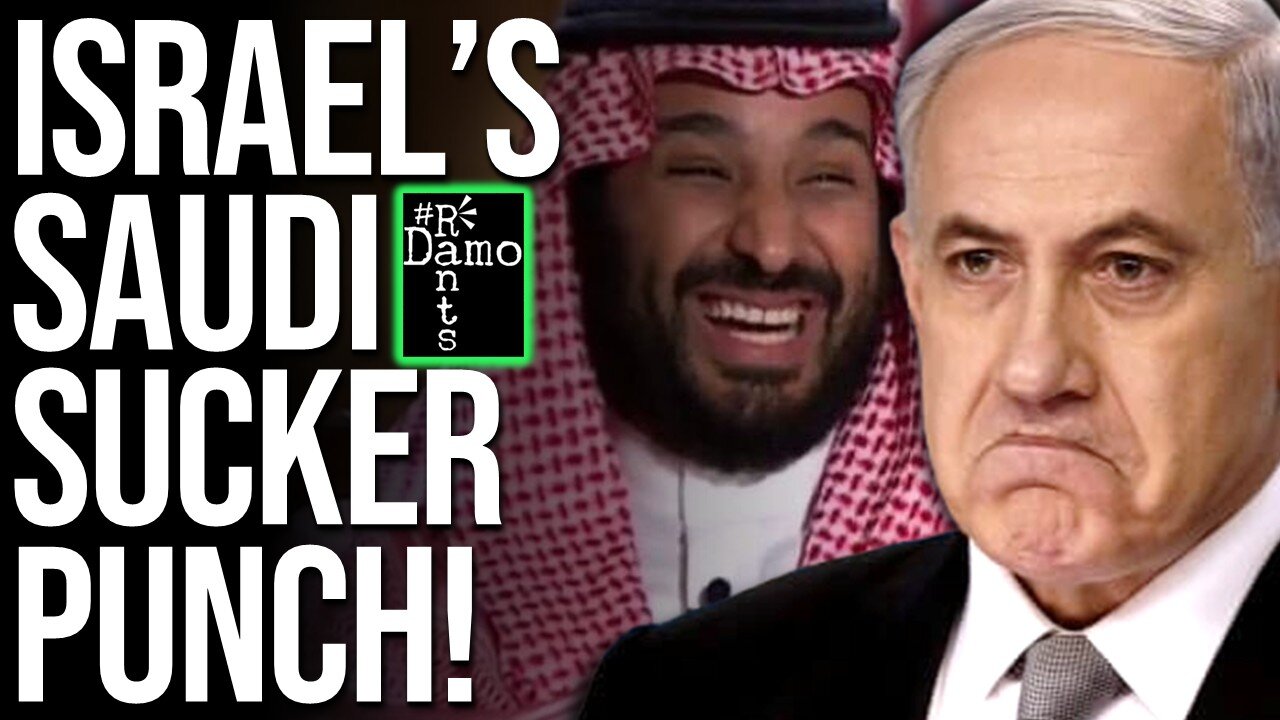
Saudi Arabia Just Pulled the Plug - And Israel's Government Has Lost It
Right, so Israel has reached the point where it thinks it can dictate the terms of Lebanon’s survival, and it’s doing it openly now, without even pretending the threat is conditional. Extremist defence minister Israel Katz stands in the Knesset and says Hezbollah must disarm by the end of the year or Israel will “work forcefully again in Lebanon,” and he ties that threat to the assassination they’ve just carried out in Beirut’s southern suburb as if that killing is an argument rather than a violation. Then Egypt arrives in Beirut using a tone Lebanese officials describe as threatening, warning that a massive bombing campaign and a ground invasion may be imminent unless Lebanon complies. And in the middle of that pressure, Lebanon’s own prime minister turns his criticism not on Israel over this, but on Hezbollah for failing to disarm having failed to be a deterrent! If Lebanon’s own leadership is determined to punch inwards therefore, who can possibly come to Lebanon’s rescue? Well as it happens there is a twist in this tale because Saudi Arabia — the financier Israel is banking on to pay for all of this while Israel and the US call all of the shots — has quietly signalled it has no intention of paying for a political order built without it. Perhaps saviour is too strong a word for them therefore, but if the outcome is the same, does it matter?
Right, so let’s walk through this properly because the stories coming out of Lebanon, Israel, and the Gulf aren’t separate threads; they’re the same crisis seen from different angles, and the thing you realise once you put them next to each other is that the region’s centre of gravity is shifting underneath Israel right as it tries to force a deadline on Lebanon. And Israel knows exactly what it’s doing with that deadline, because you don’t stand up in your parliament, point at an assassination you’ve just carried out in the capital city of a neighbouring country, call it “proof” of your intent, and then stick a date on the table unless you’re preparing the ground for escalation. That’s the point. Israel Katz isn’t improvising. He’s announcing a timetable and pretending it’s a condition.
He’s saying Hezbollah must disarm by the end of 2025, and he’s saying it in the tone of someone who believes he’s setting the pace, and he’s using the killing of a Hezbollah official in Beirut’s southern suburb as if that assassination is some form of political leverage, which it is, because it’s not a secret strike anymore; it’s a political message dressed up as enforcement. Israel is treating that kill as evidence that they’re already operating inside Lebanon even in what is supposed to be a post-ceasefire environment, which tells you straight away that the ceasefire’s only function, as far as Israel is concerned, is to create the appearance of a diplomatic backdrop they can violate at will. You can see it in the way he phrases it. “As we proved with the elimination.” That’s not diplomacy. That’s a threat delivered through a corpse.
And this is where the pressure starts to fold in from different directions because Egypt enters the story immediately afterwards, and they don’t show up in Lebanon to say hello. They show up because they’ve received information that makes them think Israel is about to do something serious, and they’re delivering that information directly to Beirut in what Lebanese officials describe as a threatening tone. And that’s Egypt — a country that normally bends over backwards to present itself as a mediator — telling the Lebanese government that a massive bombing campaign and a ground invasion might be imminent unless Hezbollah agrees to a freeze on weapons use and Lebanon pledges not to carry out any hostile acts against a country that is already carrying out strikes inside Lebanon and has been now during what has supposed to be a year long ceasefire. If that doesn’t tell you the direction of travel, nothing will.
Egypt isn’t making this up. They said they received that information “a few days ago.” You don’t turn a diplomatic visit into a warning unless you believe the timeline matters. Cairo is doing what it always does when it knows a crisis is real: it tries to get ahead of the narrative, not because they’re protecting Lebanon — they’re protecting themselves — but because if the war erupts and they say nothing, they get blamed for staying silent. So they deliver the warning, and they do it directly. And when they tell Lebanon that Israel might hit them heavily unless Hezbollah disarms, they’re not being metaphorical. They’re telling Beirut that the window for negotiation is closing, and they’re signalling that Israel has already started shaping the battlefield through targeted killings.
Then the Lebanese government reacts, and it reacts in the worst possible way because the prime minister — Nawaf Salam — decides to treat Hezbollah’s weapons as the problem, not the threat being made against the country. And this is where the political distortion becomes impossible to ignore, because Salam isn’t stating a fact when he says Hezbollah’s weapons “failed to deter” Israeli attacks; he’s performing a political function. He’s shifting the framing. He’s saying the weapons didn’t work because Israel is still attacking, which is the kind of statement you make when you’re under pressure to show goodwill to the countries pushing the disarmament line, even while those same countries are telling you a war might be about to land on your head.
And because this is Salam — a former president of the International Court of Justice, no less — he understands exactly what language like that does. He knows that deterrence is not a legal obligation for a non-state armed group. He knows that international law doesn’t treat Hezbollah’s weapons as the mechanism by which Lebanon is supposed to prevent Israeli aggression. He knows the Lebanese state is responsible for defending its territory. But he also knows the Lebanese Armed Forces can’t do that in practice, and he knows the international pressure around the Homeland Shield Plan — the plan to disarm militias and consolidate weapons under the state — is the political environment in which he’s speaking. So when Salam says Hezbollah’s weapons failed, he’s not describing events; he’s performing a posture, and the timing of that posture tells you everything.
And then you look back at the facts because the facts are what anchor the whole thing. Israel issues a threat tied to a deadline. Israel says Hezbollah must disarm or Israel will act. Israel ties that threat to an assassination in Beirut. Egypt warns Lebanon the threat may materialise as a bombing campaign and a ground invasion. Lebanon’s prime minister publicly criticises Hezbollah’s deterrence capacity in that moment. And Saudi Arabia — the one region actor Israel and the United States are counting on to bankroll the aftermath — is being positioned as the main Arab financier in a reconstruction process it is not being given any real say over.
That’s the twist. That’s the wall they didn’t expect to hit. Saudi Arabia is not stupid. They know what it looks like when they’re being asked to pay for a political order they did not design, cannot control, and will be blamed for if it falls apart. They’ve seen this playbook before in Yemen, in Syria, in Iraq, and most of all in Lebanon itself. And the question that now hangs over Riyadh — explicitly, not as speculation — is whether they’re going to bankroll their own marginalisation. That sentence isn’t commentary; it’s the problem being posed to Saudi Arabia in public. And the Saudis are not going to pretend they don’t see it.
Israel wants to reshape the south of Lebanon. They want a security regime that limits Hezbollah. They want an economic structure that flows through their channels. They want US backing to hold everything in place. And they want Saudi Arabia to pay for the reconstruction because Israel does not want to absorb the cost of stabilising the south after an operation they initiate. That’s the model: Israel designs, the US blesses, Saudi Arabia finances. It’s the same model used for decades. But the problem is the region doesn’t work like that anymore. Saudi Arabia doesn’t accept subordination. They don’t play sponsor for frameworks that diminish their leverage. And they don’t bankroll outcomes that strengthen Israel’s position in the region without any reciprocal gain.
And what makes this moment so dangerous is that Israel is operating on the assumption that the region around them will behave the way it used to, and it’s already clear that it won’t. Riyadh is not committed to underwriting a post-war regime built around Israeli power. Cairo is warning because they see the direction of travel and they know the consequences will spill across the region. Lebanon is politically fractured, and its prime minister is using language that shifts responsibility away from the threat-maker and onto the group being targeted by that threat. Hezbollah will not disarm, and everyone knows it. And Israel is trying to create the political conditions for escalation by pretending the deadline is a diplomatic request rather than a staging marker for war.
Now, nothing in the sources tells us whether Israel will actually invade Lebanon, we have to make that clear, believable an outcome as it absolutely is, but what the sources do show is that Israel is threatening war; Egypt is warning Lebanon that the threat is credible; Lebanon’s leadership is publicly criticising the one actor capable of resisting Israeli military activity; and Saudi Arabia is being positioned as the main reconstruction financier for a project that might be imposed without Saudi input.
And this is where the analysis becomes unavoidable because the regional logic is exposed by the interplay between those facts. Israel’s demand is impossible. Hezbollah will not disarm by the end of 2025. Lebanon cannot force them to. Egypt is signalling that Israel is preparing to act regardless. Salam’s language shows the Lebanese government is under political pressure to align with US-Israeli expectations. And Saudi Arabia is being asked to fund the aftermath of policies it had no voice in designing. You cannot call that a stable dynamic can you?
It looks, instead, like Israel is trying to run a pressure campaign on multiple fronts: political pressure on Lebanon through diplomatic discourse, military pressure through targeted assassinations, regional pressure through Egypt’s warnings, and financial leverage through the assumption that Saudi Arabia will pick up the bill. The problem is that this assumes Saudi Arabia will fall into line. It assumes Egypt will stay neutral beyond messaging. It assumes Lebanon’s political leadership will accept the internal consequences of a disarmament process pushed at gunpoint. And it assumes Hezbollah will either comply or be unable to mount a response. That’s a lot of assumptions, and whilst one or two might be fair, none of them are grounded in the facts available.
The facts we do have point to something else: a situation where Israel’s intention to impose a security and economic regime in the south is running into a region that no longer lets Israel dictate the terms by default. Saudi Arabia has leverage precisely because Israel needs them to pay for the aftermath. And the moment Riyadh hesitates — which they are doing — the entire post-war logic collapses. Israel can threaten the war, but they cannot stabilise the outcome without external financing. And if that financing is not guaranteed, the political risk of starting the conflict increases. I suppose Trump will bail them out if push comes to shove though eh? Then Bank of the US Public Purse is always happy to sign the cheques it seems, but ultimately that’s a maybe too isn’t it?
This is why the Saudi angle matters more than anything else. It’s not that Saudi Arabia will protect Lebanon. They won’t. That’s not their interest. It’s not that Saudi Arabia will intervene to block Israel. They won’t. That’s not their approach either. It’s that Saudi Arabia’s refusal to bankroll Israel’s vision for southern Lebanon is the first structural constraint Israel has faced in this crisis. Israel cannot force Saudi Arabia to pay. The United States cannot force Saudi Arabia to pay. And Lebanon certainly cannot force Saudi Arabia to pay. Which means Israel’s post-war plan for Lebanon — which they are already trying to put in place before the war even begins — is being undermined by the one actor they thought they could rely on.
So when you ask what this situation really is, when you peel back the rhetoric, what you find is coercion pointing in multiple directions all at the same time. Israel is coercing Lebanon. Egypt is warning Lebanon. Lebanon’s government is pressuring Hezbollah rhetorically. The United States is backing Israel’s pressure. And Saudi Arabia is being asked to fund the outcome. But coercion only works if the target bends, and the region is no longer structured in a way that guarantees compliance.
This is why the whole thing feels unstable. It’s not just the threat of war — though that’s serious. It’s the mismatch between what Israel is trying to impose and what the region is willing to absorb. Israel is behaving as if Saudi Arabia is still in the era where it finances whatever Washington helps design. It isn’t. Israel is behaving as if Egypt is comfortably subordinate to US priorities. It isn’t. Israel is behaving as if Lebanon can be pressured into a disarmament process without a political collapse. It can’t. Israel is behaving as if Hezbollah can be compelled into a deadline-driven compliance. It won’t.
And once you’ve walked through the mechanics, the conclusion isn’t complicated. Israel can threaten the war. They can set the deadline. They can point to their own assassination in Beirut as proof of their willingness to escalate. They can push Egypt to deliver warnings. They can pressure the Lebanese government into echoing parts of their narrative. But they cannot build a new regional order around that war unless Saudi Arabia pays for it, and Saudi Arabia is now being asked whether it is willing to bankroll a system that sidelines them completely. We want your cash, not your input. And if the answer is no — and it increasingly looks like no — then Israel’s war threat has already hit a wall.
That’s what this moment is. That’s the shift. And that’s the consequence Israel didn’t account for: the region doesn’t reorganise itself around Israel’s plans anymore, and the one state Israel assumed would pay for the aftermath has no reason to do so. If Israel pushes forward anyway, they may win the battle, but they will lose the framework they thought would follow it. And that’s the real danger here — not the war itself, but the political vacuum waiting after it.
This isn’t even the first story this past week that has put Israel in the Saudis bad books either, as Israel has now resorted to what very much appears to looks like blackmail in order to force Saudi normalisation by standing in the way of a US military deal, so get all the details of that story here.
Please do also hit like, share and subscribe if you haven’t done so already so as to ensure you don’t miss out on all new daily content as well as spreading the word and helping to support the channel at the same time which is very much appreciated, holding power to account for ordinary working class people and I will hopefully catch you on the next one. Cheers folks.
-
 21:57
21:57
GritsGG
18 hours agoBO7 Warzone Patch Notes! My Thoughts! (Most Wins in 13,000+)
11.6K -
 2:28:08
PandaSub2000
11 hours agoMyst (Part 1) | MIDNIGHT ADVENTURE CLUB (Edited Replay)
8.02K -
 1:12:43
TruthStream with Joe and Scott
5 days agoJason Van Blerk from Human Garage: Reset your life with Fascial Maneuvers,28 day reset, Healing, Spiritual Journey, Censorship, AI: Live 12/3 #520
17.1K4 -
 24:21
24:21
The Pascal Show
1 day ago $8.98 earned'CHALLENGE ACCEPTED!' TPUSA Breaks Silence On Candace Owens Charlie Kirk Allegations! She Responds!
38.1K28 -
 17:41
17:41
MetatronGaming
2 days agoI should NOT Have taken the elevator...
12.4K2 -
 LIVE
LIVE
Lofi Girl
3 years agolofi hip hop radio 📚 - beats to relax/study to
532 watching -
 1:20:23
Man in America
15 hours agoHow Epstein Blackmail & FBI Cover-Ups Are Fracturing MAGA w/ Ivan Raiklin
199K39 -
 2:13:49
Inverted World Live
10 hours agoSolar Storms Ground 1000 Planes | Ep. 151
115K10 -
 2:54:08
TimcastIRL
10 hours agoJ6 Pipe Bomb Suspect ARRESTED, Worked With BLM, Aided Illegal Immigrants | Timcast IRL
265K160 -
 3:59:02
Alex Zedra
9 hours agoLIVE! Bo7 Warzone
42.4K1