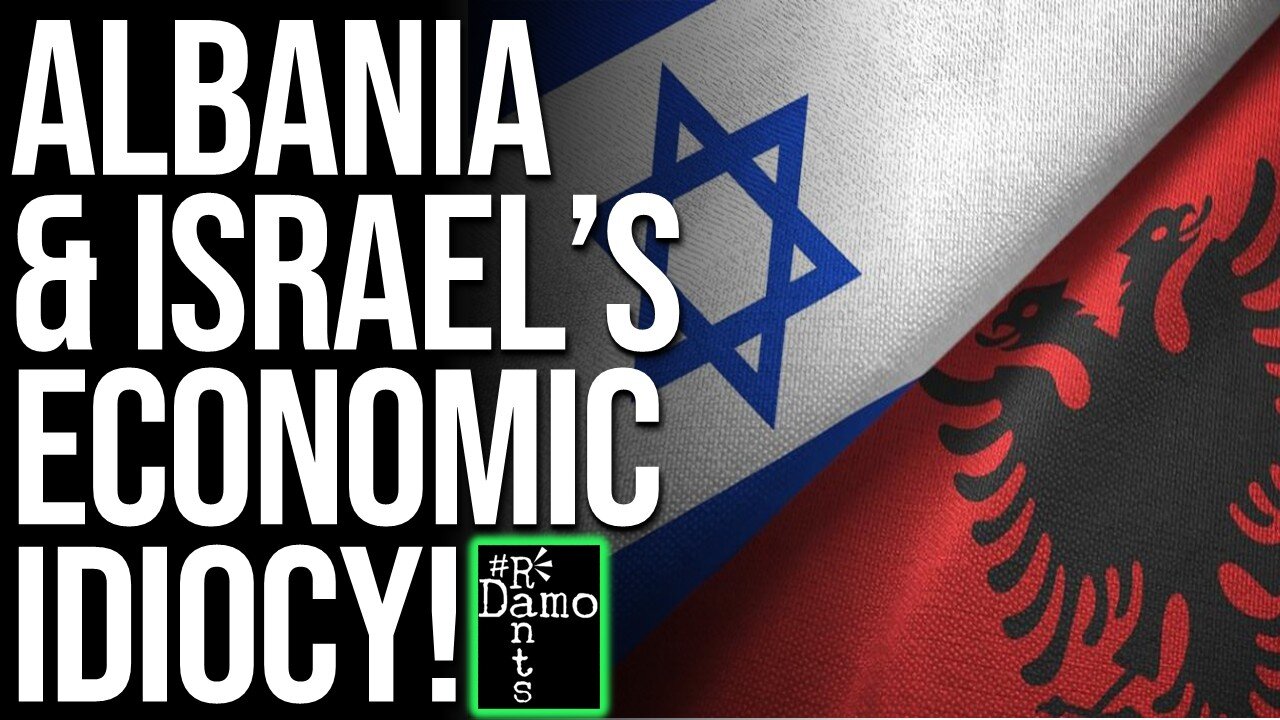
Albania’s Bet on Israel’s War Machine Has Blown Up In Its Face
Right, so Albania has picked one hell of a moment to wander into Israel’s arms trade, hasn’t it? But they very much have. A country that lives off ten million tourists a year has decided the smartest move, right in the middle of an ICJ genocide case, is to host a weapons plant for the state actually standing in the dock. You couldn’t make it up. They’re taking ATMOS howitzers, SPEAR mortars, tactical drones, a flight school, and a 5,000-square-metre production line underwritten by Israel’s own export insurer, and they’re acting like this is just another infrastructure project. It isn’t. It’s a political choice delivered with a straight face, because they’ve convinced themselves that if Germany and the UK can do it, nobody’s going to look twice at Albania. But tourists look. And Albania’s entire economy depends on the people who notice exactly this kind of thing. And if they don’t think they’re a likely target for legal repercussions because bigger economies have got away with it, perhaps BDS is something that should concern them far more.
Right, so Albania has signed a government-to-government defence deal with Israel’s biggest private weapons firm at the exact moment Israel is standing before the International Court of Justice for plausible genocide, that is abusing a ceasefire that exists only on paper anyway, that has carried on laying waste to Gaza and the people within it now for two long years. There’s no gentle way to put this, and I’m not looking to try either, because the facts are already doing the heavy lifting here. Elbit Systems is supplying Albania with artillery, mortars, and tactical drones under a formal agreement between the two states, and that agreement goes well beyond just procurement. It commits Elbit to help Albania build a 5,000-square-metre weapons plant, set up domestic production lines, and expand Albanian manufacturing capacity for Israeli-designed systems by 2027. This isn’t an arms purchase; it’s an integration into Israel’s military-industrial ecosystem, and when you take a step back and look at how small Albania’s economy is, how dependent it is on tourism, and how much its political class relies on the image of Albania as an open, friendly, rising European destination, the decision becomes even more staggering. They’re gambling their entire national image on a partnership with a state accused of starvation warfare and indiscriminate destruction, and the gamble only makes sense if they’ve decided nothing meaningful in international law applies to them.
And it’s not as if the state tried to deny what it signed. They didn’t need to. They slide the detail out quietly and trust nobody’s paying attention beyond the industrial press. Who spends any time examining Albanian news after all, unless it’s Nigel Farage bleating about the men coming here in small boats perhaps? The deal covers 155mm ATMOS howitzers, 120mm SPEAR mortars, Magni-X drones, Thor drones, and cooperation with KAYO, Albania’s state-owned defence company, to stand up domestic production capacity. There’s an earlier deal as well: a flight school in the coastal city of Vlorë developed with Elbit earlier in the year. And the financial side is no mystery either. ASHRA, Israel’s state-owned export insurance corporation, is underwriting the project, so whatever Albania wants to claim about Elbit being a private company becomes meaningless in practice, because the exporting, the insuring, and the licensing are controlled by the Israeli government. That’s what these deals look like. You don’t get an ATMOS battery and a drone fleet without the Ministry of Defence signing off; you don’t get underwriting unless the Israeli state wants the deal to happen; and you don’t get a weapons plant on your soil without Israeli strategic interest in embedding its supply chain abroad. So Albania is tied to the Israeli state whether Prime Minister Edi Rama chooses to say it out loud or not, and the timing isn’t a coincidence. They signed this deal a year after the ICJ issued provisional measures finding South Africa’s genocide claim against Israel was plausible, and at the same time Israel is very much breaching yet another Gaza ceasefire they had no intention of respecting. And in that time Israeli defence firms have only reported higher demand and rising profits, which tells you those measures haven’t slowed the arms business in the slightest. Elbit’s profits have risen sharply. Demand has gone up. And small states looking to buy influence or signal loyalty see an opportunity, rather than horror as we all do.
If you zoom into Albania’s own position on Gaza, the contradictions stand out immediately. Officially, the Albanian government says it supports a two-state solution and wants peace. Edi Rama talks about being disturbed by the destruction in Gaza and claims Albania backs a ceasefire. But Albania abstained on the UN vote on Palestinian statehood, and Albania rejected reports that it would receive Gazan refugees. When the Israeli president visited Albania, Rama welcomed him and used the moment to reframe Albania as a firm supporter of Israel’s security. So the diplomatic language says one thing and the actions say another, which is not unusual for small NATO states with tight Atlanticist alignment. What’s different here is the scale and nature of the cooperation. Albania isn’t buying a handful of rifles or protective gear. It’s letting Israel expand its production footprint into the Balkans. It’s building infrastructure that will outlast Gaza at the rate Israel is going, outlast the ICJ case, and outlast this government’s lifespan. That’s what makes this moment significant. Albania isn’t just supporting Israel during the war; it’s binding its future political and economic identity to the same industrial machine that has been sustaining the Gaza offensive.
And you can see why the Albanian political class thinks this is safe. They’ve watched every major Western government keep arming, funding, or underwriting Israel during the war without consequence. Germany is facing its own ICJ case for complicity, yet it continues military cooperation. The UK hasn’t budged in any meaningful sense. The US blocked accountability mechanisms at the UN Security Council. So Albania looks at this and thinks: if the big states aren’t punished, why would anyone care what we do? That’s the calculation. It’s not subtle. It’s the same logic Serbia applied when it sold arms to Israel during the same period, only to be called out by UN experts. And Albania’s leaders probably think the UN won’t bother with them because they’re too small, too aligned with NATO, and too economically unimportant to target. They think a tourism poster can cover a weapons plant. They think a flight school announcement can be buried under a hundred lifestyle vlogs. They think the ICJ’s provisional measures are symbolic and nothing more. And in terms of institutional enforcement mechanisms, they’re right. The ICJ cannot send police. The UNSC cannot act without the US consenting to it. NATO doesn’t discipline its members on anything involving Israel. And the EU, which Albania wishes to join, does not have a unified position on arms cooperation with Israel. The enforcement mechanisms are broken, and Albania has decided to take full advantage of that breakdown.
But while enforcement has collapsed, consequence hasn’t. And this is where Albania has miscalculated, because its political class has decided to attach itself to Israel’s military supply chain without noticing that Albania doesn’t have the insulating layers the larger states rely on. Germany can weather reputational damage. The UK can absorb criticism. Italy, France — they all have diversified economies, large manufacturing sectors, and deep ties that buffer them from public backlash. Albania doesn’t. Albania has tourism. Tourism is almost a quarter of Albania’s GDP. It’s the engine of its economic story. Ten million visitors came in 2024, and the numbers through 2025 have kept rising, with Albania posting another year of double-digit tourism growth. And this isn’t mass-tourism infrastructure that can survive any shock. Albania’s boom is driven by the exact demographic that is most tuned into Gaza, the most politically aware, the most willing to vote with their wallets. Young travellers, backpackers, digital nomads, social-media influencers, ethical tourism networks — they are the ones fuelling Albania’s rise. And they are the most connected to global justice movements, the most likely to join boycotts, the most aware of complicity narratives, and the most sensitive to a destination’s political alignment. These are the same people who’ve responded to calls for boycotts in Cyprus, Greece, Morocco, and Dubai when those states have aligned themselves with controversial actions. And there’s no reason to think Albania is exempt from that.
A tourism currency is fragile. It takes years to build and days to damage, and Albania has chosen to tie its national brand to a military partner currently accused of genocide. This doesn’t require a state-issued boycott to hurt. A shift in sentiment can do it. A handful of viral posts. A travel influencer calling Albania “ethically compromised” because it is now hosting Israeli weapons infrastructure. People deciding to go to Montenegro instead. A university travel society deciding Albania is off the list now. These aren’t fringe scenarios. They’re the kinds of public sentiment shifts that have already shaped tourism patterns in the region. And when your economy depends on a demographic that is paying close attention to Gaza, it matters. Albania’s political class either hasn’t thought this through or doesn’t care, because the cost won’t hit them. It will hit the waiters, the hoteliers, the tour guides, the taxi drivers, the small businesses that rely on those ten million visitors. It’s always the public that pays for elite decisions, and this deal is no different.
When you walk through the legal exposure, the recklessness becomes even clearer. Albania is a state party to the Arms Trade Treaty, which requires states to avoid authorising arms transfers when there is a clear risk they will contribute to violations of international humanitarian law. It is a party to the Genocide Convention, which obliges states not to be complicit in genocide and to prevent it where possible. And all states under the Geneva Conventions are required to “ensure respect” for international humanitarian law. So even if Albania wants to claim that the weapons it buys won’t be used in Gaza, the law isn’t that narrow. These obligations cover assistance that has a substantial effect on a state’s capacity to commit violations. And Albania isn’t just buying weapons; it’s helping Israel expand production capacity. It’s facilitating revenue flows, production lines, and the growth of Israeli defence infrastructure. And because ASHRA is underwriting the deal, the Israeli state is directly involved. If the ICJ ultimately rules that Israel has committed genocide or acted with genocidal intent, any state materially supporting Israel’s capacity during the period covered by the ruling could face questions of complicity. Germany is already facing that exact scenario. There is no legal path that says Albania is safe simply because it is small.
But the Albanian government behaves as if law is optional. You can tell this from the way they withheld financial details of the deal. Albanian media report that the government routinely hides figures when dealing with US and Israeli defence firms, which tells you they know the public scrutiny isn’t something they want to deal with. They want the benefits of alignment without the accountability. And when you look at Albania’s internal politics, none of this is surprising. The ruling party has spent years centralising power, weakening scrutiny, and shaping the political narrative around loyalty to NATO and the West. Signing a high-profile defence deal with Israel fits perfectly into that worldview. It signals alignment, it signals relevance, it signals a kind of geopolitical usefulness. And when a government sees its own survival tied to its Western affiliations, it will sign whatever deal helps it appear useful. It’s the oldest Westernised logic in the Balkans.
Of course, this alignment doesn’t reflect the Albanian public. And this is another layer of contradiction. Albania’s population is majority Muslim. Hundreds of imams and scholars have issued statements condemning the destruction in Gaza. Albanian civil society has expressed deep concern over the humanitarian situation. The government, on the other hand, is choosing to build a weapons plant with Israel and abstain on Palestinian recognition votes. That’s a disconnect between leadership and population you see when a government’s foreign policy is shaped by elite strategic alignment rather than public sentiment. And it’s a reminder that the consequences of this deal are not going to be confined to the diplomatic sphere. There will be domestic fallout if public perception shifts.
But the most immediate and the most consequential fallout will be economic, and that’s why the tourism angle isn’t just rhetorical framing — it’s the real-world mechanism of accountability. Albania’s political class is acting as if their alignment with Israel will be judged only by diplomats and politicians. It won’t. It will be judged by consumers. And that’s the thing they’ve failed to understand. Institutional enforcement may be dead, but consumer enforcement is alive and well. Boycotts work. Ethical tourism choices work. Public sentiment works. And Albania has built its entire economic model on that very sentiment. If tourists decide that a country hosting an Israeli weapons plant during a genocide case isn’t where they want to spend their money, Albania doesn’t have a fallback. It doesn’t have a diversified industrial base to shield it. There’s tourism. And if tourism goes, the economy goes with it.
When you look at Israel’s strategy, you can see why they’re pushing this. Israel is expanding its defence footprint into smaller states because they’re easier to work with, easier to anchor supply chains in, and easier to use as political insulation. The Balkans are a strategic region for this kind of diversification. Countries like Albania, Serbia, and others are outside the EU’s stricter structures but inside NATO’s political umbrella. They offer geographic access, political compliance, and economic need. Israel sees opportunity. Albania sees prestige and partnership. What nobody is thinking about — at least nobody in power — is the cost.
This is what impunity politics looks like. Governments assume they can do whatever they want because formal mechanisms won’t touch them. And they’re right, to a point. But what they forget is that public sentiment is its own enforcement mechanism, and Albania’s economy sits right in its path. A weapons plant on Albanian soil is a political statement, whether the state wants it to be or not. And every tourist who sees Albania’s name next to Israel’s in this context will make a judgement. You don’t need a campaign. You don’t need a coordinated boycott. You just need awareness.
When you cut through the diplomatic language, the abstentions, the vague statements of support for Palestinian rights, and the government’s self-praise for playing a role in NATO, the picture becomes brutally clear. Albania has chosen to embed itself in Israel’s military supply chain at the height of Israel’s legal exposure. It is doing this knowing the ICJ says genocide is plausible. It is doing it knowing that UN experts say any transfer of weapons to Israel likely violates international humanitarian law. And it is doing it while its economic lifeblood depends on tourists who are watching Gaza every day. It’s reckless. It’s cynical. And it’s not a mistake.
This isn’t a case of a state being pulled into something it didn’t fully understand. Albania knows exactly what it’s doing. It’s betting that no state, no court, no institution will hold it accountable because the enforcement mechanisms no longer work. And that bet might hold when it comes to governments. But it won’t hold when it comes to tourists. If Albania wants to bind its future to a weapons partnership with Israel, it will have to accept that tourists might decide to bind their future somewhere else. That’s their risk. That’s the consequence they may face.
Of course where Albania might consider Germany to be untouchable, or getting away with it so to speak, its not necessarily true. They’re fixing to resume full arms exports to Israel, but its very much blowing up in their faces as you can find out all about here.
Please do also hit like, share and subscribe if you haven’t done so already so as to ensure you don’t miss out on all new daily content as well as spreading the word and helping to support the channel at the same time which is very much appreciated, holding power to account for ordinary working class people and I will hopefully catch you on the next one. Cheers folks.
-
![MAHA News [12.5] Glyphosate Study Retracted (MONSANTO), Vaccine News (COVID), DMSO Chat](https://1a-1791.com/video/fwe2/02/s8/1/0/u/D/F/0uDFz.0kob-small-MAHA-News-12.5.jpg) 1:01:00
1:01:00
Badlands Media
13 hours agoMAHA News [12.5] Glyphosate Study Retracted (MONSANTO), Vaccine News (COVID), DMSO Chat
22.3K3 -
 1:11:14
DeVory Darkins
5 hours agoJeffries SCRAMBLES After National Gas Prices hit record low amid AFFORDABILITY CRISIS
202K90 -
 56:44
56:44
The Quartering
5 hours agoSpam Calls Are Out Of Control, Candace Hits Rock Bottom & More Poison Food
48K87 -
 47:44
47:44
Tucker Carlson
5 hours agoRupert Lowe Warns of the Globalist Agenda Destroying the West and the Revolution Soon to Come
75.8K126 -
 1:16:03
Sean Unpaved
6 hours agoWill Miami Be "ODD MAN OUT" Of The College Football Playoff? | UNPAVED
30.9K1 -
 58:31
58:31
Jeff Ahern
4 hours ago $1.25 earnedFriday Freak out with Jeff Ahern
19.8K6 -
 27:03
27:03
The Kevin Trudeau Show Limitless
2 days agoThey're Not Hiding Aliens. They're Hiding This.
41.6K62 -
 2:04:26
The Culture War with Tim Pool
7 hours agoWoke Has INFECTED Goth, Punk, & Metal, MAGA Must Save the Art | The Culture War Podcast
141K64 -
 1:12:25
Steven Crowder
7 hours agoCNN Declares J6 Pipe Bomber White & Nick Fuentes Interview Reaction
339K314 -

Dr Disrespect
7 hours ago🔴LIVE - DR DISRESPECT - ARC RAIDERS - FREE LOADOUT EXPERT
50.1K6