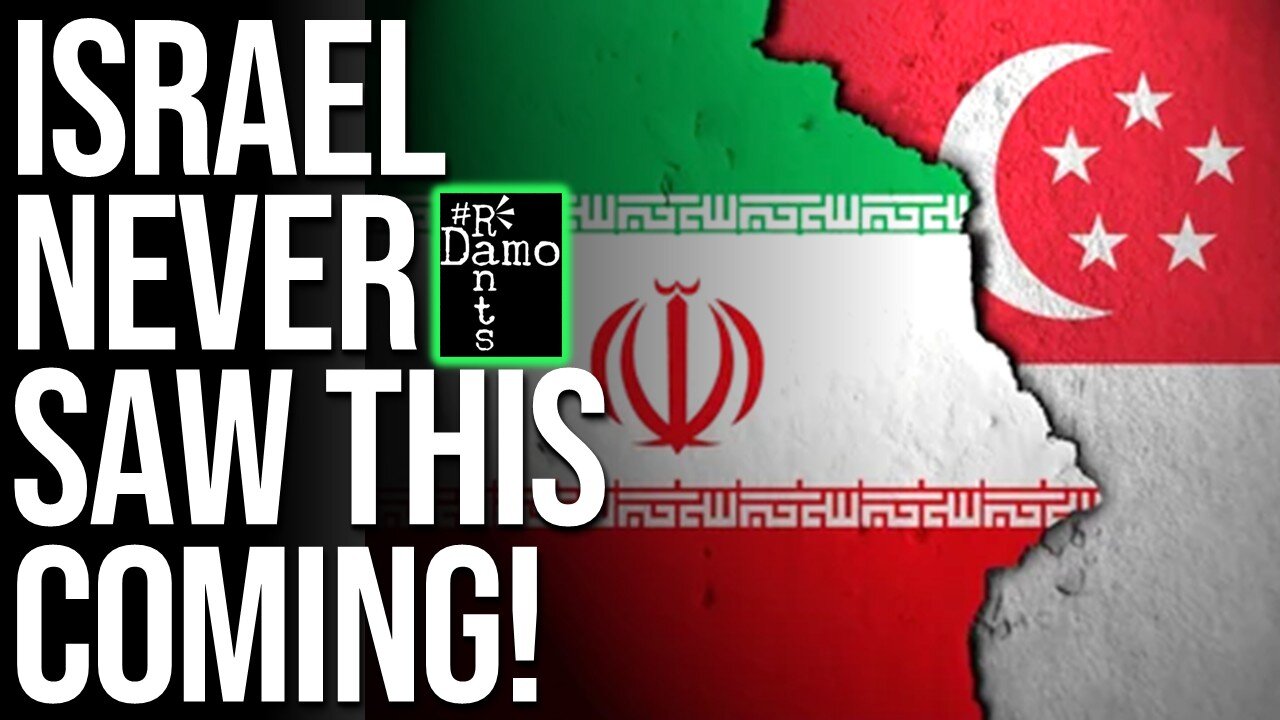
One Iran Seizure Just Exposed Why Singapore Finally Moved on Israel
Right, so Singapore has finally sanctioned four Israelis, and you almost have to laugh, because if there was ever a state that could stretch the definition of “late to the party” into a full diplomatic philosophy, it’s Singapore. Two years of Gaza being levelled, two years of famine warnings, two years of the International Court of Justice saying the risk of genocide is real and ongoing, and Singapore didn’t move an inch. Then four settler extremists in the West Bank start making headlines, the region heats up, a tanker carrying cargo bound for Singapore gets grabbed in the Strait of Hormuz by Iran, and suddenly Singapore decides it’s time to show principle. Not on Gaza, obviously. Not where the real political cost to Israel is. Just enough to look balanced now that the consequences of silence have started to reach its own shipping lanes.
Right, so you look at what Singapore has just done and the first thing you notice is how late it is. Two years of Gaza being torn apart, two International Court of Justice rulings saying the risk of genocide is real and happening in front of everyone, months of starvation warnings, aid blockages, schools and hospitals being smashed to dust, and Singapore has done nothing more than issue the usual calls for restraint. Then all of a sudden, out of nowhere, they sanction four Israeli settlers for extremist violence in the West Bank. Not for Gaza. Not for the starvation. Not for the mass displacement. Four individuals tied to settler militias who even Israel’s own institutions treat as a nuisance when things get too loud. That’s the first thing to understand: this move is tiny in scale, limited in its reach, and aimed at the softest possible target. But because Singapore has done almost nothing for two years, people are scrambling to understand why this has happened now, and why at this moment Singapore wants to look like it’s finally willing to take a stand on something involving Israel. And that’s where the timeline matters, because this isn’t morality kicking in, this is something else, and when you lay the events out in the order they’ve unfolded, you see exactly how Singapore has judged the moment and decided it had to reposition itself before things got any worse.
Singapore is saying the sanctions are about settler violence in the West Bank, which has surged, and that part is true. No invention needed. The evidence is there and it has shocked enough states into doing the same thing. The US has sanctioned extremists. The UK has sanctioned extremist outposts. The EU has condemned them. The violence is very real, and nobody, not even Israel’s own Foreign Ministry, is pretending these groups act within any recognisable legal order, it’s just that they are held to a completely different set of laws, apartheid state and all of that. So Singapore has picked a target Israel cannot defend without embarrassment. And that should set off the first alarm bell, because if Singapore really wanted to send a message about the scale of Israeli brutality, the story is overwhelmingly Gaza, that is not to minimise the atrocities in the West Bank, but to apply sanctions there and not where the overwhelming Israeli threat is, just begs for questions doesn’t it? That’s what the ICJ has been ruling on since January 2024. Gaza is where the obliteration has taken place. Gaza is where children have starved because aid was blocked. Gaza is where nearly every major humanitarian institution has been saying that international law has been shredded in real time. And Singapore said practically nothing beyond the routine statements every state issues when it wants to signal concern but avoid consequences. So the question that sits right at the centre of this is: why was Gaza off limits to Singapore for two years, and why is the West Bank suddenly safe to criticise?
You can trace the answer back to something Singapore rarely says outright but acts on constantly: its security ties with Israel are deep, old, and baked into its military identity. Singapore’s early defence structures were built with Israeli assistance. Training, doctrine, surveillance systems, cyber support — all of that has history, continuity, and bureaucratic weight. When you’ve relied on a state for that long in matters of military development, you don’t casually turn around and start sanctioning its officials or its military leadership. The political class in Singapore never forgets who helped them build their army. And you can see that in the way their statements have been framed since the start of the Gaza war. Always balanced. Always procedural. Always “we support Israel’s right to self-defence” paired with “we urge restraint.” It’s the same posture we’ve seen from far too many other states who rely on Israeli defence technology or training: criticism limited to humanitarian cost, praise reserved for Israel’s security needs, and a sudden quiet whenever the ICJ steps in and calls what Israel is doing a potential genocide. Singapore couldn’t afford to anger Israel, and so it didn’t. Not for two years. Not even after the ICJ made it legally impossible to pretend this is just another war.
But policy doesn’t move only on allegiance. It moves on risk too. And Singapore is a small state with no illusions about what keeps it safe. It relies on stable shipping lanes, predictable trade routes, consistent energy access, and the rules-based order it constantly champions because it has no realistic alternative. So when the region that sits on top of the Strait of Hormuz, one of the most vital energy corridors in the world, starts to escalate, Singapore pays attention. Then Iran seized a tanker carrying cargo destined for Singapore of course, the Talara and subsequently let it go minus the cargo that was heading Singapore’s way. And this is where people get the story wrong if they jump to cause-and-effect conspiracy-talk. Iran didn’t seize it to threaten Singapore; it seized it because Iran seizes ships when it wants to signal leverage in its own disputes with global powers, and this was not some Singapore-specific operation. But if you’re Singapore, you don’t need the seizure to be about you for it to matter. What you saw was that Iran can unilaterally disrupt the flow of goods that Singapore depends on, and it can do it instantly. One move. One ship. Cargo bound for you. Stopped. Taken. Held. And you have no military capacity to respond, no leverage to retaliate, no route to force the release, and no influence over the geopolitical conditions that led to it. That kind of disruption hits Singapore right at the heart of its strategic vulnerability. This is a city-state whose entire survival model depends on open seas and predictable flows. When that gets shaken, even indirectly, even just a little bit, it becomes a live issue.
And that’s where the timing starts to line up, because the seizure happens, the region heats up, and Singapore is suddenly aware that appearing too close to Israel — at a moment when Israel is facing global legal scrutiny and accusations of genocide — is a liability. Not because Iran is about to punish Singapore, but because being visibly aligned with Israel makes you look like a partisan actor in a conflict whose shockwaves can reach the maritime routes you depend on. If Iran sees you as leaning too far into the Western-Israeli axis, you become another soft target in a global standoff that is expanding far beyond Gaza. So Singapore starts recalibrating its public posture, not dramatically, not in a way that would anger Israel, but enough to signal that it is not blindly standing in Israel’s corner. And that’s exactly what these sanctions achieve. They target the smallest possible group of Israelis whose actions are already condemned by Israel’s own courts and by the Western states Singapore wants to stay aligned with. They send a message to Israel without touching the Gaza operation or the Israeli military. They send a message to the Muslim-majority states around Singapore - Malaysia, Indonesia, the wider ASEAN neighbourhood - That’s ASEAN as in A-S-E-A-N, the Association of South East Asian Nations, that Singapore is not ignoring Palestinian suffering. And they send a message to Iran and the states watching from the Global South that Singapore is not acting as an Israeli proxy. That is what this is. This is a signal to others.
And the real giveaway is how Singapore frames it. They say sanctions are largely a “statement of principle.” That’s a diplomatic way of saying they’re symbolic. They’re not meant to change the behaviour of the sanctioned individuals, because everyone knows sanctioning four settlers doesn’t dismantle settler terrorism, it is, even now, bare minimum stuff. They’re meant to communicate Singapore’s position under shifting geopolitical pressure. And the state knows they won’t harm its ties with Israel because Israel’s own government has divisions over settlers. Even the Israeli security establishment has been willing to publicly condemn settler attacks when they threaten stability. By aiming the sanctions at a group that Israel itself sometimes distances from, Singapore avoids the backlash it would get if it went after the military, the ministries, or the political leadership behind Gaza. This isn’t moral bravery or anything close to it. This is risk management, plain and simple.
But it feels sudden because the Gaza crisis has been going on for two years and Singapore has never once moved in a way that carried consequences for Israel. And that’s where the question of legal clarity comes in, because the ICJ rulings have been unambiguous. By January 2024, the Court had already said the risk of genocide was plausible and ordered Israel to stop obstructing aid, prevent killings, and ensure humanitarian access. By March, the Court tightened the measures because Israel wasn’t complying. By May, it was warning of imminent risk to life in Rafah. Singapore had all the law it needed to justify stronger positions. It had all the humanitarian evidence. It had all the justification anyone could want to take a more serious stance. And it did nothing except statements about suffering and proportionality. So yes, the sanctions do feel sudden, because Singapore bypassed two years of mass death, starvation, and legal rulings, and only acted when the target was politically safe for it to do so.
And because the timing sits so close to the Iranian tanker seizure, people want to know whether that had anything to do with this. And the simplest answer is that it did - not as a direct trigger, not as retaliation, but as part of Singapore’s understanding of how dangerous the region has become for small states like they are. You don’t need direct threats for a state like Singapore to recalibrate. You only need to see how easily the flow of goods you rely on can be disrupted when the region turns volatile. You only need to see how quickly you can be dragged into a conflict you weren’t part of. A tanker destined for you being taken in Hormuz is enough to remind you that you don’t want states like Iran to think you’re lining up behind their enemies. Now this is inference, but it matches Singapore’s long-established pattern: when geopolitical risks spike, Singapore always retreats to visible neutrality, because neutrality is what protects it. The sanctions are part of that defence strategy now.
And the West Bank violence gives them perfect justification, there’s no argument from me on that if taken in and of itself. This is the part that fits perfectly into Singapore’s risk-avoidance logic. Settler violence has been escalating. Reports are clear. The individuals sanctioned have been named repeatedly. Other states have already acted. The violence is easy to condemn because it’s captured on video, it’s condemned by human rights groups, and even Israeli media doesn’t defend it. So Singapore can say it is acting on principles of international law without being accused of targeting the Israeli state. If they went after Gaza policy, that’s a diplomatic explosion. If they go after four settlers, that’s manageable.
You can also track the regional pressure Singapore is under. It sits between Malaysia and Indonesia, two of the strongest pro-Palestinian voices in the region. Both have been vocal about genocide. Both have seen mass demonstrations. Both tie their foreign policy to the Palestinian cause in ways Singapore does not. Singapore cannot afford domestic or regional perception that it is sitting in Israel’s camp while the rest of Southeast Asia is calling for accountability. Its carefully managed multicultural harmony means it can’t appear indifferent to Palestinian suffering, especially when Muslim-majority states around it are treating this as a defining moral issue. So when settler violence spikes and the case becomes too obvious to ignore, Singapore sees a window to move without destabilising its other ties.
And that’s the thread running through all of this: Singapore is playing both sides, because that is how it survives. It trades with everyone. It depends on global safety nets. It knows the rules-based order is weakening but it still needs to act like the rules matter. So when the world starts shifting, and states like Iran start demonstrating their ability to disrupt global trade routes, Singapore takes note. When Israel crosses so many lines that even US-aligned states begin criticising its actions, Singapore adjusts. When the ICJ adds layer after layer of legal condemnation, Singapore sees the direction of travel. But because its defence ties with Israel matter, because its economic ties matter, because it needs to maintain credibility with the Muslim world, the move it picks is the smallest possible one that counts.
This is why the sanctions look sudden. They’re not the result of moral growth. They’re not Singapore suddenly caring about Palestinian rights. They’re not driven by humanitarian horror finally breaking through the diplomatic fog. They’re Singapore seeing the region heat up, seeing the shipping routes become vulnerable, seeing the international legal case against Israel tighten, seeing its own neighbours demand more action, and deciding that it needs to show neutrality in a way that carries some weight but no danger. The four settlers were the perfect target: enough to make a headline, not enough to risk anything meaningful.
And that’s how you understand Singapore here. A small state making a small move because a small move was all it could afford. A state that didn’t act when the genocide warnings came in. A state that didn’t act when the ICJ issued its rulings. A state that didn’t act when the destruction was visible every day. But a state that did act when the strategic environment changed and silence became a risk in itself. That’s the verdict. Singapore didn’t move because Gaza changed. Singapore moved because the world around Gaza changed. More pressure will therefore equal more shifts, simply because that’s how it works there.
Where Singapore certainly wasn’t Iran’s direct target as a result of that tanker seizure, Israel wasn’t its direct target either, as all the evidence it seems points elsewhere, to indirectly hit Israel instead, so check out that story here to get to the bottom of that.
Please do also hit like, share and subscribe if you haven’t done so already so as to ensure you don’t miss out on all new daily content as well as spreading the word and helping to support the channel at the same time which is very much appreciated, holding power to account for ordinary working class people and I will hopefully catch you on the next one. Cheers folks.
-
 LIVE
LIVE
TimcastIRL
27 minutes agoCNN SLAMMED For Claiming BLACK J6 Bomb Suspect IS A WHITE MAN w/ Milo & George Santos | Timcast IRL
12,301 watching -
 LIVE
LIVE
TheSaltyCracker
49 minutes agoPipe Bomb Bull Sh*t ReeEEStream 12-05-25
8,913 watching -
 LIVE
LIVE
Glenn Greenwald
5 hours agoGlenn Answers Your Questions on an Un-American Candidate in TX, Escalating War with Venezuela, Trump's Loyalty to Miriam Adelson, and More | SYSTEM UPDATE #554
4,792 watching -
 3:49
3:49
Gamazda
3 hours ago $0.11 earnedABBA - Dancing Queen (Piano)
2525 -
 1:03:20
BonginoReport
3 hours agoCNN’s Colorblindness Strikes Again! - Nightly Scroll w/ Hayley Caronia (Ep.191)
86K27 -
 LIVE
LIVE
The Daily Signal
2 hours ago🚨BOMBSHELL: Minnesota Somali Fraud Scandal Gets WORSE, $8 Billion Lost, Gas & Oil Prices Plummet
365 watching -
 17:44
17:44
tactical_rifleman
8 hours ago $0.45 earnedMilitary's New Belt-Fed Machine Gun | MCR | Tactical Rifleman
1593 -
 LIVE
LIVE
LFA TV
21 hours agoLIVE & BREAKING NEWS! | FRIDAY 12/05/25
616 watching -
 LIVE
LIVE
DBoss_Firearms
59 minutes agoD'Boss Firearms is LIVE! Help me vote for the Gundies!
72 watching -
 3:14:14
Nerdrotic
6 hours ago $15.54 earnedHollywood PANICS! Netflix WINS Warner Bros | RIP Star Trek - Friday Night Tights 383
122K11