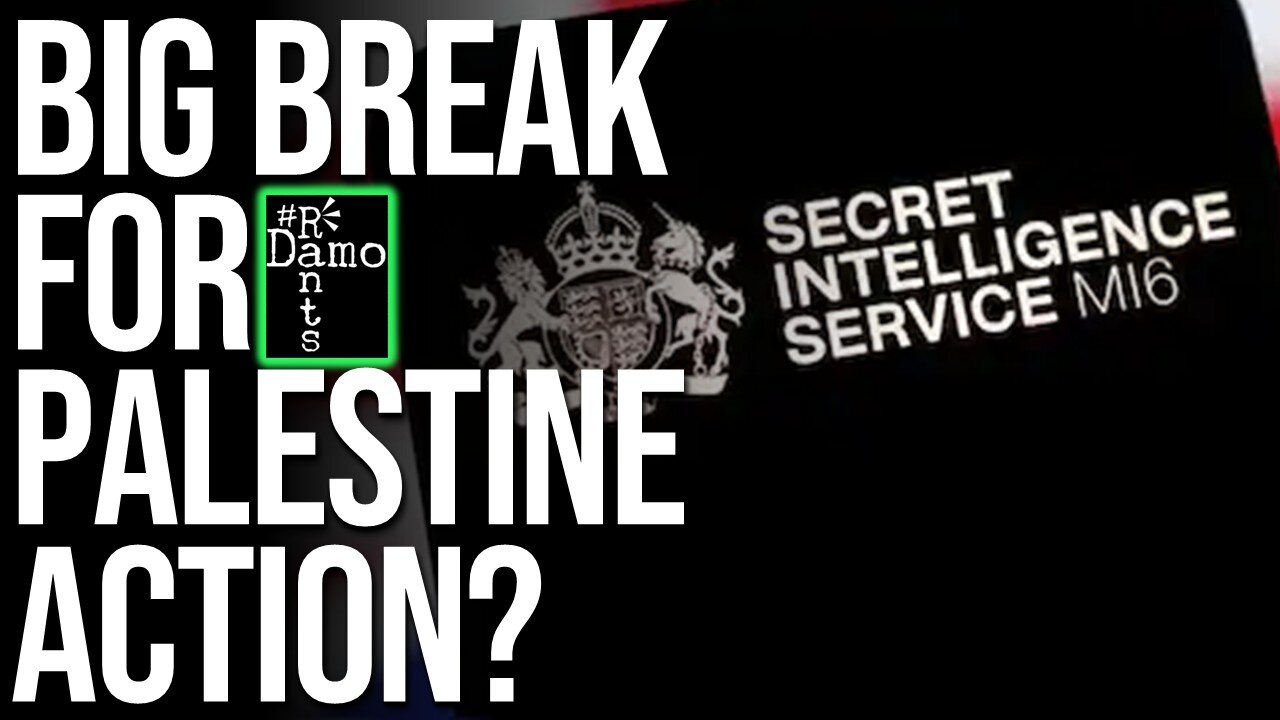
This MI6 Leak Just Shattered Starmer’s Palestine Action Ban
Right, so you know the government’s lost the plot when the only people treated like terrorists in Britain are the ones trying to stop actual weapons being built. Because while ministers were busy criminalising cardboard signs and dragging Palestine Action supporters off the pavement outside the Ministry of Justice, and with the Judicial Review of this proscription, this news story becomes even more pertinent, their own intelligence service was off quietly forging a relationship with Hay’at Tahrir al-Sham, HTS — a group who very much were committing acts of terror and had earned their proscription, all of which has now been lifted, because they now run the Syrian state. And they didn’t just talk to them at the time either, they built channels, they cultivated the relationship, and then they quietly took HTS off the terror list while slapping Palestine Action onto it. That’s not national security. That’s political convenience wearing a counterterrorism uniform. And now thus hypocritical mess may well walk into that Judicial Review courtroom with them. Has any government ever managed to undermine their own case like they have with this one before the hearing has even begun?
Right, so if you look at the way the British state has handled Palestine Action over the past year – the arrests, the proscription, the dawn raids, the police turning up outside the Ministry of Justice to drag people off for holding cardboard signs and of course elsewhere around the country – and you can see exactly what they thought they were doing. They thought they had found a soft target. They thought the terrorism label would stick because it always has before. They thought the public would back away because people usually do when the state throws around words like “extremism” and “national security.” And they thought nobody would ever be able to hold up a mirror to their own conduct, because they never expected anyone to go digging in the one place they never want scrutiny: their own foreign policy networks.
But now that mirror is up. And the reflection is catastrophic for them. Because the same government that criminalised people for supporting Palestine Action – a group that has never killed anyone, their weapon was not a loaded gun or missile, but a tin of red paint – had been quietly maintaining channels with Hay’at Tahrir al-Sham, an organisation that actually is responsible for killings, disappearances, torture sites, sectarian purges and violent rule in northern Syria. Worse, the government didn’t just talk to HTS. Its intelligence services have admitted forging a relationship with the group. They did that in 2023, while HTS was still very much proscribed, at the same moment the British government was telling the public that anyone expressing sympathy for a proscribed organisation could face arrest.
And it is MI6 itself that has made this clear. The outgoing chief at the time, Richard Moore stated the UK “forged a relationship” with HTS back in 2023. There was no leak, no scandal, no attempt to deny it. They spoke openly because they didn’t think it mattered. They assumed nobody would ask why a state that treats protest groups as national threats feels entirely relaxed about cultivating ties with a jihadist organisation. They assumed the public wouldn’t connect the dots and when the mainstream media don’t cover it, why would they? You don’t ask about stuff you aren’t informed about do you? They assumed the courts wouldn’t look beyond the Home Secretary’s statements. And they assumed the legal system would never be forced to weigh one proscription decision against another, so it’d be a rotten shame if this comes up in this week’s Judicial Review of Palestine Actions proscription wouldn’t it?
The judicial review into the proscription of Palestine Action changes everything because suddenly the government has to defend its decisions under scrutiny. Suddenly it has to explain why an anti-war direct action group was criminalised at the exact moment its intelligence services were continuing to deepen contact with HTS and they were lifting the proscription on them. Suddenly it has to account for the fact that HTS was de-proscribed under its watch while Palestine Action’s supporters were marched into police vans. And suddenly all the contradictions the state assumed would go unnoticed may now end up sitting in a courtroom, ready to be compared side-by-side.
This is why the HTS revelations matter. Not because the public didn’t already suspect double standards – anyone paying attention to Britain’s foreign policy knows terrorism is a flexible category, the farce over Palestine Action should make that abundantly obvious to even the most tin eared of Starmer regime supporters, even if they might continue to deny it – but because these admissions fall exactly inside the timeframe the courts will examine. It’s not historic. It’s not theoretical. It’s not something buried in dusty files from the Cold War. This happened in the run-up to and during the proscription of Palestine Action. MI6’s conduct, the Home Office’s decisions, the arrests, the de-listing of HTS – all of it sits inside the same political moment. And once you start lining up the dates, the government’s argument collapses under its own weight.
Consider the timeline. In 2023, HTS is still on the UK’s list of proscribed terrorist groups. Of course the Tories are still in charge at this point, but as we know there’s no real difference to the governance we had then and what we have now. MI6 establishes this relationship with HTS at this point. The public does not know this. Then, by 2024–25, Jonathan Powell – whose NGO Inter Mediate is reported to have mediated between Western governments and HTS – is appointed National Security Adviser to Keir Starmer. His proximity to these networks isn’t a footnote. It shapes how the government views “extremism,” how it frames dissent, how it weaponises the Terrorism Act. Then in the last few weeks, the UK quietly lifted HTS’s proscribed status – at basically the same time it formally branded Palestine Action a terrorist organisation. Two decisions made by the same department, under the same government, within months. One group with a long record of violence gets moved off the list, former Al Qaeda operatives as HTS are. One group whose actions are non-violent direct action gets moved onto it for throwing paint on some planes.
The Home Office has been thoroughly rinsed for this, both under the charge of Yvette Cooper then and Shabana Mahmood now, but I doubt they ever thought anybody would ever compare the two. But that’s exactly what the judicial review could force them to do as these revelations come out.
And the comparison is devastating. Because the government cannot say Palestine Action posed more of a threat than HTS. It cannot argue consistency. It cannot claim neutrality. It cannot claim this was about public safety. It cannot stand in front of a judge and explain why the Terrorism Act is applied aggressively against activists dismantling weapons equipment while being lifted from a group that has controlled territory with force and continues to commit atrocities towards minorities in Syria to this day.
Once you remove the rhetoric, the only explanation left is political usefulness. HTS became geopolitically useful. They removed Assad, Palestine Action became politically inconvenient. They oppose Israel and the UK arming of them as they commit genocide. That is the entire logic. And that logic destroys the legal foundation the government needs to defend proscription.
The state wants to insist these are different categories. That one is foreign policy and one is domestic policing. That one required engagement and one required suppression. But the Terrorism Act doesn’t recognise that distinction. If anything, the Act is deliberately broad because Parliament assumed ministers would use it responsibly. They assumed the government would safeguard the integrity of the list. They assumed proscription would be used sparingly and consistently. They assumed there would be a clear standard for what counts as support for a proscribed organisation.
The HTS material shows that standard never existed.
And this is where Powell becomes a political and legal liability. His NGO’s role in mediating with HTS is not disputed. Some elements are alleged, but the core involvement is reported across multiple open sources. Powell’s work sits right at the junction between foreign policy mediation and counterterrorism designation. When Starmer put him in charge of national security, he didn’t just inherit his experience. He inherited the contradictions built into it. And when the government decided to prosecute and arrest Palestine Action supporters, they did so under a framework Powell oversees.
This is the heart of the problem. You cannot run a foreign policy where proscribed groups are engaged, cultivated, and eventually delisted for strategic reasons, while simultaneously running a domestic policy where the public is criminalised for supporting a non-violent movement. The inconsistency is not an ethical issue. It is a legal one. The Terrorism Act cannot survive that contradiction in court.
This is what the government refuses to admit: proscription only works as a legal instrument when the state looks like it’s applying it evenly. It depends on the appearance of neutrality. Once you break that appearance, once the public can point to two groups treated in opposite ways for reasons that have nothing to do with risk, the whole system starts to creak. And the HTS revelations don’t just break the appearance — they vaporise it.
Because try explaining this with a straight face: The British state built a relationship with a proscribed extremist group in Syria while arresting people in London for holding a cardboard sign that said they oppose genocide and support Palestine Action. You can’t defend that. You can’t wrap that in national security language. You can’t hold that up in court and hope a judge won’t notice. Once the contradiction is visible, it’s fatal.
The government assumed nobody would ever compare the two tracks. They assumed Syria policy was too far removed from domestic policing. They assumed nobody would go digging through Powell’s mediation record or track MI6’s admissions. They assumed the public wouldn’t connect a quiet de-proscription decision with months of mass arrests at home. But the judicial review can force that comparison. It can pull the two tracks into the same frame. And when you put them side by side, the government’s case falls apart on contact.
Because the question the court needs to ask is simple: is the Terrorism Act being applied consistently? And the answer, based on the public record alone, is no. The government cannot argue that proscription reflects threat when they’ve lifted the designation from a violent organisation and imposed it on a non-violent one. They cannot claim zero tolerance while their own intelligence services maintained channels with a proscribed group. They cannot insist that “support” must be criminalised when the state itself engages, mediates and normalises contact with the same kind of groups it claims the public must avoid.
This is where the legal exposure opens up, and it’s the part Starmer’s advisers are now terrified of. Because judicial reviews don’t operate on political spin. They operate on evidence. They operate on process. They operate on rationality. And once you show a court that the government has used proscription selectively — not based on security, but based on political convenience — the court can strike the decision down.
That possibility was unthinkable for the government six months ago. Now it’s real. Because the HTS revelations destroy the pillars of their argument. They expose that proscription isn’t sacred. It isn’t principled. It isn’t even consistent. It’s a tool the government bends when it wants to build influence abroad and wields like a hammer when it wants to silence dissent at home.
And you can see that bending clearly in the way HTS was removed from the list. There was no great public debate. No substantive assessment published. No national conversation about why the group suddenly met the criteria for rehabilitation. It was done quietly, purposefully, without drawing attention. And the timing could not be more telling: HTS delisted while Palestine Action is listed. A group with a record of violence is freed while a group whose most “destructive” act is dismantling weapons infrastructure is criminalised.
Starmer’s government wants to argue that they inherited the HTS contacts from the Conservatives. That it wasn’t their decision. That they merely continued an approach already embedded in the security services. But that defence is worthless. Because Starmer didn’t distance himself from it. He didn’t review it. He didn’t challenge it. He didn’t question why MI6 cultivated a relationship with a proscribed group. He didn’t question Powell’s involvement before making him national security adviser. Instead, he appointed Powell to one of the most sensitive roles in government. And that makes the contradiction his responsibility, not his predecessor’s.
This is why the HTS revelations are not just embarrassing — they are structurally damaging. They show that the state doesn’t actually believe what it says about terrorism. They show the law is being used differently depending on whose interests are at stake. They show that the same state willing to arrest peaceful protestors is perfectly at ease managing relationships with armed groups when foreign policy calls for it. And once you expose that, every prosecution of Palestine Action supporters becomes harder to sustain. Because the government can’t argue that the public must be held to a standard the state doesn’t follow itself.
You only need to look at the arrests to see how weak the government’s position really is. Over two thousand people detained under the new rules. For signs. For chants. For standing outside a ministry. Not for violence. Not for plotting. Not for carrying weapons. For political expression. And all of this done while HTS’s de-proscription was being finalised. Nothing exposes the double standard more clearly than that. It’s not about safety. It’s about control. It’s not about extremism. It’s about shutting down the one movement exposing Britain’s complicity in Gaza.
And here’s what the government didn’t anticipate: once the HTS story became public, underreported certainly, but public nonetheless, it didn’t matter whether you agreed with Palestine Action or not. The contradiction is so enormous that it’s visible regardless of your politics. You can be indifferent to Gaza. You can disagree with direct action. It doesn’t matter. The point stands: the government maintained channels with a proscribed extremist group while criminalising peaceful protest. That contradiction doesn’t need a political lens. It stands on its own.
This is the point where the machinery behind British counterterrorism starts to become visible in a way it never was meant to. Because the government has spent two decades insisting that the Terrorism Act is neutral, principled, based on threat, and insulated from politics. They have told the public the list is sacrosanct. They have told judges it is evidence-led. They have told Parliament it reflects objective risk. And then, without any attempt to explain the contradiction, they removed a violent extremist organisation from the list at the exact moment they criminalised an anti-war group at home.
Once you see that, you can’t unsee it. And once a court sees that, the government’s authority over proscription is no longer taken for granted. Because the very thing the law relies on — public and judicial trust in the neutrality of designation — has been ripped apart by the government’s own actions.
The state engages with HTS when it wants leverage in Syria. It criminalises Palestine Action when it wants to protect its alliance with Israel. That’s the pattern. And the law bends to whichever pattern is politically useful. That is not counterterrorism. It is political usefulness dressed in security language. And the judicial review is about to force that into the open.
The government cannot argue that proscription was necessary for public safety. There is no evidence of risk. Palestine Action has never harmed anyone. There are no weapons. There are no plots. There are no cells. There is only direct action against defence contractors supplying a military engaged in mass civilian killing in Gaza. And the government’s decision to use proscription instead of public order law is what exposes their motives. Because if this was about disruption, they could have used civil measures. If this was about safety, existing policing powers were enough. But they wanted the terrorism label. They wanted the fear. They wanted the chilling effect.
And now that decision has boxed them in. Because you cannot deploy the most severe tool in British criminal law against nonviolent activists while your own intelligence agencies are forging links with a proscribed group. You cannot hold citizens to a higher standard than the state itself follows. You cannot insist on consistency while behaving inconsistently. You cannot demand respect for the law while demonstrating that it is bendable if you sit in the right room.
Starmer’s government has walked into this trap because it wanted to look strong. It wanted to show it was ruthless. It wanted to send a message. But ruthlessness is not a legal defence. Posture is not a legal principle. And the courts do not care about political theatrics. They care about rationality. They care about proportionality. They care about whether the government has applied the law correctly. And on every one of those tests, the HTS revelations shatter the government’s case.
It’s not just the admission of links. It’s the timing. It’s the de-proscription. It’s Powell’s appointment. It’s the arrests. It’s the expanded definition of “support.” Taken separately, the government could try to spin each one. But taken together, they reveal a state using proscription as a political tool, not a legal measure. And that is the one thing the Terrorism Act cannot survive.
And this raises a deeper question the government hoped nobody would ask: how often has this happened before? How often has the state engaged with proscribed organisations while criminalising public contact with them? How often has proscription been shaped by foreign policy rather than threat? How often have designations been lifted quietly because a group became useful, not because it stopped being dangerous? And if that is how the system works, how many other decisions on the list are now vulnerable to legal challenge?
That’s the real exposure. Not just this judicial review, but the precedent it sets. If the court finds the government acted inconsistently here, it won’t just be Palestine Action’s proscription at risk. It will be the credibility of the entire list. It will be the authority of the Home Office. It will be the idea that ministers can wield this power without scrutiny. And once that authority cracks, it doesn’t heal. Because the public doesn’t forget. Activists don’t forget. Lawyers don’t forget. And judges don’t forget.
And here’s the turn nobody in government wants to acknowledge: the HTS material doesn’t just damage their legal case. It damages their political story. It exposes a Prime Minister who talks about national security with the certainty of someone who believes his words won’t be checked. It exposes a Home Secretary who weaponised counterterrorism powers against protestors while her department was lifting the designation from a group that used executions as governance. It exposes a policing strategy built not on risk but on intimidation. And it exposes a state apparatus that treats dissent as danger and geopolitical manoeuvring as acceptable.
This is why the judicial review is now a genuine threat to the government, not to Palestine Action. Because the courtroom is the one place where the government cannot lean on the press, cannot hide behind ministerial authority, and cannot wave the terrorism label around without explaining it. They will have to justify their decisions. They will have to defend their logic. They will have to show evidence. And they will have to stand under the weight of their own contradictions.
And this is where it lands, because when the contradictions are this large, the verdict writes itself. The British government wants to stand in court and argue that proscription is a neutral safeguard, that the Terrorism Act is applied consistently, that the decision to criminalise Palestine Action was driven by threat, not politics. But the facts sitting in the record say something else entirely.
They say the state built a relationship with a proscribed extremist group while preparing to criminalise a nonviolent one at home.
They say MI6’s own leadership admitted a relationship with HTS in the same period the government was brandishing the terrorism label at activists.
They say the Home Office quietly removed HTS from the list while placing Palestine Action on it.
They say Jonathan Powell — whose mediation networks touched HTS according to open reporting — now sits at the centre of Downing Street’s national security thinking.
They say over two thousand people were arrested for speech and association at the exact moment the government relaxed its treatment of an organisation tied to real violence.
And they say the Terrorism Act has not been applied as a measure of risk but as a measure of political convenience.
The government cannot defend these contradictions. It cannot explain why its own conduct remains outside the criminal law while peaceful activists are pushed inside it. It cannot claim consistency while the record shows the opposite. And it cannot maintain the authority of the proscription system when it has already demonstrated that the system bends when useful and hardens when challenged.
So when this judicial review begins, the danger isn’t for Palestine Action. The danger is for the government, because the case forces a judge to look directly at the gap between what ministers say the Terrorism Act means and how the state actually behaves. It forces the court to weigh the claim of threat against the reality of selective enforcement. It forces the government to stand next to its own contradictions and pretend they form a coherent legal position.
They don’t.
They can’t.
And the HTS revelations are the reason.
This is not a story about activists overreaching. It’s a story about the British state overreaching. It’s about a government that believed the terrorism label would stick because it always had. It’s about an establishment that assumed nobody would put its foreign policy deals next to its domestic policing strategy. And it’s about a legal system that is finally being asked the question the government hoped would never be asked: how can a state criminalise support for one proscribed organisation while cultivating another?
There is no answer that saves them. Not politically. Not legally. Not morally.
And that is the verdict.
Criminalising protest seems to be becoming a bigger and bigger habit in this country, and not just for the Starmer regime either, but not necessarily any more successfully. Israeli cheerleader and alleged actress Gal Gadot has tried on similar where it came to her filming in London being protested at too, though hilariously in her case she tried to use Thatcherite trade union laws to win her case and it has backfired spectacularly, so get all the details of that story here.
Please do also hit like, share and subscribe if you haven’t done so already so as to ensure you don’t miss out on all new daily content as well as spreading the word and helping to support the channel at the same time which is very much appreciated, holding power to account for ordinary working class people and I will hopefully catch you on the next one. Cheers folks.
-
 35:55
35:55
ZeeeMedia
13 hours agoPfizer mRNA in Over 88% of Human Placentas, Sperm & Blood | Daily Pulse Ep 156
5.43K94 -
 LIVE
LIVE
Pickleball Now
3 hours agoLive: IPBL 2025 Day 5 | Final Day of League Stage Set for Explosive Showdowns
335 watching -
 9:03
9:03
MattMorseTV
16 hours ago $14.63 earnedIlhan Omar just got BAD NEWS.
26.7K79 -
 2:02:41
Side Scrollers Podcast
20 hours agoMetroid Prime 4 ROASTED + Roblox BANNED for LGBT Propaganda + The “R-Word” + More | Side Scrollers
133K14 -
 16:38
16:38
Nikko Ortiz
14 hours agoVeteran Tactically Acquires Everything…
20.6K1 -
 20:19
20:19
MetatronHistory
2 days agoThe Mystery of Catacombs of Paris REVEALED
11.7K2 -
 21:57
21:57
GritsGG
18 hours agoBO7 Warzone Patch Notes! My Thoughts! (Most Wins in 13,000+)
18.1K -
 2:28:08
PandaSub2000
12 hours agoMyst (Part 1) | MIDNIGHT ADVENTURE CLUB (Edited Replay)
12K -
 1:12:43
TruthStream with Joe and Scott
5 days agoJason Van Blerk from Human Garage: Reset your life with Fascial Maneuvers,28 day reset, Healing, Spiritual Journey, Censorship, AI: Live 12/3 #520
24.6K4 -
 24:21
24:21
The Pascal Show
1 day ago $9.29 earned'CHALLENGE ACCEPTED!' TPUSA Breaks Silence On Candace Owens Charlie Kirk Allegations! She Responds!
43.7K27