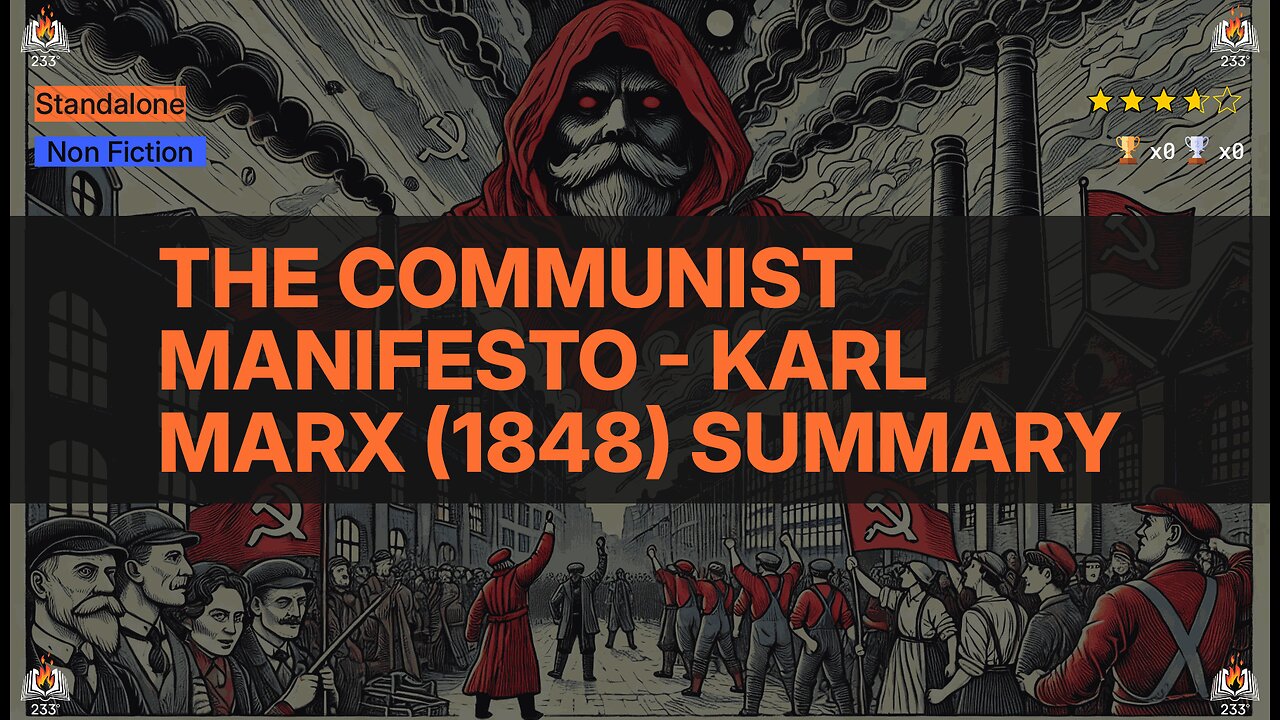
The Communist Manifesto - Karl Marx (1848) Summary
Book 193: The Communist Manifesto - Karl Marx (1848)
Category: Non Fiction
Genre: Classics, German Literature, History, Nonfiction, Philosophy, Political Science, Politics, Sociology, Theory
Book at a glance: The Communist Manifesto is a political pamphlet written by Karl Marx and Friedrich Engels, first published in 1848.
It is one of the most influential political documents in history, laying the foundation for the theory and practice of communism.
The manifesto provides a critical analysis of capitalism and its inherent class struggles, advocating for the overthrow of capitalist systems and the establishment of a classless, communist society.
Creating videos is a slow process, but you can read The Communist Manifesto - Karl Marx (1848) and 1000+ book summaries at Celsius 233 (@celsius233books) website: https://celsius233.com/onlysummary/book-summary/english/non-fiction/the-communist-manifesto-karl-marx-1848/
#Books #BookRecommendations #BookTube #BookTok
--
New Book Summaries Everyday!
Welcome to Celsius 233, your go-to place for fiction book summaries!
Remember, while our summaries capture the essence, they can never replace the full experience of reading the book. If this summary intrigued you, consider diving into the complete story - buy the book and immerse yourself in the author’s original work.
--
📚 Love fiction?
❤️ Like, ➕ Follow, ✈️ Share
Support Celsius 233 and keep the fire 🔥 burning.
Join Celsius 233 Universe wherever you are: https://celsius233.com/celsius-233-universe/
Fuel with a coffee ☕: https://buymeacoffee.com/celsius233books
Be a pal through PayPal 🖊️: https://paypal.me/celsius233books
Support via crypto:
Bitcoin: bc1qvtac6yr7qgz8guhg3j4f70dmvv7zuhaa9ep2vm
ETH/Solana/Litecoin/USDT: 0xC9953b32FA125bC97B5e75Cf1376cDDf62cd0d66
--
the communist manifesto summary, communist manifesto summary, karl marx summary, friedrich engels summary, class struggle explained, capitalism critique summary, socialism and communism overview, political theory classic
-
 2:28:08
PandaSub2000
1 day agoMyst (Part 1) | MIDNIGHT ADVENTURE CLUB (Edited Replay)
32.3K -
 21:57
21:57
GritsGG
1 day agoBO7 Warzone Patch Notes! My Thoughts! (Most Wins in 13,000+)
39K -
 LIVE
LIVE
Lofi Girl
2 years agoSynthwave Radio 🌌 - beats to chill/game to
709 watching -
 7:51
7:51
Comedy Dynamics
6 days agoLife on Lake Erie - Bill Squire stand-up comedy
76.8K3 -
 5:08:20
FreshandFit
15 hours agoArt Basel IRL Stream
219K22 -
 5:21:52
Akademiks
7 hours ago50 cent Declares War on Diddy. Drake #1 streamed artist of 2025. Candace vs TPUSA. YB 19 bodies?
29.5K3 -
 4:51:31
Drew Hernandez
1 day agoKASH DENIES FOREIGN INVOLVEMENT IN CHARLIE KIRK MURDER & CANDACE WILLING TO MEET WITH ERIKA KIRK?
40.2K25 -
 1:19:49
Adam Does Movies
8 hours ago $27.39 earnedLive Taping! Reviewing Five Nights At Freddy's 2, Marty Supreme, Fackham Hall - Live!
39.7K -
 0:43
0:43
Gaming on Rumble
8 hours ago $4.15 earnedLvl UP (Raids)
30.9K -
 7:50:40
SpartakusLIVE
12 hours agoBUYBACKS Have RETURNED || #1 Gamer w/ Most HEALTHY and VIBRANT Hairline
39K