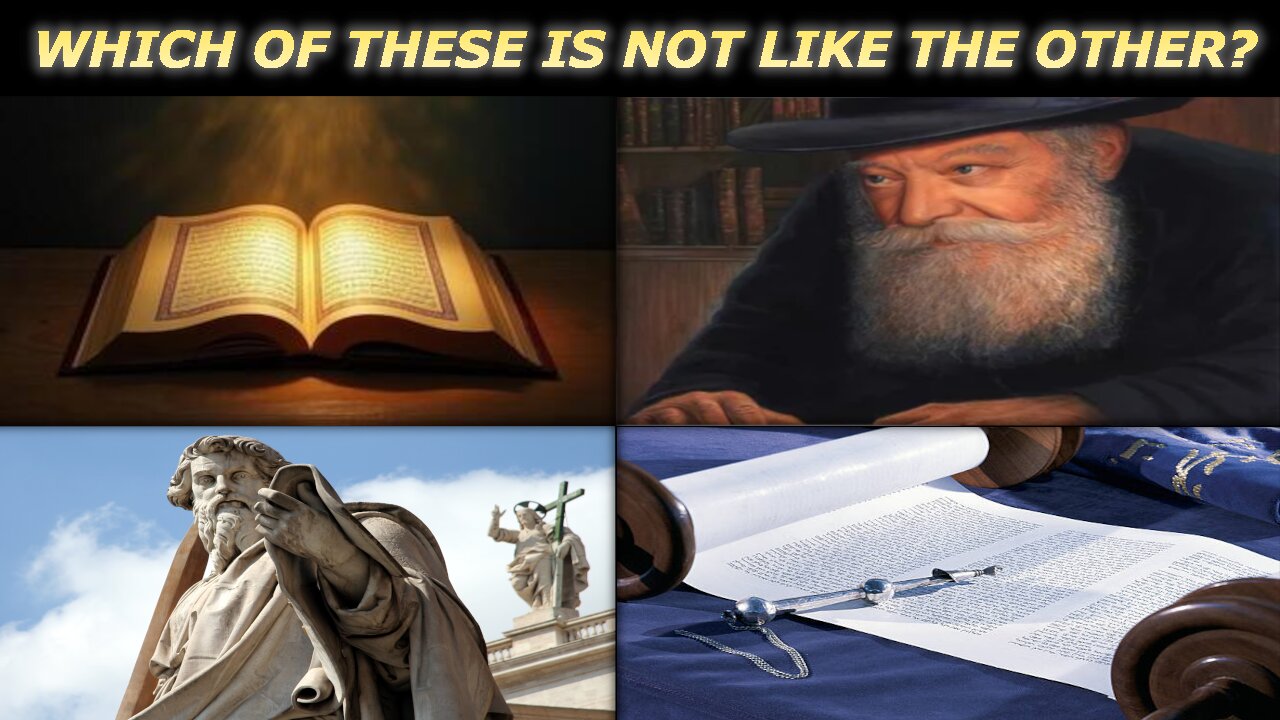
Was Jesus a Muslim?
0:00 Outline
0:27 Muhammad and Jesus
8:29 Contemporary non-Muslim witnesses
13:23 What law did Jesus follow?
15:52 Paul the “False Prophet” and “the Samaritan”
19:38 Why is Pauline theology so full of contradictions?
26:27 Was Jesus a Muslim?
Islam’s portrayal of biblical prophets as Muslims may seem anachronistic or revisionist at first blush. However, it is actually the contrary. Islam criticizes Judaism and Christianity for being anachronistic and revisionist, since Abraham was neither a Jew (named after Judah) nor a Christian; nor did he speak a “foreign tongue” (Qur’an 16:103), namely Phoenician or Greek. Rather, he was a Muslim (Qur’an 3:67)—i.e., “perfect”. See OpenjusticeDotNet, “Islam and Science 3/3” (28 Nov 2025) Rumble <https://rumble.com/v72ci3c-abraham-the-godless.html>.
Islam further maintains that the Deen (law) of God has always been “to be perfect” (Islam), as God commands Abraham in Genesis 17:1 to “Walk before me and be perfect” (Tameem), which has the same meaning in Arabic. The Qur’an correspondingly states that Abraham fulfilled (Atimma) God’s commandments (v. 2:124) and that God perfected (Atimma) the Deen (law) of Islam (v. 5:5), whence the word Muslim, from the Hebrew Mushlam and Arabic Musallam (v. 2:71; cp. Numbers 19:2 & Ephesians 5:27).
In particular, Islam resolves legal and doctrinal issues concerning which Jews and Christians differed (Qur’an 22:76). For instance, it repudiates the trinity (Qur’an 5:73), increases daily prayers from three (Daniel 6:10) to five (Bukhari 97:142; i.e., the perfect Yom Kippur prayer) and includes pilgrimage to Baka (Qur’an 3:94, Psalm 84:6, 2:196) and Jerusalem (Ibn Majah 5:607).
Such dispensations do not abrogate or derogate from the Law, since they include former dispensations (e.g., Qur’an 2:183), while dispensing of particularities and novelties (Qur’an 3:93) and restoring the original and universal laws (Qur’an 5:90-91). This is consistent with Jesus’ saying that believers’ righteousness must surpass the Pharisees’, who observed the Law (Matthew 5:20; cp. Luke 18:9-14). Pauline Christianity, by contrast, denigrates and abolishes the Law on the pretext of fulfilling it.
Muhammad rose during the reign of Heraclius, whom Jews regarded as Armilus—an antichrist (Sefer Zerubbabel)—and who declared that he would eradicate circumcised people (i.e., Jews and Arabs); see Bukhari 7:1 and Walter Kaegi, Byzantium and the Early Islamic Conquest (UK: Cambridge University Press, 2000) at 194. Contemporary Jews and Arabs anticipated the coming of a prophet-warrior (Bukhari 63:131 & 65:7) from Mt. Sela (Isaiah 42:11 & al-Adab al-Mufrad 12:9) in Ethribus (Ar. Yathrib; see Qur’an 33:13) who would be a “light to the nations” (Isaiah 42:6) and “triumph over his enemies” (Isaiah 42:14). Muhammad was correspondingly greeted with the song Tala’al-Badr (Isaiah 42:10) in Medina, which was called “the Menorah” (al-Madina al-Munawarra) in his honor.
Muhammad and his caliphs (successors) and their followers subdued the “beasts” or evil empires in the vision of Daniel (ch. 7), as he predicted they would (an-Nasa’i 25:92). When victorious, Muhammad pardoned his enemies instead of executing them. They consequently embraced Islam in droves (Qur’an 110).
Only a few decades after his ministry began, almost the entire Middle East and North Africa (the biblical world) became Muslims with hardly any resistance, as John Bar Penkaye (7th c.) wrote: "[T]he children of Hagar at once gained control over more or less the whole world [. . .]. We should not think of [their] advent as something ordinary, but as due to divine working. [. . .] [T]hese people came, at God’s command, [. . .], not with any war or battle [. . .]. God put victory into their hands in such a way that [. . .] “One man chased a thousand and two routed ten thousand” [Deuteronomy 32:30]”; see Kaegi, supra at 216. Jews and Christians thus saw Muhammad as fulfilling the promise of a “great nation” to Ishmael (Genesis 17:20) as Moses fulfilled the promise of a “holy nation” to Israel (Exodus 19:6).
So, to answer the hypothetical question whom Jesus or Moses would follow today, it is likely that Moses would believe Muhammad, since Moses could not convince his own people, the Israelites—let alone the Egyptians; let alone MENA or the world—to believe him, not even with all the miracles he is supposed to have performed (Mishkat al-Masabih 1:185).
Jesus, on the other hand, would disavow Jews and Christians who support the genocide of his people: the Palestinians, as Romans called Judeans. He would also oppose genocidal settlers from Nazi Europe who pretend to be ancient Israelites, as well as Jews who curse him, tormented him and claim to have stoned him to death (Sanhedrin 43a). Jesus would also repudiate Romans, like the Catholic and Orthodox Churches, who claim to have executed him as a Zealot (lit. Hamas) for opposing Roman occupation of the Holy Land. He wouldn’t consider the Roman pontiff, the Orthodox patriarch or charismatic gentile preachers like pastor John Hagee or Joel Osteen to be his legitimate successors.
What is certain, at any rate, is that if Muhammad was not a prophet by any definition, then neither was anyone before him or after, since—as the most influential man in history—his existence is more difficult to doubt and he eclipses their putative accomplishments. It should finally be borne that people from the Middle East and North Africa are the original Jews and Christians who legitimately inherit the scriptures from their ancestors. Vikings, Aztecs and sub-Saharan Africans, who comprise the overwhelming majority of Jews and Christians today, since the fall of Rome, only claimed to be Christians or the fictional “Lost Tribes” of Israel many centuries—and genocides—later.
-
 1:18:24
The Illusion of Consensus
1 month ago“Your Math Is WRONG” - Mark Cuban GRILLED Over His NBA COVID Vaccine Mandate | Part 2
23.7K15 -
 14:17
14:17
RTT: Guns & Gear
17 hours ago $3.77 earnedBest Budget RMR Red Dot 2025? Gideon Optics Granite Review
25.1K4 -
 2:05:05
BEK TV
1 day agoTrent Loos in the Morning - 12/05/2025
23.3K -
 LIVE
LIVE
The Bubba Army
23 hours agoWill Michael Jordan TAKE DOWN NASCAR - Bubba the Love Sponge® Show | 12/05/25
1,007 watching -
 35:55
35:55
ZeeeMedia
16 hours agoPfizer mRNA in Over 88% of Human Placentas, Sperm & Blood | Daily Pulse Ep 156
30.9K111 -
 LIVE
LIVE
Pickleball Now
6 hours agoLive: IPBL 2025 Day 5 | Final Day of League Stage Set for Explosive Showdowns
140 watching -
 9:03
9:03
MattMorseTV
19 hours ago $22.08 earnedIlhan Omar just got BAD NEWS.
52.4K108 -
 2:02:41
Side Scrollers Podcast
23 hours agoMetroid Prime 4 ROASTED + Roblox BANNED for LGBT Propaganda + The “R-Word” + More | Side Scrollers
152K15 -
 16:38
16:38
Nikko Ortiz
17 hours agoVeteran Tactically Acquires Everything…
34.4K2 -
 20:19
20:19
MetatronHistory
2 days agoThe Mystery of Catacombs of Paris REVEALED
24.1K3