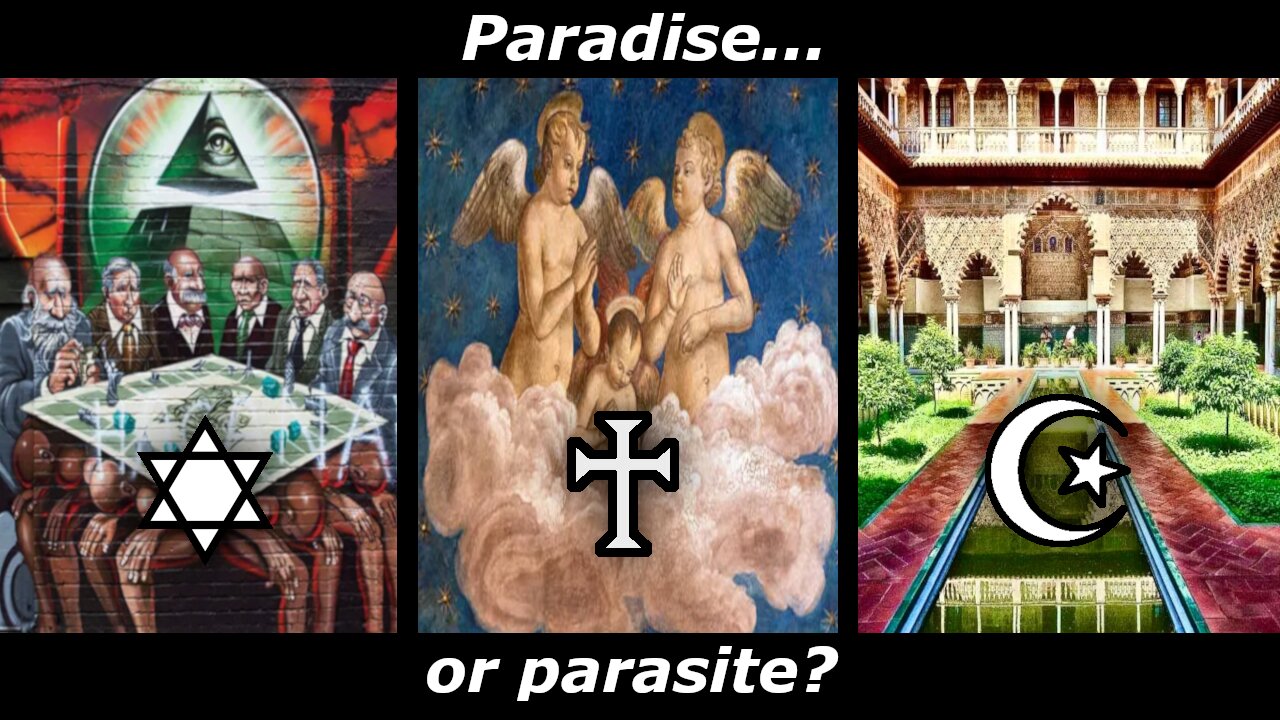
What is the best explanation for Abrahamic religions?
0:19 What is the best explanation?
0:53 Jewish law
2:47 Best explanation
4:23 Christian “law”
7:50 Best explanation
10:26 Islamic law
12:17 Best explanation
The Abrahamic religions, namely Judaism, Christianity, and Islam, have had a profound impact on world history. As we examine these religions from legal, teleological (the study of purpose or function), and practical standpoints with over 1000 years of history to consider, it is essential to explore their origins and endgame or purpose.
Most of the Bible was written around the middle of the first millennium BCE by Levitical priests in service of Judahite monarchs. Fast forwarding to Roman-occupied Judea in the 1st c. CE, a Galilean rabbi named Joshua (Lat. Jesus) claimed to be the Messiah: the rightful successor of King David. After Jesus was crucified by Romans according to gospel accounts, worshippers began depicting him as a white man similar to early Pantokrator icons adapted from images of Zeus. Christianity eventually became the state religion of the Roman Empire and influenced numerous barbarian tribes who sacked it in the 5th c.
Jews, on the other hand, claim that Jesus was a heretic whom they stoned to death (Sanhedrin 43a), contrary to gospel narratives, and assert their status as God's chosen people, whom gentiles (non-Jews) are destined to serve (Shabbat 32b:6).
Since Christianity is a lawless religion (cp. Daniel 7:25), it has supported every kind of ruler and rule. For instance, common law—an ever-changing blend of culture that includes Christian principles—prescribed various tortures and capital punishments like the Bloody Code. Many Christians still believe in a white male God who must be worshipped or risk going to hell (e.g., the Spanish Requirement of 1513).
Islam, meanwhile, acknowledges that Hebrew prophets were righteous but believes that Jews and Christians have strayed from this path. It posits a distinct rule of law and vision of paradise compared to Judaism and Christianity. Unlike colonial empires, Muslims are indigenous to their countries with the exception of Turks who invaded them before converting to Islam themselves.
In conclusion, understanding the origins and evolution of Abrahamic religions is crucial for grasping their current influence on global culture and politics.
-
 LIVE
LIVE
Barry Cunningham
15 hours agoLIVE BREAKING NEWS: President Trump Addresses The Nation | Marco Rubio | Kash Patel | News!
925 watching -
 59:34
59:34
Timcast
1 hour agoNarco Boat Double Strike Triggers MASSIVE Political Firestorm, Admiral To Be QUESTIONED By Congress
47.2K42 -
 LIVE
LIVE
Dr Disrespect
2 hours ago🔴LIVE - DR DISRESPECT'S TRIPLE THREAT CHALLENGE - ARC RAIDERS • BF6 • FORTNITE
1,453 watching -
 LIVE
LIVE
Side Scrollers Podcast
2 hours agoKaceytron Publicly Humiliated by H3H3 + Sabrina Carpenter/White House FEUD + More | Side Scrollers
1,153 watching -
 LIVE
LIVE
Sean Unpaved
1 hour agoArch Manning & Texas ELIMINATED From College Football Playoff Contention | UNPAVED
127 watching -
 5:58
5:58
Buddy Brown
3 hours ago $0.35 earnedAngel CAUGHT ON CAMERA Saves Street Preacher from ATTACK! | Buddy Brown
3875 -
 LIVE
LIVE
The Charlie Kirk Show
1 hour agoBlackpilled Zoomers + Charlie's Sabbath + Minnesota Meltdown | Bowyer, Turek, Glahn | 12.3.2025
2,837 watching -
 2:01:57
Steven Crowder
3 hours agoVintage MAGA: Trump's Epic Somalia Rant Isn't Racist - It's Irrefutable
243K179 -
 12:23
12:23
The Illusion of Consensus
3 hours agoThe Moment Dave Smith was Accused of Being A Holocaust Denier by Alex Berenson
121 -
 1:06:14
The Rubin Report
2 hours ago‘The View’ Crowd Gets Confused as Whoopi Contradicts Facts
16.7K29