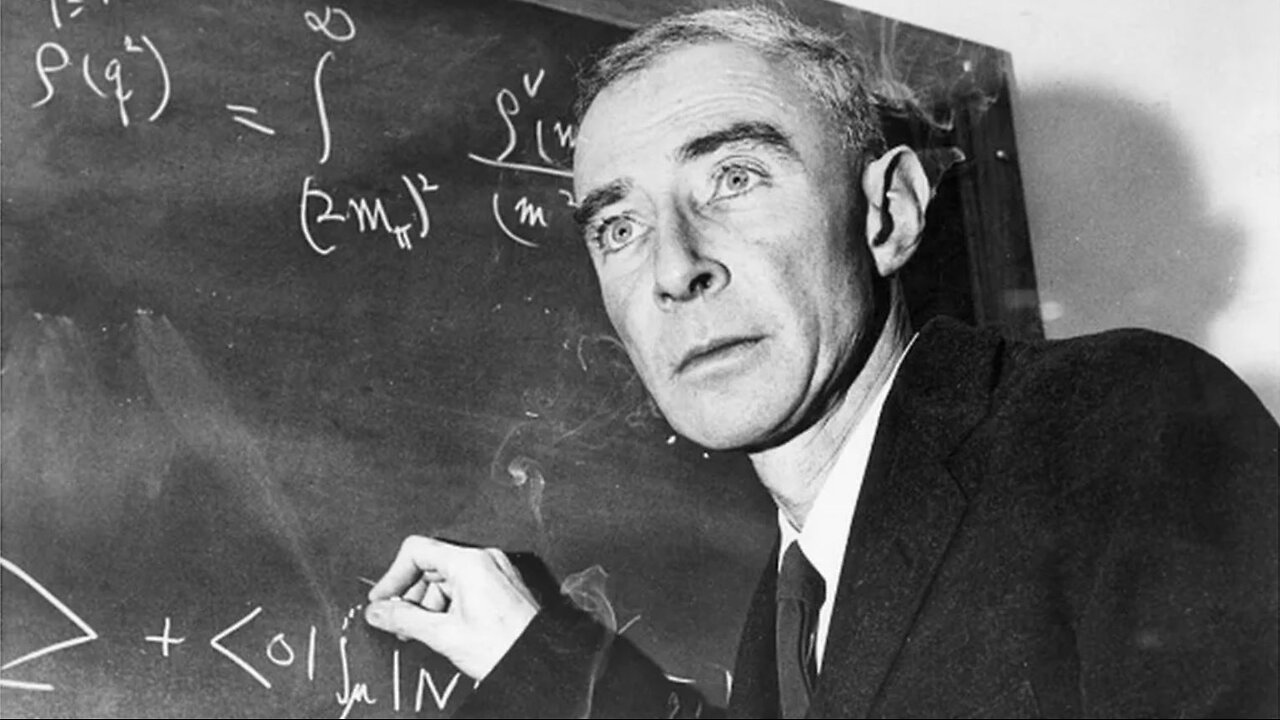
1995 Biography _ J. Robert Oppenheimer: Father of the Atomic Bomb
Biography
J. Robert Oppenheimer | Father of the Atomic Bomb |
The man chosen to build the world’s first nuclear weapon was neither a militaristic hawk nor a chest-thumping patriot. He was J. Robert Oppenheimer—scientist, bohemian, and radical. BIOGRAPHY® presents the ironic story of the man known as “the father of the atomic bomb.” Physics professor J. Robert Oppenheimer was plucked from the University of California at Berkeley to lead the army’s top secret Manhattan project in 1942. Three years later, his mission completed, the former professor became a government advisor on nuclear weapons. But true to his days at Berkeley, Oppenheimer chose to campaign against further development of nuclear arms. This controversial stance left an indelible mark on his short, charismatic life.
Produced by CLAYPOINT PRODUCTIONS in association with A&E NETWORK. Host JACK PERKINS, Executive Producer RICHARD O’REGAN, Producer/Director/Writer MARY DORE, A&E Director, Documentary Programming BILL HARRIS, A&E Executive Producer MICHAEL CASCIO.
©1995 Claypoint Productions, Inc. All Rights Reserved. BIOGRAPHY is a registered service mark of A&E Television Networks. Art and Design ©1995 A&E Television Networks. All Rights Reserved. Marketed in the U.S. by New Video Group, 126 Fifth Avenue, New York, NY 10011
Color, approx. 50 mins., VHS, Biography. Cat # AAE-14022
Uploader's note: Sourced from VHS cassette tape. I do not own the copyright on this content; it is presented here strictly for educational purposes. With that in mind, I urge you to donate to Archive.org and its mission to preserve the past digitally for future generations to enjoy.
The 1995 documentary "Biography—J. Robert Oppenheimer: The Father of the Atomic Bomb" explores the life of the brilliant physicist who led the Manhattan Project, a key figure in the development of the atomic bomb. The documentary, hosted by Jack Perkins, produced by Claypoint Productions in association with A&E Network, delves into Oppenheimer's early life, his contributions to nuclear physics, his leadership of the Manhattan Project, and his post-war role as a government advisor on nuclear weapons, according to the Internet Archive. It also covers his later advocacy against further development of nuclear arms.
Oppenheimer's Journey:
Early Life and Education:
The documentary likely begins with a glimpse into Oppenheimer's childhood as a precocious and solitary child, highlighting his intellectual curiosity and interests in mineralogy and poetry.
The Manhattan Project:
A significant portion of the documentary focuses on Oppenheimer's role as director of the Los Alamos Laboratory during the Manhattan Project. This section would likely explore the scientific challenges of developing the atomic bomb, the secrecy and pressure of the project, and Oppenheimer's leadership in gathering the best minds in physics.
Trinity Test and its Aftermath:
The documentary would undoubtedly cover the Trinity test, the first atomic bomb explosion, and Oppenheimer's personal reflections on the event, including his famous quote from the Bhagavad Gita: "Now I am become Death, the destroyer of worlds".
Post-War Years and Advocacy:
The documentary would also explore Oppenheimer's post-war efforts as a government advisor, his advocacy for international control of nuclear energy, and the controversy surrounding his security clearance revocation during the Red Scare.
Legacy and Moral Dilemmas:
The documentary likely concludes by examining Oppenheimer's complex legacy, his scientific brilliance, and the moral dilemmas he faced in creating a weapon of such destructive power.
Oppenheimer, Christopher Nolan's sweeping new biographical thriller about the "father of the atomic bomb", has opened to a glowing reception around the world. In India, it's been a hit too but some have protested against a scene depicting the scientist reading the Bhagavad Gita, one of Hinduism's holiest books, after sex. Oppenheimer learnt the ancient Sanskrit language and counted the book as one of his favourites.
In July 1945, two days before the explosion of the first atomic bomb in the New Mexico desert, Robert Oppenheimer recited a stanza from the Bhagavad Gita, or The Lord's Song.
Oppenheimer, a theoretical physicist, had been introduced to Sanskrit, the ancient Indian language, and subsequently the Gita, as a teacher in Berkeley years before. More than 2,000-year-old, Bhagavad Gita is part of the Mahabharata - one of Hinduism's greatest epics - and at 700 verses, the world's longest poem.
Now, hours before an event that would change history, the "father of the atomic bomb" relieved his tension by reciting a stanza he had translated from Sanskrit:
In battle, in forest, at the precipice of the mountains
-
 21:06
21:06
Nikko Ortiz
11 hours agoBodycam's Zombie Update Is Crazy...
2.01K1 -
 17:11
17:11
MetatronHistory
1 day agoMedieval Christianity in the Historical Context of Power
1.41K2 -
 2:16:21
Side Scrollers Podcast
17 hours agoTwitch has a SERIOUS Problem + Leaflit’s VIRAL Interview + More | Side Scrollers
38.9K13 -
 21:55
21:55
GritsGG
12 hours agoMega Win Streak On Warzone! Over 4100 Wins on BO6 WZ!
758 -
 20:22
20:22
The Pascal Show
1 day ago $2.61 earnedARE THEY IGNORING HER?! Is The White House & FBI Ignoring Candace Owens' A**assination Claims?!
25.1K14 -
 1:00:45
TruthStream with Joe and Scott
1 day agoMondays with Matt Geiger from Verity Metals: Gold, Silver, The Housing Market and more. Live 12/1 6pm pacific #519
4.11K -
 2:17:46
The Connect: With Johnny Mitchell
3 days ago $14.61 earnedA Sitdown With The Real Walter White: How An Honest Citizen Became A Synthetic Drug Kingpin
76.9K1 -
 2:40:08
PandaSub2000
9 hours agoDEATH BET | Solo Episode 01 (Edited Replay)
1.65K -
 LIVE
LIVE
Lofi Girl
3 years agolofi hip hop radio 📚 - beats to relax/study to
1,052 watching -
 2:03:38
Inverted World Live
7 hours agoSatanic Pedophile Network in Australia | Ep. 149
230K54