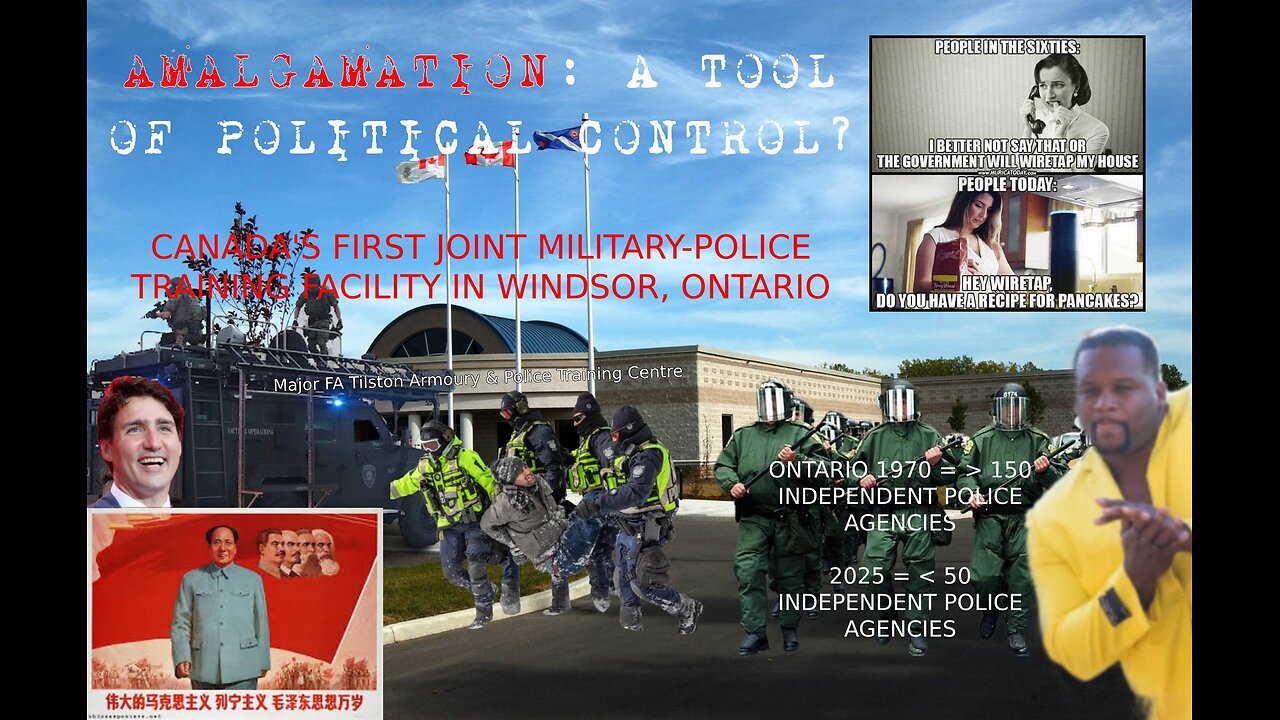
Police & City Amalgamation In Canada: Incremental Surveillance Society?
The militarization of police forces, marked by the integration of military gear, strategies, and mindset, presents numerous risks. These include a heightened likelihood of forceful responses, a breakdown of trust between law enforcement and communities, and the potential for disproportionate impacts on marginalized populations. This trend has been increasingly evident in Canada over the past five decades.
A significant milestone occurred in 2004 with the creation of a joint military-police training facility in Windsor, Ontario, known as the "Major FA Tilson VC Armory," which was justified by claims of "cost savings."
Similar assertions were made during the amalgamation of Ontario's police forces in the 1970s, which peaked in the 1990s. At that time, there were over 150 independent police agencies catering to various municipalities, from small towns to larger cities.
The same rationale was applied when independent cities merged into larger urban areas, such as the Greater Toronto Area (GTA) amalgamation in 1998. Many other cities have followed suit, with numerous others contemplating the consolidation of smaller municipalities into larger entities.
However, where is the cost efficiency in reduced competition? What individualized health strategies are in place to help keep communities healthier and reduce the likelihood of crime, thereby minimizing the need for extensive policing and the centralization of cities?
https://wikimapia.org/11556691/Major-FA-Tilston-Armoury-Police-Training-Centre
https://www.publicsafety.gc.ca/cnt/rsrcs/pblctns/mlgmtn-plc-srvcs/smmry-en.aspx
-
 15:30
15:30
IsaacButterfield
17 hours ago $0.22 earnedViolent Immigrant Crime Is Exploding in Australia
1K12 -
 8:37
8:37
DBoss_Firearms
7 hours agoHow hard is it to shoot with a G-Flex Trigger?
11 -
 1:05:17
BonginoReport
4 hours agoWhite House Claps Back At Sabrina Carpenter - Nightly Scroll w/ Hayley Caronia (Ep.189)
96.7K25 -
 1:06:50
TheCrucible
5 hours agoThe Extravaganza! EP: 69 (12/03/25)
66.6K18 -
 1:08:49
Kim Iversen
5 hours agoEpstein Island: What's With The Creepy Medical Chair and Masks?
41.2K37 -
 23:54
23:54
Jasmin Laine
6 hours agoCarney’s WORST Day EVER—BOOED, Fact-Checked, and Forced to FLEE the House
24.6K19 -
 1:59:47
Redacted News
5 hours agoDeep State Coup Coming for Trump? New JFK Files Released and NATO Preparing Attack on Russia
163K114 -
 7:31:43
Dr Disrespect
10 hours ago🔴LIVE - DR DISRESPECT'S TRIPLE THREAT CHALLENGE - ARC RAIDERS • BF6 • FORTNITE
102K8 -
 1:00:57
Russell Brand
8 hours agoThe Vaccine Ideology Unmasked | Dr Peter McCullough - SF658
128K39 -
 1:11:25
vivafrei
6 hours agoKash Patel's Jacket-Gate! Pfizer Whistleblower Qui Tam on Appeal! Meanwhile in Canada! AND MORE!
70.4K45