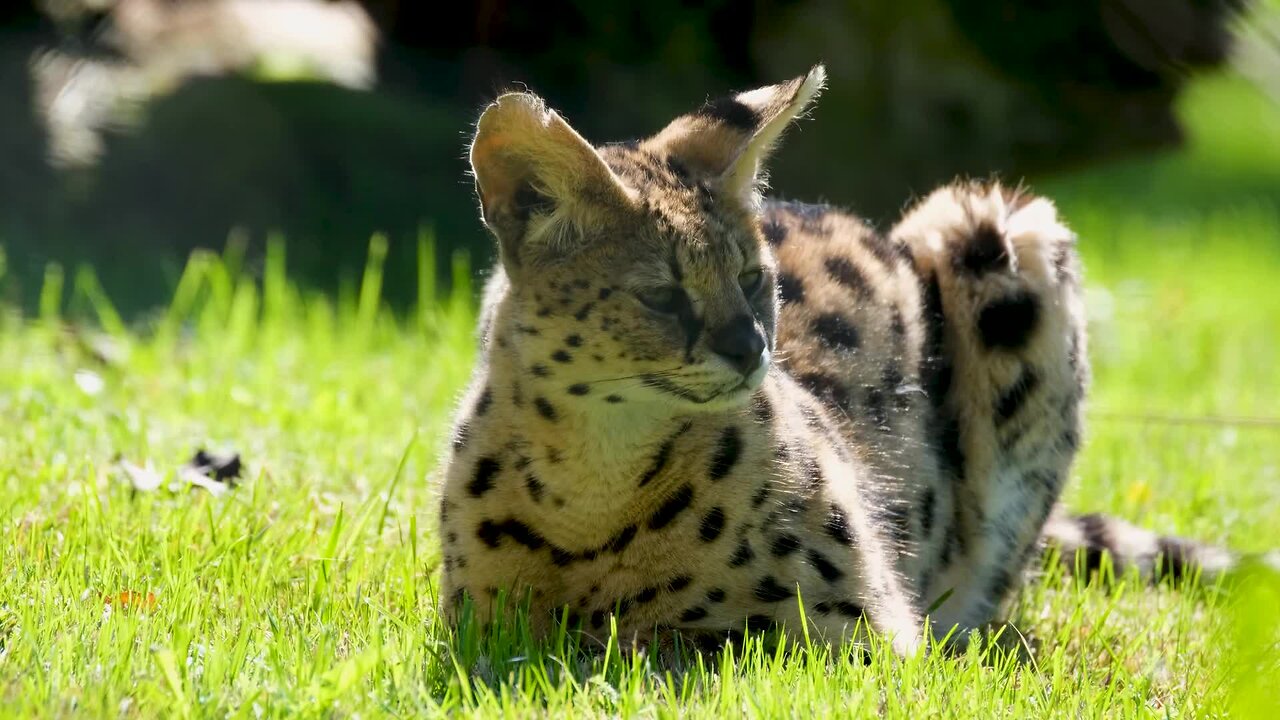
"Spotting the Serval: Africa’s Graceful Predator"
*Leptailurus serval* is one of the subspecies of the serval, a medium-sized wild cat native to Africa. This subspecies, like others of its kind, is particularly well-adapted to the African savanna and grassland ecosystems. Here’s a detailed overview: ### Physical Characteristics: - **Size:** The *Leptailurus serval serval* typically stands about 54-62 cm (21-24 inches) tall at the shoulder. Males are usually larger than females. - **Weight:** They usually weigh between 9-18 kg (20-40 lbs), with males being slightly heavier. - **Body Length:** The body length ranges from 67 to 100 cm (26-39 inches), excluding the tail, which adds an additional 30-40 cm (12-16 inches). - **Coat and Coloration:** The serval’s coat is striking, with a yellowish to orange background covered in black spots and stripes. This coat provides excellent camouflage in tall grass. The pattern of spots and stripes can vary between individuals, much like a fingerprint. - **Legs:** They have notably long legs, the longest of any cat relative to body size, which help them see over tall grasses and leap great distances. - **Ears:** Their large, rounded ears are another distinctive feature. These ears are crucial for detecting the high-frequency sounds made by their prey. ### Habitat: - **Geographical Range:** The *Leptailurus serval serval* is found across sub-Saharan Africa, particularly in regions with a good supply of water. They are commonly found in countries like South Africa, Botswana, Namibia, and parts of Zimbabwe. - **Preferred Environment:** Servals prefer environments with plenty of tall grasses, such as savannas, wetlands, and reed beds. They are also found in forest fringes and open grasslands. The presence of water is a critical factor in their habitat choice. ### Behavior and Ecology: - **Diet:** Servals are carnivorous and have a diverse diet. They primarily hunt small mammals, particularly rodents, which make up a significant portion of their diet. However, they are opportunistic hunters and will also prey on birds, insects, frogs, and fish. Their long legs and agile bodies allow them to leap high into the air to catch birds in flight or pounce on small mammals. - **Hunting Technique:** Servals are solitary hunters and are most active during dawn and dusk (crepuscular), though they can also be nocturnal. They use their large ears to locate prey by sound and then employ a combination of stalking, pouncing, and leaping to catch it. Their ability to leap vertically up to 3 meters (10 feet) allows them to snatch birds from the air. - **Territoriality:** Servals are solitary animals, with each individual maintaining a territory. Males tend to have larger territories than females, which they mark with scent markings such as urine and feces. ### Reproduction: - **Breeding:** Servals do not have a specific breeding season, though in some areas, breeding peaks are observed. Females come into estrus and are receptive to mating for a few days. After mating, the male leaves, and the female raises the young alone. - **Gestation and Birth:** The gestation period lasts about 74 days, after which the female gives birth to a litter of 1-4 kittens. The kittens are born in hidden locations like dense vegetation or burrows. - **Development:** The kittens are born blind and helpless but grow rapidly. Their eyes open after about 9-13 days. They begin hunting with their mother at about 6 months old and become independent around 12-18 months of age. ### Conservation Status: - **Threats:** While the *Leptailurus serval serval* is not currently endangered and is listed as "Least Concern" on the IUCN Red List, it faces threats from habitat loss, hunting, and trapping. In some areas, they are hunted for their beautiful pelts, or because they are perceived as threats to livestock, even though they rarely prey on domestic animals. - **Conservation Efforts:** Conservation efforts include habitat preservation and legal protections against hunting. In some regions, servals are protected by law, and there are efforts to mitigate human-wildlife conflict to ensure their survival. ### Unique Traits: - **Adaptability:** The *Leptailurus serval serval* is highly adaptable and can thrive in a variety of environments, provided there is adequate cover and prey availability. - **Communication:** Servals communicate using a variety of vocalizations, including high-pitched calls, growls, and purrs. They also use visual signals and scent markings to communicate with other servals. - **Lifespan:** In the wild, servals can live up to 10 years, but in captivity, they can live up to 20 years. The *Leptailurus servall* is a fascinating and agile predator, perfectly adapted to the African landscape. Its remarkable hunting skills, unique physical adaptations, and striking appearance make it one of the most intriguing members of the feline family.
-
 35:55
35:55
ZeeeMedia
14 hours agoPfizer mRNA in Over 88% of Human Placentas, Sperm & Blood | Daily Pulse Ep 156
5.43K99 -
 LIVE
LIVE
Pickleball Now
4 hours agoLive: IPBL 2025 Day 5 | Final Day of League Stage Set for Explosive Showdowns
261 watching -
 9:03
9:03
MattMorseTV
16 hours ago $14.63 earnedIlhan Omar just got BAD NEWS.
26.7K84 -
 2:02:41
Side Scrollers Podcast
20 hours agoMetroid Prime 4 ROASTED + Roblox BANNED for LGBT Propaganda + The “R-Word” + More | Side Scrollers
133K14 -
 16:38
16:38
Nikko Ortiz
15 hours agoVeteran Tactically Acquires Everything…
20.6K1 -
 20:19
20:19
MetatronHistory
2 days agoThe Mystery of Catacombs of Paris REVEALED
11.7K2 -
 21:57
21:57
GritsGG
19 hours agoBO7 Warzone Patch Notes! My Thoughts! (Most Wins in 13,000+)
18.1K -
 2:28:08
PandaSub2000
12 hours agoMyst (Part 1) | MIDNIGHT ADVENTURE CLUB (Edited Replay)
12K -
 1:12:43
TruthStream with Joe and Scott
5 days agoJason Van Blerk from Human Garage: Reset your life with Fascial Maneuvers,28 day reset, Healing, Spiritual Journey, Censorship, AI: Live 12/3 #520
24.6K4 -
 24:21
24:21
The Pascal Show
1 day ago $9.29 earned'CHALLENGE ACCEPTED!' TPUSA Breaks Silence On Candace Owens Charlie Kirk Allegations! She Responds!
43.7K27