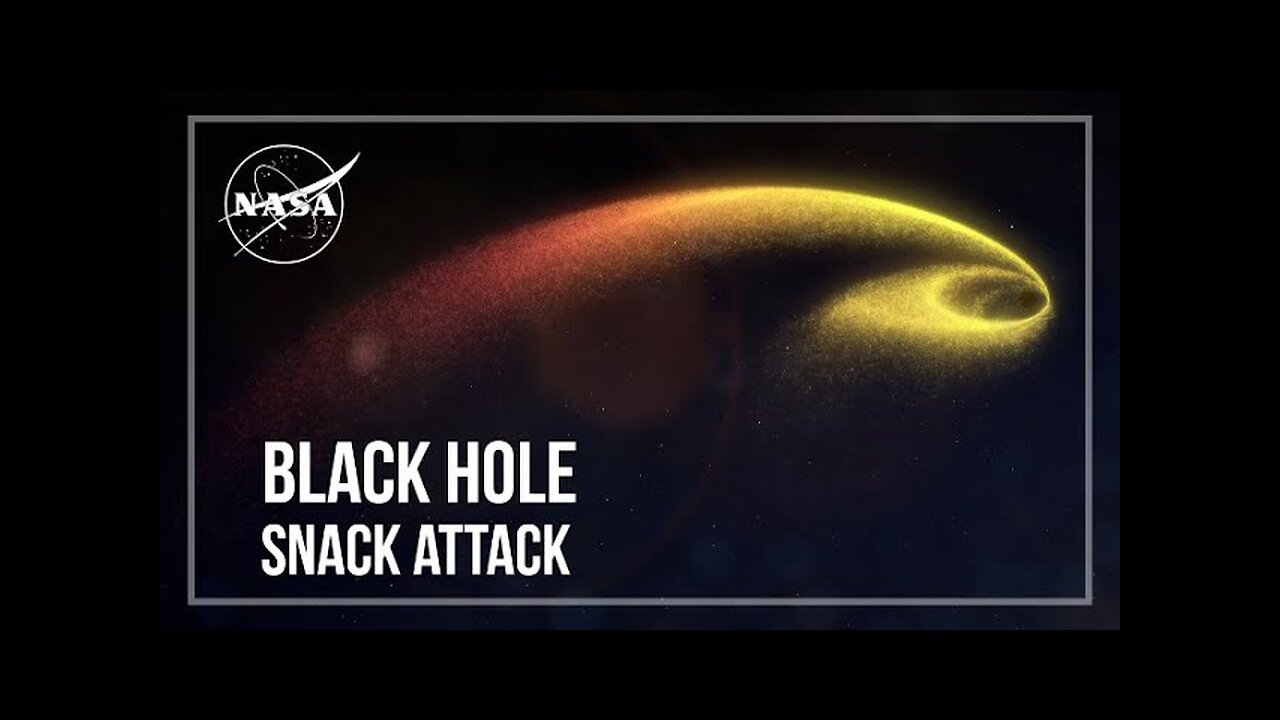
Black Hole Snack Attack
Using NASA’s Neil Gehrels Swift Observatory, which launched in 2004, scientists have discovered a black hole in a distant galaxy repeatedly nibbling on a Sun-like star. The object heralds a new era of Swift science made possible by a novel method for analyzing data from the satellite’s X-ray Telescope (XRT).
When a star strays too close to a monster black hole, gravitational forces create intense tides that break the star apart into a stream of gas. The leading edge swings around the black hole, and the trailing edge escapes the system. These destructive episodes are called tidal disruption events. Astronomers see them as flares of multiwavelength light created when the debris collides with a disk of material already orbiting the black hole.
Recently, astronomers have been investigating variations on this phenomena, which they call partial or repeating tidal disruptions.
During these events, every time an orbiting star passes close to a black hole, the star bulges outward and sheds material, but survives. The process repeats until the star looses too much gas and finally breaks apart. The characteristics of the individual star and black hole system determine what kind of emission scientists observe, creating a wide array of behaviors to categorize.
On June 22, 2022, XRT captured Swift J0230 for the first time. It lit up in a galaxy around 500 million light-years away in the northern constellation Triangulum. Swift’s XRT has observed nine additional outbursts from the same location roughly every few weeks.
Scientists propose that Swift J0230 is a repeating tidal disruption of a Sun-like star orbiting a black hole with over 200,000 times the Sun’s mass. They estimate the star loses around three Earth masses of material on each pass. This system provides a bridge between other types of suspected repeating disruptions and allowed scientists to model how interactions between different star types and black hole sizes affect what we observe.
Swift J0230’s discovery was possible thanks to a new, automated search of XRT observations called the Swift X-ray Transient Detector.
After the instrument observes a portion of the sky, the data is transmitted to the ground, and the program compares it to previous XRT snapshots of the same spot. If that portion of the X-ray sky has changed, scientists get an alert. In the case of Swift J0230, astronomers were able to rapidly coordinate additional observations of the region.
Music credit: "Teapot Waltz" by Benjamin Parsons from Universal Production Music
Credit: NASA's Goddard Space Flight Center
Producer: Sophia Roberts (AIMM)
Science writer: Jeanette Kazmierczak (University of Maryland College Park)
Editor: Sophia Roberts (AIMM)
Narrator: Sophia Roberts (AIMM)
Animator: Chris Smith (KBRwyle)
Project support: Scott Wiessinger (KBRwyle)
-
 21:57
21:57
GritsGG
15 hours agoBO7 Warzone Patch Notes! My Thoughts! (Most Wins in 13,000+)
49 -
 2:28:08
PandaSub2000
8 hours agoMyst (Part 1) | MIDNIGHT ADVENTURE CLUB (Edited Replay)
80 -
 1:12:43
TruthStream with Joe and Scott
5 days agoJason Van Blerk from Human Garage: Reset your life with Fascial Maneuvers,28 day reset, Healing, Spiritual Journey, Censorship, AI: Live 12/3 #520
4.62K4 -
 24:21
24:21
The Pascal Show
1 day ago $8.25 earned'CHALLENGE ACCEPTED!' TPUSA Breaks Silence On Candace Owens Charlie Kirk Allegations! She Responds!
27.2K13 -
 17:41
17:41
MetatronGaming
2 days agoI should NOT Have taken the elevator...
34 -
 LIVE
LIVE
Lofi Girl
3 years agolofi hip hop radio 📚 - beats to relax/study to
1,351 watching -
 1:20:23
Man in America
12 hours agoHow Epstein Blackmail & FBI Cover-Ups Are Fracturing MAGA w/ Ivan Raiklin
178K28 -
 2:13:49
Inverted World Live
7 hours agoSolar Storms Ground 1000 Planes | Ep. 151
106K6 -
 2:54:08
TimcastIRL
7 hours agoJ6 Pipe Bomb Suspect ARRESTED, Worked With BLM, Aided Illegal Immigrants | Timcast IRL
249K124 -
 3:59:02
Alex Zedra
6 hours agoLIVE! Bo7 Warzone
33.4K1