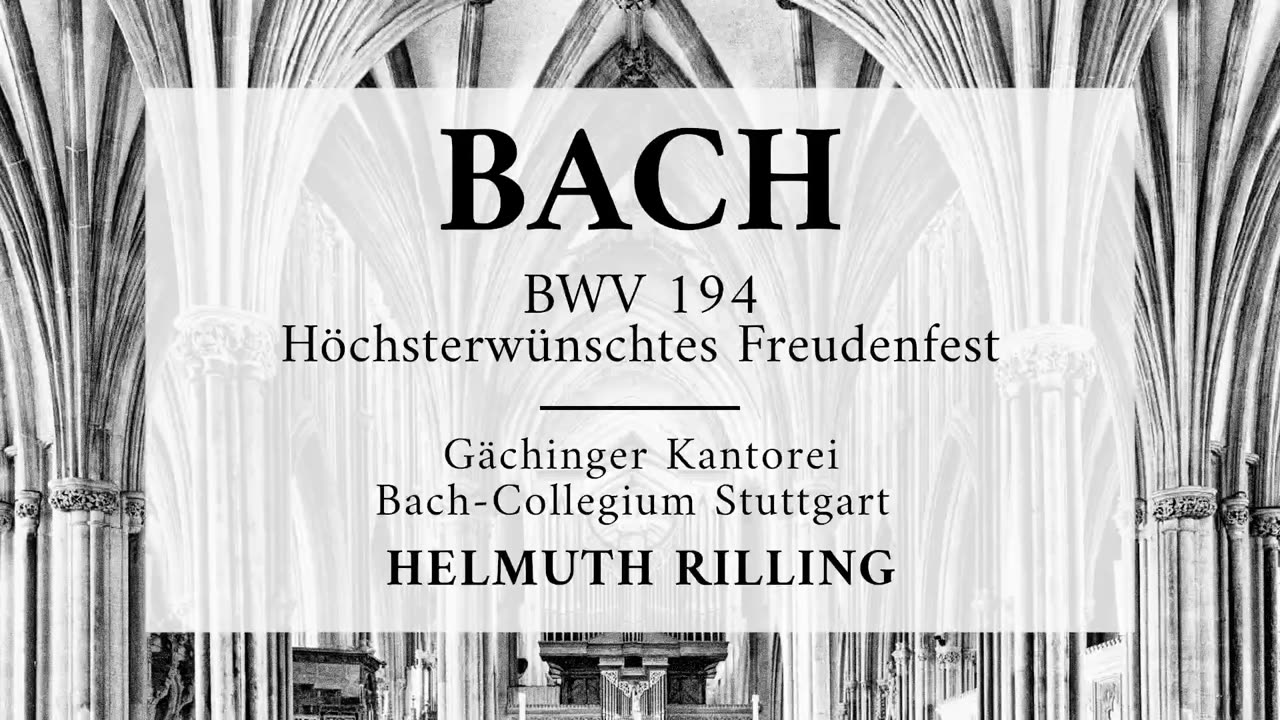
Cantata BWV 194, Höchsterwünschtes Freudenfest - Johann Sebastian Bach 'Helmuth Rilling'
Composition Year: 1723 in Leipzig
First Performance: 1723-11-02 in Störmthal
Dedication: Trinity Sunday - Dedication of the Church and the Organ at Störmthal
Recorded: Gedächtniskirche Stuttgart, Januar 1977
~
Performers:
Judith Beckmann – Soprano • Adalbert Kraus – Tenore • Walter Heldwein – Basso
Hansjörg Schellenberger, Hedda Rothweiler – Oboe • Günther Pfitzenmaier – Fagotto • Albert Boesen – Violino • Jürgen Wolf – Violoncello • Harro Bertz – Contrabbasso
Montserrat Torrent – Organo • Martha Schuster – Cembalo
~
Gächinger Kantorei Stuttgart • Bach-Collegium Stuttgart • Helmuth Rilling - Conductor
~
Prima Parte
00:01 1. Chorus: Höchsterwünschtes Freudenfest
06:55 2. Recitative (bass): Unendlich großer Gott, ach wende dich
08:24 3. Aria (bass): Was des Höchsten Glanz erfüllt
13:07 4. Recitative (soprano): Wie könnte dir, du höchstes Angesicht
14:54 5. Aria (soprano): Hilf, Gott, dass es uns gelingt
21:46 6. Chorale: Heilger Geist ins Himmels Throne
~
Seconda Parte
23:53 7. Recitative (tenor): Ihr Heiligen, erfreuet euch
25:31 8. Aria (tenor): Des Höchsten Gegenwart allein
31:10 9. Duet Recitative (soprano, bass): Kann wohl ein Mensch zu Gott im Himmel steigen
33:55 10. Duetto Aria (soprano, bass): O wie wohl ist uns geschehn
44:55 11. Recitative (bass): Wohlan demnach, du heilige Gemeine
45:54 12. Chorale: Sprich Ja zu meinen Taten
~
Work:
Höchsterwünschtes Freudenfest (Most highly desired festival of joy), BWV 194, is a church cantata by Johann Sebastian Bach. He composed it in Leipzig for dedication of the church and organ at Störmthal on 2 November 1723.
~
The cantata text was written by an anonymous poet, including two stanzas of Johann Heermann's hymn "Treuer Gott, ich muß dir klagen" (1630) and two stanzas of Paul Gerhardt's "Wach auf, mein Herz, und singe" (1647). Bach used an earlier secular cantata as a base for a structure in two parts of six movements each, beginning with an extended choral movement and concluding both parts with chorale stanzas. The inner movements are alternating recitatives and arias. The chorales are the only movements which were certainly newly composed for the occasion. Bach scored the work for three vocal soloists, a four-part choir and a Baroque instrumental ensemble of three oboes, bassoon, strings and continuo. After the first performance in Störmthal, Bach performed the cantata again in Leipzig for Trinity Sunday, first on 4 June 1724, a shortened version in 1726, and the complete version in 1731.
~
Bach Cantatas website: https://www.bach-cantatas.com/
~
ATTRIBUTION
Music contained in this video is licensed to, Hänssler-Verlag, Germany
-
 3:04
3:04
Classical Music P.D.
2 years agoCantata BWV 200, Bekennen will ich seinen Namen - Johann Sebastian Bach 'Helmuth Rilling'
105 -
 LIVE
LIVE
LFA TV
20 hours agoLIVE & BREAKING NEWS! | FRIDAY 12/05/25
975 watching -
![MAHA News [12.5] Glyphosate Study Retracted (MONSANTO), Vaccine News (COVID), DMSO Chat](https://1a-1791.com/video/fwe2/02/s8/1/0/u/D/F/0uDFz.0kob-small-MAHA-News-12.5.jpg) 1:01:00
1:01:00
Badlands Media
14 hours agoMAHA News [12.5] Glyphosate Study Retracted (MONSANTO), Vaccine News (COVID), DMSO Chat
35.1K5 -
 1:11:14
DeVory Darkins
6 hours agoJeffries SCRAMBLES After National Gas Prices hit record low amid AFFORDABILITY CRISIS
213K116 -
 56:44
56:44
The Quartering
6 hours agoSpam Calls Are Out Of Control, Candace Hits Rock Bottom & More Poison Food
60.6K97 -
 47:44
47:44
Tucker Carlson
6 hours agoRupert Lowe Warns of the Globalist Agenda Destroying the West and the Revolution Soon to Come
86K139 -
 1:16:03
Sean Unpaved
7 hours agoWill Miami Be "ODD MAN OUT" Of The College Football Playoff? | UNPAVED
35.8K1 -
 58:31
58:31
Jeff Ahern
4 hours ago $1.38 earnedFriday Freak out with Jeff Ahern
23.3K6 -
 27:03
27:03
The Kevin Trudeau Show Limitless
2 days agoThey're Not Hiding Aliens. They're Hiding This.
44.1K65 -
 2:04:26
The Culture War with Tim Pool
8 hours agoWoke Has INFECTED Goth, Punk, & Metal, MAGA Must Save the Art | The Culture War Podcast
147K68