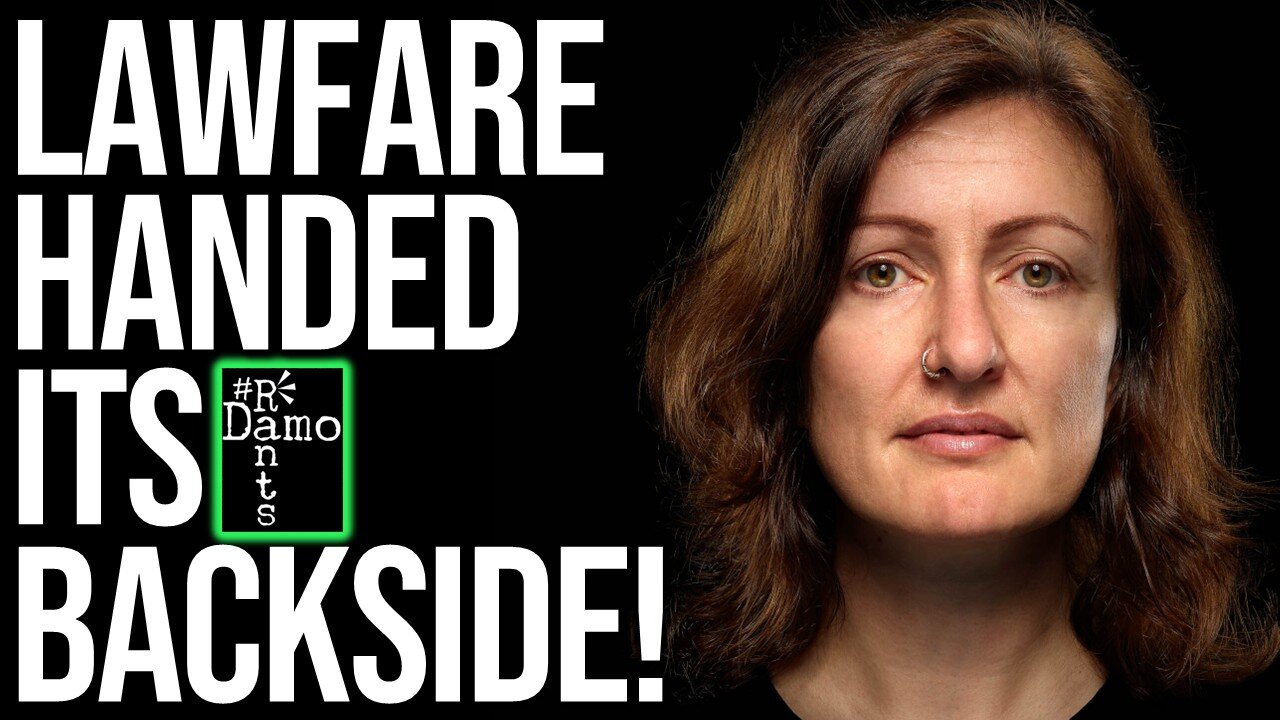
Starmer’s Political Policing Is on Trial — And The Courts Aren’t Done
Right, so you can tell when a government has run out of arguments to defend Israel, because that’s when it starts inventing terror threats out of thin air, and the Starmer crew just tried exactly that with Jersey based activist Natalie Strecker. They scraped four social media posts out of tens of thousands, mangled the digital evidence with a software bug, shipped in outside “help” to steer a prosecution Jersey didn’t need steering, and still couldn’t convince a court that a pacifist was secretly running a pro-Hamas fan club. It’s pathetic, but it’s also the clearest look yet at how desperate this government has become to make pro-Palestine voices disappear. They wanted a scalp. They got an acquittal. And in the process they’ve shown everyone that their big law-and-order posture, their lawfare against protesters and activists and pro Palestine voices is just political cowardice dressed up as national security.
Right, so it is hardly news to many of you I’m sure that something has gone very wrong inside a political system when a government tries to turn a human-rights activist into a terrorism suspect and ends up being exposed for how flimsy the whole operation is, and that’s the thing about this case that has just ended in acquittal in Jersey, the Natalie Strecker case, because once you strip out the courtroom formality, the titles, the press releases and the drama that comes of state authority, what you’re left with is a prosecution that never had the weight to carry the political purpose built into it, and that’s why it fell apart, because it wasn’t designed for scrutiny, it was designed for fear, and fear only works when nobody looks at it too closely. This is what lawfare looks like when the government overreaches, when the evidence isn’t strong enough to survive daylight, and when a court decides it isn’t going to sign off on a political message disguised as a security concern. And if you want to understand why this matters, you start with the basic truth that this case should never have existed in the first place.
Because the charge was terrorism, the label was terrorism, the framework was terrorism, and the punishment would have carried all the weight of that word even though the prosecution knew she hadn’t committed, planned or facilitated anything remotely connected to terrorism. They went after her because of words, pulled from the mass of her online activity and stripped of context, and even then they only used four posts, which tells you everything about the scale of what they were looking at and the scarcity of anything they could build a case out of. Four posts from tens of thousands, and those four were treated as proof of a political orientation the Crown wanted to paint as dangerous. It’s a dishonest way to build a case, and it’s a dishonest way to treat political speech, but dishonesty becomes convenient when the government wants an example, which is exactly what this felt like and nobody has turned dishonesty into their stock in trade, like Keir Starmer, our Pinocchio Prime Minister who’s nose should now be so long it can touch the moon. They saw an activist who talks plainly about genocide, apartheid and the political right of occupied people to resist, and they tried to turn that into criminal intent.
The structure of this case makes sense when you zoom out to what the Starmer government has been doing for the past year, because they’ve been treating pro-Palestine activism as a national-security problem, and that framing has been used to justify everything from workplace crackdowns to police surveillance to attempts to proscribe Palestine Action, currently going through Judicial Review of course. They’ve been trying to rewrite the boundaries of acceptable speech, and they’ve been hoping that institutions would follow their lead without needing to be pushed. So when Jersey police decided to map her online activity into a terrorism framework, they weren’t acting in isolation. They were operating inside a political weather system that said “this is fair game,” and they built the case accordingly. The problem came when they tried to make the evidence fit the politics rather than letting the evidence speak for itself, which is why they ended up admitting that a technical fault had corrupted the dataset and mis-attributed messages to her.
And once you say that, it’s game over, because digital evidence is supposed to be the backbone of prosecutions like this, and if that backbone is fractured, you can’t build anything stable on top of it. But the prosecution still pressed ahead because this was never really about the quality of the evidence. It was about the symbolism of putting a pro-Palestine activist on trial for terrorism. They needed the image, not the facts, because the image alone sends a message to thousands of people watching from the outside: we are watching you, we are mapping your words, we are treating your speech as suspicious, and you are one wrong phrase away from being dragged into a courtroom. That’s how lawfare works. It turns the legal system into a deterrent, not by securing convictions but by making people afraid of even being accused.
But the moment she stepped into a courtroom, the whole thing started to come apart, because courts, for all their flaws, still require some connection between allegation and evidence. And when you looked at what the prosecution actually had, there was nothing to sustain the weight of the charge. They didn’t have intent, because her posts were clearly political commentary rather than calls to action. They didn’t have incitement, because she didn’t name any proscribed group or express support for any. They didn’t have solid attribution, because the police had compromised the dataset. They didn’t have context, because they’d removed it themselves. And they didn’t have consistency, because they were trying to claim that someone described in their own documents as an “aspiring pacifist” was also someone trying to rally support for terrorism.
The contradiction is obvious, and the court saw it immediately, which is why the acquittal came down the way it did. The Jurats, the jury as it is known in Jersey - didn’t buy the interpretive leaps, and they didn’t buy the attempt to turn political phrasing into coded messages. They looked at the posts, and they saw what any reasonable person would see: anger, solidarity, frustration, the language of someone watching a mass atrocity unfold and refusing to stay quiet about it. And because intention matters, and because the law requires actual evidence of an invitation to support terrorism, the Crown couldn’t bridge the gap between what they wanted the posts to mean and what the posts actually said. So the court did its job, and the case fell apart.
Where this becomes even more serious is the allegation that the UK government sent one of its senior barristers, a KC no less, to help shape the prosecution, because if that is accurate - and the reporting says it is, this is claim made on video by former MP Chris Williamson, who was there in Jersey for the first day of the trial to Steve Walker of Skwawkbox and the Canary - then this wasn’t simply a local misjudgement but a political intervention. It means the UK government wasn’t content to let Jersey run its own trial, because they wanted Judge and Jurat, to disregard international law in this case. Well why would the Starmer government do such a thing and want such a directive carried out in the name of the law? They wanted influence, guidance, oversight, control, depending on how far you think that intervention went, and they wanted it in a case that was politically convenient for them. The government has been using the concept of terrorism to silence, intimidate or discipline pro-Palestine voices across the country, and the Strecker case was a perfect chance to extend that strategy into the courts. They just totally miscalculated. They thought the court would take the prosecution’s story at face value. It didn’t.
And this is where the stakes widen beyond the borders of the island, because the collapse of this case undermines the government’s attempt to redraw the meaning of terrorism. They’ve been trying to shift it away from violence and planning and towards political dissent, and they’ve been hoping that the public wouldn’t notice. But Strecker’s acquittal has shown that when someone challenges that shift with actual legal scrutiny, the government’s logic collapses, because it can’t be defended with evidence. It relies on inference, suspicion, association and atmospherics, all of which evaporate in a courtroom. And once the state is forced to make its argument openly, the contradictions become visible.
The other part of this story is media behaviour. Independent outlets laid out the political nature of the case, the weak evidence, the state interference, the broader crackdown, the whole pattern, I’ve spoken of this case previously as well. They told the story as it was. Meanwhile, some mainstream outlets have covered the case too, but they treated it as a conventional terror trial. None have probed or framed it as part of the broader crackdown on pro-Palestine activism. And that silence is part of the machinery too. It protects the government from public scrutiny while the prosecution does its work. It depoliticises political repression by pretending it’s standard procedure. And it allows the government to operate in the space between public ignorance and institutional compliance. So when independent media exposed the interference and the political project behind the trial, they weren’t offering opinion. They were filling the void left deliberately by legacy media.
And this silence matters because if the prosecution had succeeded, it would have rewritten the boundaries of political speech. It would have allowed the government to treat phrases like “the resistance” as extremist indicators. It would have blurred the line between anti-genocide activism and terrorism. It would have let prosecutors draw meaning out of sentiment rather than evidence. And it would have created a chilling effect on thousands of people who now see that speaking plainly about what is happening in Gaza can make you a target. The court stopped that from becoming a legal precedent, but the fact that the government tried to push it as far as it did, interfering as has been claimed, shows how quickly these boundaries can shift when political incentives align.
And this is the real warning from the Strecker case. Lawfare doesn’t rely on winning. It relies on wearing people down. It relies on the weight of accusation. It relies on fear. The state doesn’t need to convict you for terrorism to make you feel like you’re carrying the label. It just needs to prosecute you, and let the public imagination do the rest. Strecker was acquitted, but she still had to endure the process, the stigma, the headlines, the time, the cost, the intrusion. And that’s the point. The process is the punishment, even when the verdict isn’t.
But sometimes the government picks the wrong target, and the case unravels, and when that happens the state’s motives become visible. This was political. It was constructed. It was flimsy. It was opportunistic. And it was aligned with a wider project to make pro-Palestine speech dangerous. The acquittal doesn’t mean the project stops. It means they misjudged this one. And now the rest of us can see exactly how they’re doing it and be mindful of that.
They tried to criminalise a political position. They tried to twist the meaning of terrorism. They tried to use the courts to send a message. And the court sent one back. The case collapsed because it had nothing underneath it. And when a government’s lawfare breaks open like that, it tells you what kind of government you’re dealing with.
And the thing you notice, once the dust settles and the judgement is out, is that the government doesn’t rush to explain why it backed a case this weak, or why the prosecution was allowed to lean on corrupted data, or why the broader political context has been pushing police forces, employers and institutions to treat pro-Palestine speech as dangerous. They go quiet, because quiet is safer than admitting the obvious, which is that this case was never about the posts themselves. It was about the politics behind them. It was about turning political dissent into a threat the government could manage through the courts rather than through public debate, which they’ve been losing for a long time because the facts in Gaza have been impossible to disguise. And when you can’t win an argument honestly you start redefining what the argument is, which is exactly what this government has been doing by shifting dissent into the domain of extremism.
The irony is that the government’s own behaviour during the trial made the political motive clearer, not less. The decision to treat vague solidarity language as terror support only makes sense if you assume the state was looking for something symbolic to display. The decision to rely on unstable evidence only makes sense if the political value of the prosecution outweighed the legal risk of losing. The decision to escalate the case in this way only makes sense if you see this as part of a broader policing strategy that treats criticism of Israel as inherently subversive. And the decision to intervene — allegedly with a senior barrister shipped across jurisdictions — only makes sense if someone understood the trial’s importance inside the government itself. None of these are normal features of a routine terrorism case. These are features of a political project.
And because the court rejected the prosecution’s story, what’s left in the public record is the architecture of that project, exposed because the government misjudged its own evidence. And you can see the same architecture everywhere else in the country. You see it when NHS staff are disciplined for speaking about Palestine. You see it when protest movements are treated as extremist threats. You see it when people are sacked or investigated for using perfectly legal political slogans. You see it when employers adopt state talking points and treat them as policy. What happened to Strecker is one instance in a pattern that has been tightening across the entire political landscape, because lawfare doesn’t spread through grand declarations. It spreads through repeated acts of institutional caution and state pressure that turn political positions into liabilities, one workplace at a time, one policing decision at a time, one prosecution at a time.
So when the Strecker case collapsed, it didn’t just collapse because the evidence was weak. It collapsed because the prosecution tried to do too much with too little, because it leaned on political assumptions instead of legal ones, and because the court wasn’t willing to give the government what it wanted. And that’s the most interesting part of the whole story: the government thought it would win. They thought the climate they’d built was strong enough to carry the case. They thought invoking terrorism would be enough to make the court defer. They thought the symbolic weight of the accusation would do the heavy lifting. They thought the defence wouldn’t be able to break apart the narrative. And they thought the public wouldn’t notice the political implications if the verdict went the other way. In other words, they thought this was safe.
They were wrong. And that wrongness tells you something about how confident this government has become in using the law to shape political realities, and how risky that confidence is when the facts don’t cooperate. The facts were the problem here. They didn’t match the accusation. They didn’t fit the story. They didn’t give the prosecution what it needed. And because of that mismatch, the case fell through the floor. And when that happens, the state loses not just the case but the image of authority it was hoping to project, because nothing looks weaker than a government caught stretching the law to make a political point, especially when the court refuses to go along with it.
And the collapse matters because it slows the project down. It doesn’t stop it, but it slows it. It forces the government to reconsider how far it can push the terrorism framework into political speech. It forces prosecutors to think twice before building another case this thin. It forces police to realise they might end up testifying about software bugs in front of a tribunal that isn’t inclined to indulge them. And it forces the public to confront the possibility that the terrorism label is being used for political management rather than public safety. These are not small consequences. They reshape how the next case is built, and they remind people watching that the government’s narrative is not always the law, even if it wants to be.
There’s a deeper issue here, which is the health of British democracy itself, because democracies don’t criminalise political dissent unless they feel threatened by it, and they don’t treat solidarity movements as security problems unless they’ve already decided that public opinion is the enemy. And when a government starts using terrorism laws to discipline political speech, it’s a sign that something is broken. The Strecker trial exposed that break because it showed how easily the government will reach for its harshest tools when confronted with a political position it doesn’t want to see grow. And it showed how vulnerable activists become when the line between dissent and extremism is controlled by a government with an ideological stake in blurring it.
But the trial also showed that the state’s power is not absolute. It showed that when someone forces the government to argue openly, to justify its claims, to expose its evidence, the machinery can be made to stall. It showed that courts still have the capacity to resist political pressure. And it showed that independent media, acting outside the constraints of billionaire ownership and political patronage, can break stories that mainstream outlets would rather ignore. The fact that the allegation of government interference came from independent reporting is not a coincidence. It’s a reminder that real journalism survives outside the legacy media system, and that without it this case might have looked like a routine prosecution instead of what it was: an attempt to set a political precedent through legal intimidation.
The final thing to say is this. Strecker’s acquittal doesn’t undo the damage the government intended to inflict, because the point of lawfare is not the verdict but the ordeal. The process is the punishment, and the government got the process even if it didn’t get the conviction. But it also didn’t get the precedent, and that matters. It didn’t get the chilling effect it wanted, because now people can see the weakness in the strategy. It didn’t get a court to endorse its attempt to conflate political solidarity with terrorism. And it didn’t manage to turn Strecker into an example for others. Instead, it turned itself into an example of political overreach, exposed in open court.
So yes, this was a collapse. Not just of a case, but of a strategy. And the government won’t say it out loud, but it knows what this verdict means. It means the lawfare isn’t as tight as it thought. It means the courts aren’t as compliant as it assumed. It means independent media has the power to disrupt the state’s preferred story and more people need to embrace that, so support your favourite outlets. And it means activists now have a clear demonstration that when you push back hard enough, even a government determined to silence you can be forced to retreat.
That’s the lesson here. They pushed. She pushed back. And the case fell apart because the truth was stronger than the story the government tried to construct.
Massive congratulations and much love and solidarity from this channel to Natalie Strecker, this is very much the early Christmas present she deserved.
As aforementioned there are similar shenanigans going on within the NHS right now as well, and once again it is independent media calling it out, so check out the details of the threat to our health service and those working in it with more pro Israel diktat here.
Please do also hit like, share and subscribe if you haven’t done so already so as to ensure you don’t miss out on all new daily content as well as spreading the word and helping to support the channel at the same time which is very much appreciated, holding power to account for ordinary working class people and I will hopefully catch you on the next one. Cheers folks.
-
 20:52
20:52
Exploring With Nug
2 hours ago $11.15 earnedTwo Missing People, One Missing Truck — What’s in the River?
51.3K1 -
vivafrei
5 hours agoBREAKING: Jan. 6 Pipe Bomber Prosecutor is the SAME ONE Who Prosecuted Enrique Tarrio?
117K37 -
 35:16
35:16
Tactical Advisor
3 hours agoNew Pivoting Rifle for Backpacks | Vault Room Live Stream 048
24.2K -
 LIVE
LIVE
Amish Zaku
7 hours agoRumble Spartans December Event
88 watching -
 LIVE
LIVE
OhHiMark1776
5 days ago🟢12-06-25 ||||| HMR. 21: King of the Hill ||||| Halo MCC (2019)
88 watching -
 20:08
20:08
MYLUNCHBREAK CHANNEL PAGE
10 hours agoThe Field Museum is From Another Timeline
69K17 -
 LIVE
LIVE
BigTallRedneck
2 hours agoRUMBLE SPARTANS HALO NIGHT
124 watching -
 LIVE
LIVE
AirCondaTv Gaming
3 hours ago $0.45 earnedHalo: The Master Chief Collection - Conda a Clause is Spreading some Plasma Holiday Cheer (Collab)
41 watching -
 3:22:01
SpartakusLIVE
6 hours agoSOLOS on ARC Raiders || WZ Stream LATER
134K2 -
 LIVE
LIVE
GritsGG
8 hours agoBO7 Warzone Is Here! Win Streaking! New Leaderboard?
142 watching