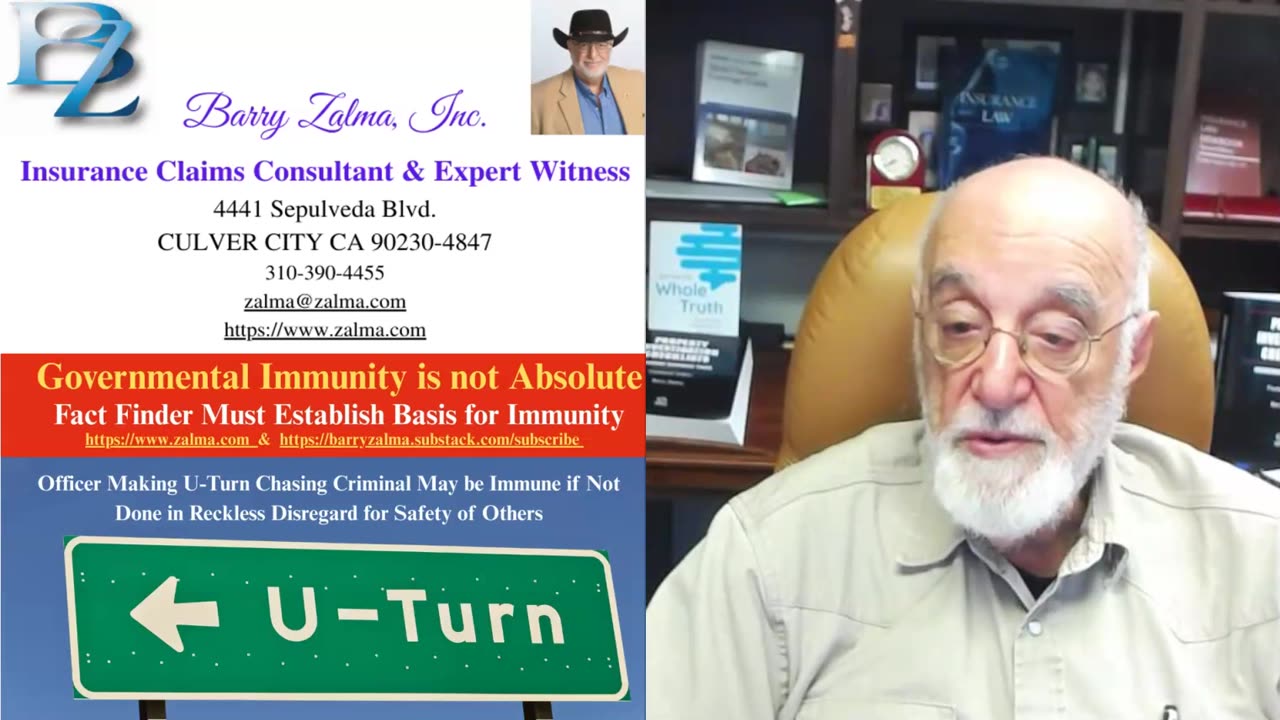
Governmental Immunity is not Absolute
Fact Finder Must Establish Basis for Immunity
Post 5236
Officer Making U-Turn Chasing Criminal May be Immune if Not Done in Reckless Disregard for Safety of Others
In Robert Young v. Officer John Doe et al. No. 2025 CA 0527 (La. App. 1st Cir. November 22, 2025) Robert Young sued Sid J. Gautreaux, III, in his official capacity as Sheriff of East Baton Rouge Parish (the “Sheriff”), and multiple insurance companies. The Sheriff’s Office and an unnamed deputy were not part of the summary-judgment ruling on appeal.
Procedural Posture
The trial court granted Sheriff’s motion for summary judgment, dismissed all claims against the Sheriff with prejudice, holding that La. R.S. 32:24 immunity applied and that Deputy Miller’s conduct did not rise to reckless disregard/gross negligence.
Key Facts
On July 19, 2019, Highway 19 Deputy Kevin Miller (EBR Sheriff’s Office) was responding to assist in a foot pursuit of fleeing suspects; his emergency lights were activated; sirens had been on earlier but were off at the moment of the collision. The Deputy said he was traveling northbound and began a U-turn after the suspect ran past him. Young says the deputy was parked/stationary on the northbound shoulder, then abruptly pulled out and executed a U-turn directly in front of him without warning.
Young was traveling northbound in the inside (left) northbound lane at normal or reduced speed. Deputy Miller initiated a U-turn into the southbound lanes to pursue/block the suspect; the front of Young’s vehicle struck the passenger side of the deputy’s Tahoe. Young suffered shoulder/neck injuries requiring surgery.
Controlling Statute: La. R.S. 32:24 (Emergency Vehicle Privileges)
Subsections A–C grant privileges to emergency vehicles responding to calls or in pursuit provided audible/visual signals are used sufficient to warn motorists.
These privileges do not relieve the driver of the duty of due regard for the safety of others and do not protect the driver from the consequences of reckless disregard for the safety of others. Emergency-vehicle drivers are liable only for reckless disregard (defined by Louisiana courts as gross negligence), not ordinary negligence.
Legal Standards Applied by the Court of Appeals
Statutory immunity under La. R.S. 32:24 is an affirmative defense. The governmental defendant bears the initial burden. Immunity statutes are strictly construed against the party claiming immunity.
On summary judgment, all factual inferences and doubts are resolved against the mover and in favor of trial on the merits. Summary judgment is rarely appropriate when reasonableness, state of mind, or degree of care (ordinary vs. gross negligence/reckless disregard) are at issue, because those determinations usually require weighing evidence and credibility assessments.
Genuine Issues of Material Fact Identified by the Appellate Court
The appellate court found multiple disputed material facts that precluded summary judgment:
Whether Deputy Miller was moving northbound (straddling lanes) or parked/stationary on the shoulder immediately before initiating the U-turn.
Whether adequate visual or audible signals were used immediately before/during the U-turn maneuver sufficient to warn northbound traffic.
Conflicting descriptions of the overall scene (location of suspects, other officers, traffic, etc.).
Because the disputes went to the heart of whether the statutory privileges were properly invoked, and whether the deputy’s conduct rose to reckless disregard/gross negligence, the court held that the Sheriff failed to carry his burden.
CONCLUSION
The appellate court reversed the trial court’s grant of summary judgment. The resolution was based upon Louisiana’s emergency-vehicle immunity under La. R.S. 32:24 is not absolute.
When material facts are disputed about the driver’s position, the adequacy of warnings, and the overall circumstances of an abrupt maneuver (here, a U-turn across traffic), summary judgment on the reckless-disregard/gross-negligence exception is improper. The case must go to a fact-finder (jury or judge) to determine whether the deputy’s actions amounted to reckless disregard for the safety of others.
ZALMA OPINION
The insurance issues will be determined by the findings of the trial court whether the deputy's actions were reckless disregard for the safety of others. If so, he and the Sheriff's office will be found liable and if not, they can be found immune and the insurers may not be required to indemnify the defendants.
(c) 2025 Barry Zalma & ClaimSchool, Inc.
Please tell your friends and colleagues about this blog and the videos and let them subscribe to the blog and the videos.
Subscribe to my substack at https://barryzalma.substack.com/subscribe
Go to X @bzalma; Go to Barry Zalma videos at Rumble.com at https://rumble.com/account/content?type=all; Go to Barry Zalma on YouTube- https://www.youtube.com/channel/UCysiZklEtxZsSF9DfC0Expg; Go to the InsuranceClaims Library – https://lnkd.in/gwEYk.
-
 8:24
8:24
Insurance Law
9 hours agoLife Insurance Policy Rescinded for Lies on Application
14 -
 LIVE
LIVE
LFA TV
20 hours agoLIVE & BREAKING NEWS! | TUESDAY 12/02/25
1,297 watching -
 LIVE
LIVE
John Crump Live
3 hours agoDLD Makes His Case For Micro Influencer of The Year
85 watching -
 LIVE
LIVE
freecastle
6 hours agoTAKE UP YOUR CROSS- Then you will call on ME and come and pray to ME, and I will LISTEN to you."
230 watching -
 1:48:12
The HotSeat With Todd Spears
2 hours agoEP 218: God Bless America, Why Not America Bless GOD? Pt 2
13.3K12 -
![[Ep 804] HOAX or War Crime? Dems Hysteria | Hakeem’s Threats| Guest Sam Anthony [your]NEWS](https://1a-1791.com/video/fwe2/1c/s8/1/u/K/V/E/uKVEz.0kob-small-Ep-804-HOAX-or-War-Crime-De.jpg) LIVE
LIVE
The Nunn Report - w/ Dan Nunn
2 hours ago[Ep 804] HOAX or War Crime? Dems Hysteria | Hakeem’s Threats| Guest Sam Anthony [your]NEWS
207 watching -
 52:43
52:43
Right Side Broadcasting Network
5 hours agoLIVE REPLAY: President Trump Makes an Announcement at the White House - 12/2/25
57.8K22 -
 47:27
47:27
The White House
4 hours agoPresident Trump Makes an Announcement, Dec. 2, 2025
26.9K24 -
 53:14
53:14
Professor Nez
4 hours ago🇺🇸 Trump’s SECRET Weapon for American Families (LIVE)
30.8K37 -
 1:07:14
DeVory Darkins
4 hours agoBREAKING: Washington Post suffers Major SETBACK after Hegseth story gets debunked
127K75