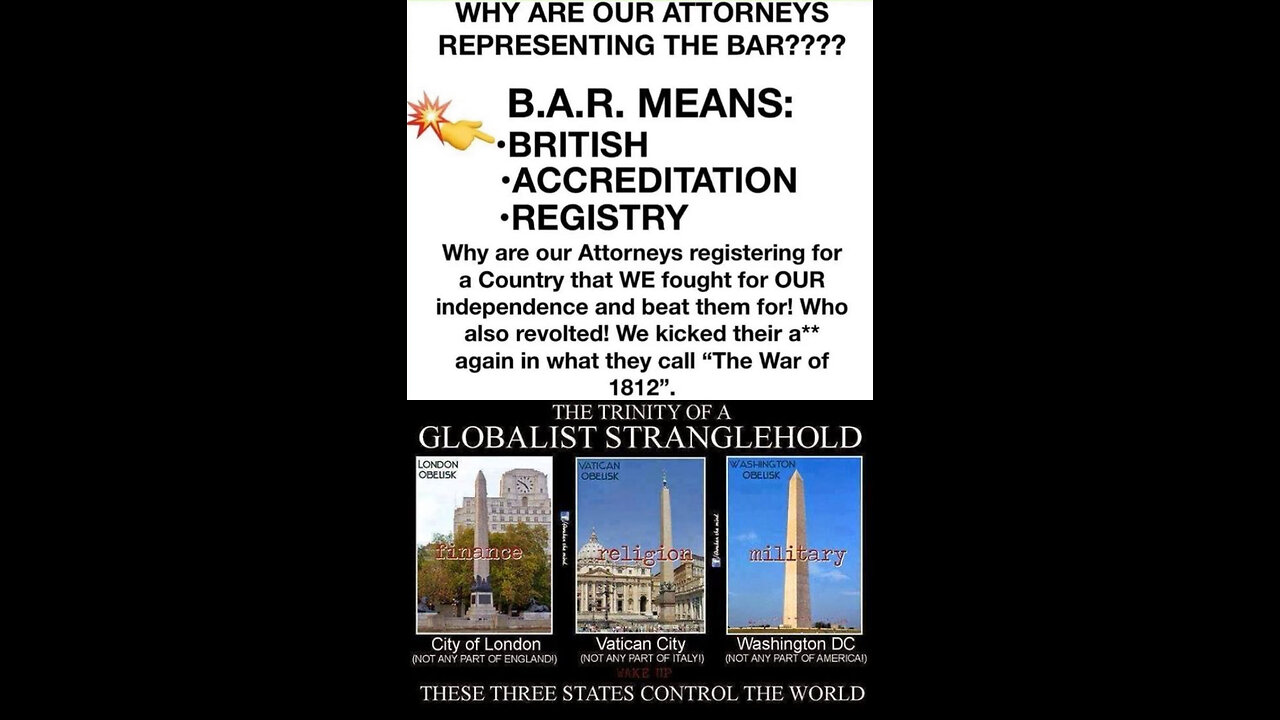
THE BAR AND THE CONTINUITY OF LEGAL POWER
A SPECULATIVE ANALYSIS OF IMPERIAL JURISDICTION IN MODERN PROFESSIONAL LAW**
I. INTRODUCTION: LAW AS THE STRUCTURE THAT SURVIVES REVOLUTIONS
Revolutions overthrow governments, constitutions reorganize institutions, but the legal profession—its rites, its language, its internal hierarchies—persists with striking uniformity. This endurance raises a serious theoretical question:
Does the modern BAR represent not merely a regulatory guild, but the latest iteration of a trans‑historical architecture of legal sovereignty—one that outlasts empires and quietly transmits their logic into successor states?
This analysis does not argue intentional conspiracy; rather, it examines why certain ideas about bar associations feel plausible: because legal power has historically been organized through transnational, semi‑autonomous orders whose influence endured long after the flags above them changed.
⸻
II. ANCIENT PRECEDENTS: THE CLOSED ARCHITECTURE OF THE LEGAL CASTE
The earliest legal systems were never democratic.
They were closed epistemic communities, built on restricted literacy and specialized interpretation.
• Mesopotamian scribes controlled property and taxation through cuneiform registries.
• Egyptian legal priests mediated between royal decrees and social enforcement.
• Israelite Levites held a hybrid spiritual‑legal role, interpreting codes accessible only to initiates.
These groups served not rulers, but the continuity of the legal order itself. Kings came and went; the scribal machinery endured, maintaining an unbroken institutional memory.
The precedent was established early:
To control law is to control sovereignty without needing to sit on the throne.
⸻
III. THE ROMAN JURISTS: LAW AS AN IMPERIAL LANGUAGE
Rome transformed this scribal heritage into a professional class of jurists whose authority became quasi‑sovereign.
Roman legal governance had three critical features:
1. A universalist legal framework (jus gentium) usable across diverse territories.
2. A maritime-commercial system (admiralty law) operating across borders and flags.
3. A professional juristic class who acted as custodians of precedent, not servants of emperors.
These jurists linked the empire not through armies but through binding norms, registries, and procedural authority.
When Rome fell, this class did not disappear—it fragmented into:
• canon lawyers under ecclesiastical jurisdiction,
• civil-law notaries,
• commercial judges along international trade routes.
The structure survived the empire that created it.
⸻
IV. MEDIEVAL GLOBALIZATION: MERCHANT LAW AND TRANSNATIONAL ACCREDITATION
Between the 11th and 15th centuries, a new legal architecture emerged that did not belong to any single crown:
the Lex Mercatoria, the law of merchants.
It had defining traits:
• It governed international commerce.
• It required standardized procedures.
• It was enforced by accredited professionals, not monarchs.
• It operated on principles of maritime jurisdiction, inherently transnational.
Accreditation—and loyalty—was owed to the order of practitioners, not to the governments they served. This created the earliest modern legal “registry”: a list of recognized, trained, and trusted legal actors who could operate across borders.
This is the conceptual ancestor of the modern bar roll.
⸻
V. THE ENGLISH INNS OF COURT: THE FORMALIZATION OF A LEGAL CASTE
By the 13th century, England consolidated Roman, canon, and mercantile influences into the Inns of Court—Middle Temple, Inner Temple, Lincoln’s Inn, Gray’s Inn.
These were not universities.
They were not guilds.
They were not state agencies.
They were autonomous legal jurisdictions, with:
• their own governance,
• their own courts,
• their own internal discipline,
• their own rites of initiation,
• and their own registries of admitted members.
Within their precincts, royal authority was limited.
Even today they maintain peculiar constitutional status within the United Kingdom.
From these Inns emerged the modern figure of the lawyer—trained by a professional order that, while operating within the nation, was never fully of the nation.
The symbolic architecture—oaths, titles such as “Esquire,” ceremonies “calling one to the bar”—was designed to signal entry into a lineage older than the state itself.
⸻
VI. CONTINUITY THROUGH REVOLUTION: THE AMERICAN ADOPTION
When the United States broke from Britain, the codes of law did not.
• Contracts
• Property registries
• Maritime law
• Legal procedure
• Professional customs
All remained essentially British in structure, because replacing them would have dissolved every debt, title, and commercial instrument in the new republic.
Thus, after 1776, America had political independence without legal discontinuity. Even American judges in the early republic cited:
• Blackstone’s Commentaries,
• London court precedents,
• and principles derived from the Inns.
The profession remained structurally English, even as it became nationally American.
⸻
VII. BAR ASSOCIATIONS: MODERN REGISTRY, ANCIENT LOGIC
American bar associations in the late 19th and early 20th centuries did not invent a new profession—they formatted an old legal architecture into a modern administrative shell.
Consider their key features:
• Admission controlled by examination and oath
• A centralized roll of licensed practitioners
• Disciplinary authority independent of legislatures
• A monopoly over legal representation
• Rules of ethics prioritizing duty to the “court” and “profession” over individual clients
This structure closely mirrors:
• Roman juristic orders,
• medieval notarial registries,
• merchant-law accreditation networks,
• and the Inns of Court.
Whether or not one invokes foreign influence, the continuity is unmistakable:
The BAR functions as a self-regulating legal caste whose internal sovereignty rivals that of the states it operates within.
Its loyalty is to the professional order and the stability of the legal system—not to any particular government.
⸻
VIII. WHY THE BRITISH ACCREDITATION REGISTRY THEORY PERSISTS
Even though “British Accreditation Registry” is not a historically documented entity, the theory persists because it articulates something structurally true:
• That the legal profession behaves like a transnational order.
• That bar membership resembles entry into an ancient registry.
• That professional loyalty often supersedes national allegiance.
• That the logic of legal authority predates and transcends the nation-state.
• That English legal architecture continues to shape American law.
The theory’s factual claims may not hold, but its structural diagnosis resonates:
People sense that lawyers do not merely represent clients; they represent the legal order itself—a lineage much older than the United States.
⸻
IX. CONCLUSION: THE BAR AS THE MODERN FACE OF AN ENDURING JURIDICAL LINEAGE
Viewed through the lens of historical continuity, the BAR is not simply an administrative credentialing body. It is the latest embodiment of a millennia-old tradition:
• Roman jurists,
• merchant-law judges,
• canon lawyers,
• and the English Inns of Court.
Across civilizations, legal authority has always been guarded by initiates whose jurisdiction extends beyond the political boundaries they inhabit.
Whether or not one accepts any speculative theory, one fact remains:
Law has always been the architecture through which power survives the fall of empires.
The BAR is simply its modern façade.
-
 1:45:37
FragmentsOfTruth
4 days agoThe Dark History of the Homunculus: Alchemy’s Forbidden Artificial Humans Exposed
3934 -
 LIVE
LIVE
LFA TV
10 hours agoLIVE & BREAKING NEWS! | TUESDAY 12/02/25
6,072 watching -
 11:36
11:36
tactical_rifleman
11 days agoNever Run Out Of Ammo | Magazine Pez Dispenser | Tactical Rifleman
15.9K -
 26:11
26:11
Upper Echelon Gamers
15 hours ago $0.50 earned"Her" Wasn't Fiction - Its Real
2.64K1 -
 3:11
3:11
Canadian Crooner
2 years agoPat Coolen | It's Beginning to Look A Lot Like Christmas
54.8K17 -
 5:22
5:22
DropItLikeItsScott
1 day ago $1.76 earnedThe GLOCK Killer? Shadow Systems XR920 / Would You Choose It?
3.21K7 -
 LIVE
LIVE
BEK TV
23 hours agoTrent Loos in the Morning - 12/01/2025
245 watching -
 LIVE
LIVE
The Bubba Army
22 hours agoDIDDY'S NEW DOC EXPOSED! - Bubba the Love Sponge® Show | 12/02/25
1,968 watching -
 40:10
40:10
ZeeeMedia
13 hours agoFDA Memo: "Covid-19 Vaccines Have Killed American Children" | Daily Pulse Ep 153
12.4K28 -
 LIVE
LIVE
Pickleball Now
5 hours agoLive: IPBL 2025 Day 2 | High-Intensity Matchups Continue in the Indian Pickleball League
189 watching