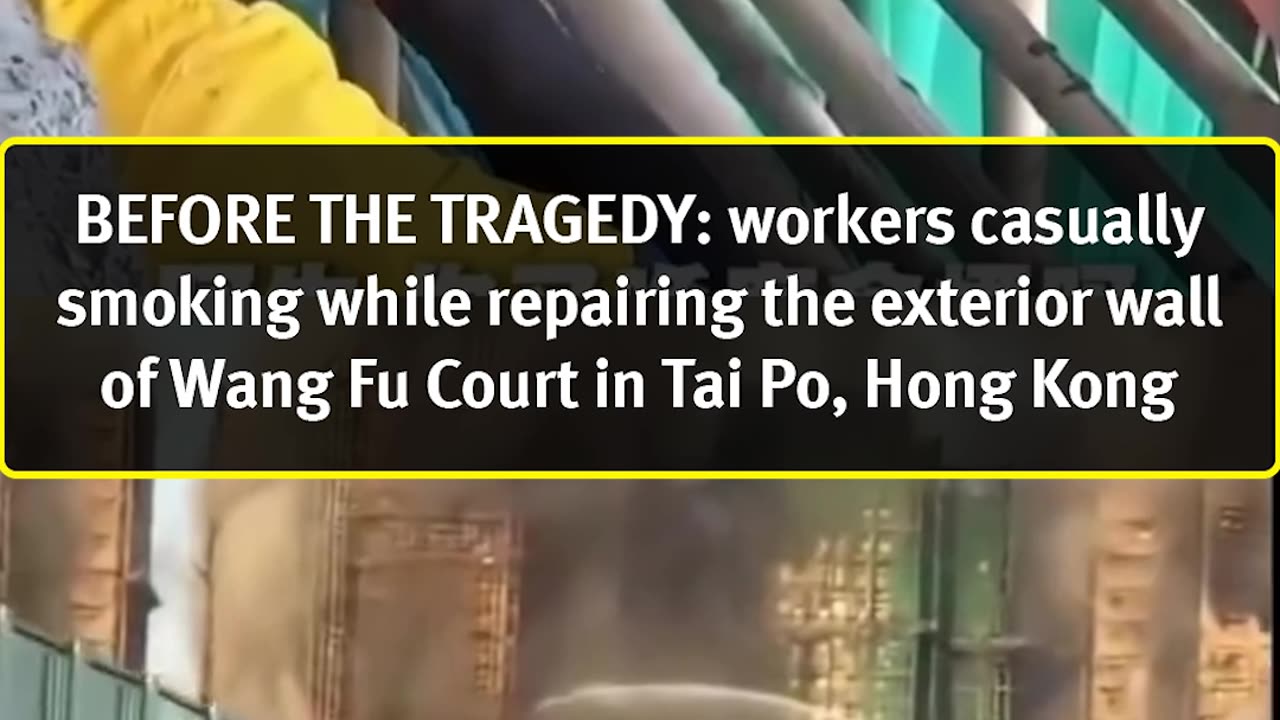
BEFORE THE TRAGEDY: Workers smoking informally while repairing the exterior wall of Wang Fu Court
BEFORE THE TRAGEDY: Workers smoking informally while repairing the exterior wall of Wang Fu Court
The footage emerging from Hong Kong in recent hours has shaken global audiences, offering a heartbreaking reminder of how fragile urban life can be. At Wang Fu Court, a residential complex in the densely populated district of Tai Po, a massive fire erupted and spread within minutes, leaving a devastating number of casualties. Just moments before the blaze ignited, a video captured several construction workers taking a brief break while repairing the exterior wall—some lighting cigarettes in what appeared to be a routine moment during an exhausting workday.
The initial online reaction was swift and, in many cases, disproportionately harsh. For anyone familiar with construction work, the scene was far from unusual: fatigued workers, often under pressure, striving to meet demanding deadlines and maintain productivity. What many critics failed to recognize is that these workers operate under long hours, intense heat, physical strain, and inconsistent workplace oversight. They do not control the materials they are told to install, the structural integrity of the site, or the safety policies enforced by employers and local authorities.
Experts now believe that the materials used on the building façade may have been highly combustible—an element entirely outside the workers’ control. In such conditions, even a small spark, a mechanical malfunction, or a material defect can escalate into disaster. Blaming frontline workers not only oversimplifies the situation but distracts from the real systemic failures behind the incident: inadequate regulatory enforcement, weak oversight, and administrative decisions that place cost efficiency above public safety.
When the fire broke out, many of these same workers were among the first to respond. Witnesses report that they shouted warnings, knocked on doors, and guided residents toward safer exits. Some risked their own lives trying to assist elderly residents and families trapped in smoke-filled hallways. Far from abandoning the scene, several workers helped emergency crews navigate blocked pathways and provided crucial information about the building’s layout. These acts of courage—largely ignored by sensational headlines—are an integral part of the story.
The tragedy has reignited deeper questions about construction standards and safety protocols in regions where political and economic pressures often overshadow proper regulatory enforcement. In Hong Kong, where Beijing’s oversight has expanded sharply and press freedom has declined, incidents like this reveal the vulnerabilities created when transparency and accountability weaken. For many conservative analysts, the Wang Fu Court fire highlights the need for stronger inspections, safer materials, and real accountability for those who make decisions at the top—not those who carry them out under difficult conditions.
Residents, though devastated, have expressed both grief and gratitude: grief for the lives lost, and gratitude for those who acted heroically amid the chaos. This event should not be framed as a simple story of worker negligence, but as a broader lesson on the importance of safety systems, regulatory integrity, and humane working conditions.
Ultimately, the tragedy is a reminder that public safety requires more than rules on paper—it requires enforcement, oversight, and respect for the dignity of every worker and every resident.
#HongKong #TaiPo #WangFuCourt #PublicSafety #FireIncident #Workers #Infrastructure
-
 1:33
1:33
Gateway Hispanic
1 day agoAccording to a Turkish court, liking other people's photos is grounds for divorce.
5 -
 3:08:15
Decoy
6 hours agoFinally
47.4K13 -
 2:55:01
TimcastIRL
7 hours agoTrump Calls Democrat RETARDED, Whistleblower EXPOSES Democrat FRAUD | Timcast IRL
226K65 -
 LIVE
LIVE
Akademiks
6 hours agoMeg Thee Stallion spent $2 mil on lawyers to win $59k vs Milagro! 50 Cent BURIES Diddy. SNAKES HIM!
908 watching -
 5:37:32
SpartakusLIVE
7 hours agoI'M BACK from Florida || The RETURN to the Spartan Stronghold
63.5K -
 1:38:45
Joker Effect
6 hours agoWhy is everything so DIFFICULT?! Cuffem, Gypsy Crusader, WVAGABOND is getting SUED?! IDuncle is mad!
35.8K3 -
 54:46
54:46
Flyover Conservatives
1 day agoInside the Kill Zones: Kidnappings, Camps & the War on Nigerian Christians Exposed - Judd Saul | FOC Show
34.6K1 -
 1:02:35
MattMorseTV
7 hours ago $27.24 earned🔴We just got the CONFIRMATION.🔴
45.3K91 -
 1:24:52
Glenn Greenwald
9 hours agoTrump Admin Preparing for New Regime-Change War Against Venezuela; Who Should Win Anti-Semite of the Year? See the Top 10 Finalists | SYSTEM UPDATE #551
123K88 -
 23:12
23:12
Jasmin Laine
11 hours agoCBC TURNS on Carney—Poilievre Speech Goes VIRAL, ROASTS Canada’s Elites
32.4K17