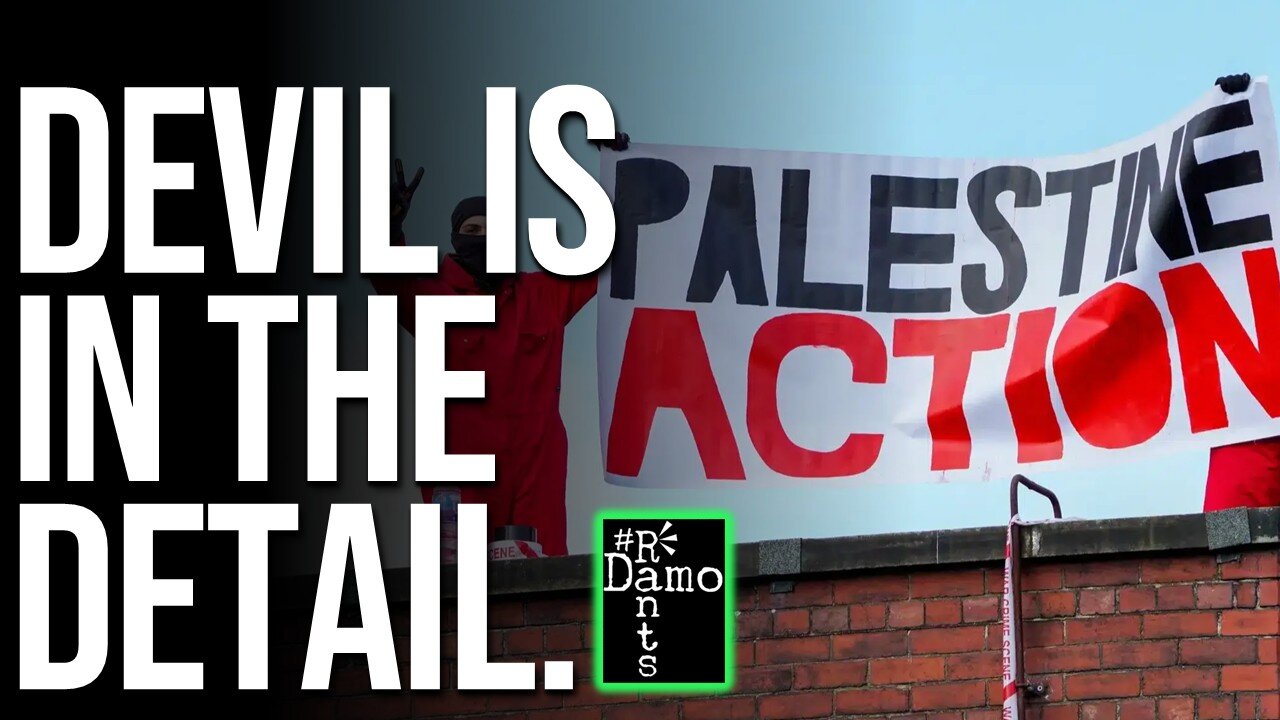
Palestine Action Review Bombshell Drops MASSIVE Stitch Up Accusations
Right, so you can always tell when the British state is nervous, because it stops pretending it isn’t. And that’s exactly what’s happened with the Palestine Action judicial review. A judge who granted permission for the case has been removed from it. No reason, no explanation, just gone. And in his place the judiciary has quietly installed a panel that reads like the Home Office’s wish-list: the government’s former national-security attack dog, the judge who has already shielded the UK–Israel arms pipeline, and the senior public-law judge whose own family sits deep inside the financial networks tied to the very companies Palestine Action has been exposing. And the Starmer government thinks people won’t notice. Well they’re going to after this rant. Get comfy because this is a long one, but you won’t hear half of this anywhere else, but more people need to, because this is one hell of a stitch up.
Right, so the situation with the Palestine Action judicial review is one of those moments where you can feel the system blinking. You can feel it shifting its weight, you can feel it deciding that the truth of what has happened cannot be allowed to stand on its own terms, and you can feel the Starmer government settling into the machinery with the kind of confidence only a government has when it believes the institutions will bend for it, not against it. You start with a simple fact: a High Court judge, Mr Justice Chamberlain, granted permission for the most significant challenge to the UK’s terrorism powers in years, and days before the hearing, he gets removed without explanation. No reason, no notice, no transparency. A judge removed at the last minute from a case that threatens two thousand arrests, the credibility of the Home Office itself, the state’s alignment with Israeli defence interests, and the political authority of the Starmer government which has been presenting its proscription as a clean, lawful act. And you don’t need to be an expert in judicial process to recognise that this isn’t normal. You just need to know how British institutions behave when they’re under pressure, because they behave like this: silently, abruptly, and in a way that reveals more about the pressures they are under than they ever intended to show.
You then take the next step, because the story isn’t just that a judge was replaced. It’s that Chamberlain is a judge with a record. He’s not radical, he’s not adversarial, he’s not some kind of civil liberties crusader. What he is is independent, and that’s enough to make the British state nervous when the case touches Israel, arms exports, national security policy, and a proscription that was rushed through with a political narrative rather than an evidential one. The last time Chamberlain touched a case involving Israel and the UK’s military role, he granted permission for a challenge to the export of parts for F-35 jets being used in Gaza. And before the substantive hearing, he was removed from that case too. Two cases in the same year. Two involving Israeli military operations. Two involving whether the British state is facilitating those operations. Two where Chamberlain granted permission. And two where he mysteriously vanished from the proceedings before the government had to defend itself in open court. You don’t need conspiracy to see a pattern. You just need a basic sense of how power behaves when it faces risk. And the risk here isn’t subtle. It’s whether the courts will allow a legal process that might say: this government is breaching its own export rules, and this government is abusing terrorism powers to suppress direct action against arms companies.
This is where you turn to the mechanics, because people like to imagine these things as drama when really they’re procedures. Judges don’t get replaced like this. When a judicial review is given permission, the case stays with the judge unless there is a conflict of interest, unavailability, or a scheduling issue, and every one of those situations comes with a public explanation. Because the integrity of the system depends on reasons being given. Without reasons, the process becomes discretionary, and discretionary judicial process is the beginning of judicial politics. And the system knows it. Legal experts have said the same thing: this doesn’t happen, and the way it’s been done cuts against how the Administrative Court works. If a case needs a panel, you add two judges alongside the original judge. You don’t remove the judge who granted permission. You keep the original judicial mind because they’re the one who has already said: this case is arguable, and the government must answer. And that’s the thing the Starmer government, assuming they are behind this, as many of us I’m sure are making that inference, could not risk. Because once a judge has already signalled the government must answer, the executive loses control of the frame. And control is all this is about.
Then you look at the replacement bench properly, because this is the moment where the whole thing stops reading like a scheduling change and starts looking like the judiciary rearranging itself around political pressure. Dame Victoria Sharp. Dame Karen Steyn. Sir Jonathan Swift. On any ordinary day these are senior, experienced, serious judges. In a case like this, with this subject matter and this level of political exposure, they’re something else entirely. They’re exactly the kind of judges the state relies on when a case threatens the government’s interests in foreign policy, national security, or the arms industry. And once you understand the track records sitting behind those names, you understand why removing Chamberlain and replacing him with this panel is not a neutral act. It’s a structural response.
Start with Swift, because he is the most obvious example of how the judiciary absorbs the instincts of the institutions it has served. Before becoming a judge he spent years as the government’s First Treasury Counsel, the barrister the Home Office and other departments used whenever they needed to defeat public-law challenges on detention, deportations, surveillance, intelligence, anything that touched national security or executive discretion. If you ever tried to take the state to court on a matter the state didn’t want examined, Swift was the person standing there arguing that the courts should not interfere. That career doesn’t vanish the moment you put on a robe. It forms the entire legal instinct. And you see that instinct clearly in the Assange appeal, where he ruled against allowing further grounds to be heard and sided squarely with the position advanced by the same state whose interests he spent years defending. This isn’t a question of impropriety. It’s a question of public confidence. Because when you put the state’s former national-security barrister in charge of a case about whether the Home Office misused terrorism powers to suppress protest against arms exports, anyone looking at that bench instantly sees the structural alignment. A judge who spent a decade protecting the state from scrutiny is not the judge the public would expect to examine whether the state has stretched its powers beyond the law is it?
Then you move to Steyn, whose ruling in the F-35 challenge earlier this year, she was the judge who replaced Chamberlain then too, so she’s now replaced him twice. She has already shaped the political landscape this case now sits in therefore. The government admitted in court that exporting parts for the F-35 programme breached its own rules on international humanitarian law risk. That should have been the point where the courts stepped in. Instead Steyn held that the matter was ultimately a political question, too bound up with foreign policy to warrant judicial intervention. That is a judicial philosophy. It’s not subtle. It tells you plainly where she believes the limits of judicial oversight lie when UK foreign policy and UK complicity in Israeli military operations are concerned. And when you are dealing with a proscription challenge that sits right on top of those same foreign-policy sensitivities, you already know what that instinct means don’t you? If she wouldn’t intervene when the government admitted breaching its own rules, she is hardly going to carve open a proscription that the government is presenting as a matter of national security and diplomatic necessity. Again, you don’t need to allege motive. You just read the record.
But the real weight on this panel comes from Sharp, because she brings both the institutional authority and the public-confidence problem. She is the President of the King’s Bench Division — one of the most senior judicial roles in the country. Presidents do not normally appear on first-instance judicial reviews unless the case is sensitive, politically charged or institutionally delicate. Her very presence tells you the judiciary recognises the stakes before anyone has said a single word. But it gets even worse than that, because then comes the detail that no amount of judicial polish can possibly neutralise: she is the twin sister of this chap, Richard Sharp, the former chair of the BBC who was pushed out in disgrace after being caught out trying to help Boris Johnson secure a £800,000 loan and a long-time figure in the financial world through senior roles at JP Morgan and Goldman Sachs. These are institutions with substantial investment positions in Israel’s defence sector, including companies directly linked to the manufacturing infrastructure targeted by Palestine Action. He also moved within high-level political and lobbying networks that intersect with pro-Israel advocacy. None of that is rumour. It is documented. He now chairs One Million Mentors, where he and a chap by the name of Sir Trevor Chinn sit together on the board. Chinn is not just any charity trustee; he’s a long-time pro-Israel lobbyist, a founder and leader inside BICOM, a vice-president of the Jewish Leadership Council, and a funder of both Labour Friends of Israel and Conservative Friends of Israel, as well as a key donor to Keir Starmer’s leadership campaign. That same Chinn was appointed a director of One Million Mentors on 10 July this year, just days after Palestine Action was formally banned under terrorism law, and now his fellow trustee’s twin sister is presiding over the case that will decide whether that proscription stands. And while Victoria Sharp is not responsible for her brother’s career, the test for judicial independence is not “is there actual bias?” The test is whether a reasonable person, looking at those family connections and looking at the subject matter of the case, would be confident the judge is independent. And when the case concerns the suppression of a movement targeting the exact part of the arms pipeline that her brother’s sector is financially tied to, it is impossible to pretend the appearance-of-bias issue doesn’t exist. It is built into the structure.
And when you place these three judges side by side — the state’s former national-security defender, the judge who has already refused to intervene in UK-Israel arms supply even when the government admitted fault, and the senior judicial figure whose immediate family sits inside the financial and political networks surrounding the Israeli arms industry — you don’t need a conspiracy theory. You don’t need a smoking gun. You don’t need to claim intent. You just look at the panel and you understand instantly why the government would feel comfortable with it. Because this is the bench you would choose if your priority was protecting a proscription built on national-security framing, foreign-policy alignment with Israel, and political necessity. A bench steeped in the instincts of deference. A bench that does not need pressure applied because its own histories lean naturally toward the state. A bench that tells the public, before the hearing even begins, that the judiciary is not insulated from the political gravity of the case — it is already orbiting it.
Now you step back, because the deeper question is why. Why this case, this moment, this level of manoeuvring. Well, the Palestine Action judicial review threatens the Starmer government’s credibility at the exact point where it is at its most fragile. This government has spent the year positioning itself as the party of law and order after a decade of Conservative chaos, building a narrative around toughness on extremism, discipline in public order, and a refusal to tolerate disorder. And yet here they are facing a judicial review which says: you abused your terrorism powers, you failed to consult, you violated freedom of expression and assembly, and you used proscription to protect the UK’s role in the Israeli arms pipeline. A loss would not just dissolve two thousand arrests. It would cut a hole straight through the political pitch they’ve been making. It would show that the Starmer government’s counter-extremism stance is performative, fragile, and grounded in opportunism rather than law. And they know it.
And this takes you to the second pressure point: the Foreign Office. Because the Palestine Action Judicial Review isn’t just a domestic question. It hits UK-Israel diplomatic relations in the middle of a genocide where Britain has been supplying components, logistics and political cover. Israel does not tolerate British courts telling Britain to stop exports. We saw that in the F-35 challenge. That case was the most direct confrontation between arms export law and the reality of Gaza, and the government knew it could not afford a judge willing to examine evidence on its merits. And when you see the same judge removed from two cases with the same sensitivity, involving the same foreign policy partner, in the same year, you don’t pretend you don’t see what’s happening. You recognise institutional pressure being absorbed by the judiciary without ever being spoken aloud. That is how British power works: through signals, not orders.
But the real centre of gravity is the arms industry. And that’s the point people miss. Palestine Action has spent four years disrupting the UK infrastructure of Israeli arms production. They have shut factories, forced closures, exposed supply chains, and made the political economy of the arms trade visible to the public in a way no parliamentary process ever did. And for the British state, that is intolerable. Because once the public sees that the UK is directly embedded in the machinery of the Gaza genocide, the government loses control of the narrative. So the state needs the proscription to stand. Not because Palestine Action poses a security threat, but because it poses a political threat to the UK’s relationship with Israel and to the legitimacy of the UK’s arms export regime. And the arms industry knows this. The companies know it. The City knows it. The lobby networks know it. And the courts feel the weight of that entire structure when a case like this lands on their desk.
And here’s the thing: none of this requires direct interference. You don’t need to imagine the Home Secretary calling a judge. That’s not how any of this works. The system is built so that once a case touches national security, foreign policy or the arms trade, the executive’s anxiety radiates through the machinery. The listing office knows it. The senior judiciary knows it. The government lawyers know it. Everybody knows when a case is too sensitive to leave to chance. And this is where the Starmer government comes in, because they have been leaning on the national security narrative all year. They have turned extremism into a political instrument. They have framed dissent as disorder. They have used the language of security to shut down challenges to their foreign policy. And once you create that environment, the grip of the executive tightens without the executive ever needing to say a word.
And this is why the silence matters. Because when the judiciary refuses to give a reason, they are telling you the reason would undermine confidence in their independence. If it was scheduling, they would say. If it was illness, they would say. If it was conflict, they would say. If it was administrative necessity, they would say. Silence is the tell. Silence is the point where the system reveals its own vulnerability. Because the only reasons you cannot say are the reasons that would show the judiciary was influenced by political or diplomatic concern. And nobody in the judiciary wants to be the person who has to say: “this case was too politically sensitive for us to risk an independent judge.”
And this is why the switch is so dangerous. Because if the Starmer government gets the judgment it wants under this panel, that judgment will carry no authority outside the narrow legal formality of it. It will be treated by the public as a political ruling, not a judicial one. It will be appealed. It will be scrutinised. It will be remembered as a moment when the separation of powers broke under pressure. And every conviction under the proscription becomes less secure from the moment the ruling is delivered. Because once the appearance of bias is established, the legitimacy of the entire process collapses. That’s the consequence the government has risked to protect itself from being told it abused its own counterterrorism powers.
And this is the deeper thing: the damage does not end with one case. If the judiciary can be bent under political pressure in a case involving protest, foreign policy, arms exports and national security, it can be bent in any case involving those domains going forwards. And the Starmer government is leaning harder on those domains than any British government I can think of. They are using national security language to police activism. They are using foreign policy alignment with Israel to define domestic policing. They are using the arms trade as a reason to suppress protest. And once you link those things together, the judicial system becomes another tool for stabilising political pressure rather than examining evidence. That is the danger here. Not that the government gets away with one improper listing change, but that the precedent it establishes becomes the new normal.
And when you look at this situation with clear eyes, the thing that stands out is how little the government trusts its own case. If the Home Office believed the proscription was lawful, they would have welcomed a robust judicial process. If the Foreign Office believed the public could handle an honest account of British involvement in Israeli military supply, they would not panic at the thought of disclosure. If the government believed its own narrative about extremism, it wouldn’t need this level of institutional shielding. The judge-switch isn’t a sign of confidence. It’s a sign of fragility. It’s a sign the government knows its case can’t survive open scrutiny under a genuinely independent judicial mind.
This isn’t just a stitch-up of the Palestine Action review. It’s a stitch-up of the judicial process itself. It’s a sign that the Starmer government, when pushed on its alignment with Israel and the arms industry, will lean on the machinery of the state until the machinery bends. And once a state learns it can bend the judiciary by signalling anxiety through the right channels, it doesn’t stop. It does it again, and again, until the distinction between executive preference and judicial decision becomes meaningless. And the public sees it. And once the public sees it, legitimacy evaporates. Trust in British law itself evaporates. Which is why this case is so much worse than people think. It’s not a glitch. It’s a revelation. It shows you how the system protects itself when its political commitments collide with legal accountability. And that’s why this story matters, because it tells you exactly how British power works when nobody is supposed to be watching.
The thing that becomes unavoidable as you keep pulling at this thread is that the Starmer government is now treating the judiciary as an extension of its political strategy, whether it admits it or not. And that’s where the constitutional danger really sits, because this government has spent the year using the language of national security as a shield for everything from protests to foreign policy alignment to the arms trade, and once a government frames its political priorities as national security priorities, the courts become vulnerable. Because national security is the one area where British judges consistently defer. They don’t want to be seen as obstructing the executive. They don’t want to be accused of undermining diplomacy. They don’t want to be cast as interfering with the machinery of the state. And the executive understands this instinct better than anyone. It’s why governments lean on these narratives, because they know the language itself creates pressure without needing to instruct or intervene. And the Starmer government has leaned on this narrative with a kind of ideological certainty, presenting protest as extremism, dissent as a threat, and actions that challenge the arms trade as destabilising. And once you set that frame, the courts hear it, even if nobody says a word directly.
And this is why the Palestine Action judicial review is the moment the whole thing snaps into focus. Because this isn’t an abstract question about civil liberties. It’s a direct challenge to the government’s use of terrorism powers, the kind of powers the state hates being challenged on because they are designed to be unchallengeable. The proscription tool is the bluntest political weapon in the statute book. It doesn’t just criminalise actions, it criminalises association. It allows the state to treat political dissent as criminal intent. It reverses the burden of proof. It creates guilt by proximity. It is the kind of power a government uses when it wants to shut something down without having to argue the case in public. And when a judge agrees to hear whether that power has been abused, the government has a real problem. Because once the case enters the courtroom, the government can’t hide behind press releases and podium lines. It has to justify itself, and it has to justify itself to someone outside its own structure. And the last thing the Starmer government wants is that level of scrutiny on a proscription that was rushed, politically charged, and aligned with a foreign policy priority rather than an evidential risk.
This is also why the stakes are so high for the Home Office. They’ve built their entire posture on restoring “credibility” after Conservative chaos, which in practice means clamping down on protest, enforcing public order, and projecting authority. They want to be the government that isn’t afraid to use the Terrorism Act, not because it’s necessary, but because it plays well in the political theatre they’ve built around competence. And Palestine Action is the wrong group to pick a fight with if you want to avoid scrutiny. Because everything they’re doing exposes the connection between the British state and the Israeli war machine. They have forced the public to look at Elbit, at the supply chain, at the fact that British factories are producing parts used in Gaza. They’ve exposed how deep the complicity runs. And instead of addressing that complicity, the government has tried to criminalise the movement. And that’s why losing the judicial review isn’t an option for them. Because a loss isn’t just a courtroom setback. It’s a political collapse.
And this brings you to the Foreign Office, because this is where the international pressure becomes part of the domestic calculation. Israel is not a passive observer here. The UK is a strategic ally, a supplier, and a diplomatic shield. And the Palestine Action Judicial Review threatens all of that. If the proscription is found unlawful, Israel loses a political tool it has been using through allies for the last year. If the courts allow scrutiny of UK arms exports, Israel loses a critical part of its supply chain. And if the case exposes that the UK has breached its own rules, the Foreign Office faces a diplomatic crisis with a government it has spent the last year protecting. The Starmer government has tied itself tightly to Israel’s military position, even as public opinion has shifted dramatically. And once the F-35 case cracked the door open on UK complicity, the political class has been scared stiff of what a fully litigated challenge would expose. That’s why Chamberlain’s removal from that case matters for this one. Because it shows you the sensitivity. It shows you the pressure. It shows you the pattern.
Then you look at the arms industry, because they’re the quiet centre of the story and they always are. The British state has spent decades entangling its foreign policy with its defence economy. The arms industry is not just a commercial sector, it’s a diplomatic instrument. And when a group like Palestine Action starts forcing closure after closure, disrupting production lines, hitting investors, and exposing financial networks, the industry doesn’t just panic. It mobilises. It talks to ministers. It raises concerns. It frames protest as a national security issue. And the government responds, not because it takes orders from industry, but because the interests are aligned. The UK’s global posture depends on a stable arms export regime. Palestine Action destabilises it. And once you accept that, it becomes obvious why this judicial review couldn’t be left to chance.
And this is where the judge-switch becomes the most revealing detail. Because if the state was confident in its legal basis, it would not need to interfere with the process. If the Starmer government genuinely believed the proscription was legitimate, it would have had no fear of a judge like Chamberlain, who is cautious, serious, and grounded in law. The panic comes from the recognition that the proscription may not be able to survive independent scrutiny. That the evidence is too thin. That the consultation process was bypassed. That the use of terrorism powers to protect foreign policy interests is too naked. So the government can’t risk it. And the judiciary feels that risk. It feels the pressure. It sees the context. And under that context, the removal of Chamberlain becomes the path of least institutional resistance. Nobody gives an order. Nobody signs a memo. The system just moves. It decides that the risk is too high. And it reshapes itself to protect the government.
And you can see the consequences of this already, because public confidence in the courts is brittle. The judicial system rests on the perception that judges are independent, not because they are perfect, but because they are insulated. And when a judge is removed without explanation from a politically explosive case, that insulation falls apart. People see it for what it is: the judiciary responding to political and diplomatic pressure in silence, hoping that the opacity will hide the fracture. But the opacity reveals the fracture. It shows people exactly what the government does not want them to see. It shows them that the separation of powers is not guaranteed. It’s a habit. A convention. And conventions collapse the moment they clash with political necessity.
This is why the Palestine Action Judicial Review matters beyond Palestine Action. It’s a test of whether the courts can withstand the political gravity of a government determined to align domestic protest law with foreign policy. It’s a test of whether judges can act independently when national security language is being used to shut down dissent. It’s a test of whether the machinery of the state will protect its own political commitments, or whether the law can cut through those commitments when they are misused. And right now, the machinery is winning. The judge-switch tells you everything you need to know about who holds the real power in cases like this. And the answer isn’t the courts.
And here’s the real question: what happens if the government wins under this panel. Because the ruling won’t settle anything. It will open a new conflict. An appeal will undoubtedly follow. A challenge to the fairness of the process will follow. Public distrust will grow. Every prosecution under the proscription will become unstable, because once the process is tainted, every downstream case suffers. And the Starmer government will have to defend a victory that everyone can see was built on a compromised process. And that’s the thing about stitching up a judicial review. You can win the ruling. But you lose the legitimacy. And once you lose legitimacy, you lose control.
So the verdict is already clear. The Palestine Action Review stitch-up is worse than people already think because it’s not about one case or one judge. It’s about a government that has learned how to lean on the machinery of the state until the machinery shifts its weight. It’s about a judiciary that has shown it will bend to political and diplomatic pressure when the stakes are high enough. It’s about a foreign policy that has fused with domestic policing. It’s about an arms industry that knows the government will protect it at all costs. And it’s about a protest movement that has exposed the British state’s role in a foreign war so clearly that the government has resorted to national security theatrics to shut it down. The stitch-up isn’t the scandal. The scandal is what the stitch-up is revealing: a system that will not let its own actions be judged independently when those actions serve the interests of the powerful.
Right before all of this kicked off though, Palestine Actions case did get a bit of a boost in a roundabout way as MI6 dropped a clanger concerning relations with the very much proscribed at the time group HTS, the group that deposed the Assad regime in Syria consisting of Al-Qaeda leftovers as they do and the state very much forging relations with them despite that, all as Palestine Action got proscribed. The hypocrisy stinks there too, get all the details right here.
Please do also hit like, share and subscribe if you haven’t done so already so as to ensure you don’t miss out on all new daily content as well as spreading the word and helping to support the channel at the same time which is very much appreciated, holding power to account for ordinary working class people and I will hopefully catch you on the next one. Cheers folks.
-
 1:43:05
vivafrei
6 hours agoBREAKING: Jan. 6 Pipe Bomber Prosecutor is the SAME ONE Who Prosecuted Enrique Tarrio?
128K46 -
 35:16
35:16
Tactical Advisor
4 hours agoNew Pivoting Rifle for Backpacks | Vault Room Live Stream 048
30.6K -
 LIVE
LIVE
Amish Zaku
8 hours agoRumble Spartans December Event
108 watching -
 LIVE
LIVE
OhHiMark1776
5 days ago🟢12-06-25 ||||| HMR. 21: King of the Hill ||||| Halo MCC (2019)
106 watching -
 20:08
20:08
MYLUNCHBREAK CHANNEL PAGE
11 hours agoThe Field Museum is From Another Timeline
69K24 -
 3:05:52
BigTallRedneck
3 hours agoRUMBLE SPARTANS HALO NIGHT
15.7K1 -

AirCondaTv Gaming
4 hours ago $0.45 earnedHalo: The Master Chief Collection - Conda a Clause is Spreading some Plasma Holiday Cheer (Collab)
12.2K1 -
 3:22:01
SpartakusLIVE
7 hours agoSOLOS on ARC Raiders || WZ Stream LATER
134K2 -
 LIVE
LIVE
GritsGG
8 hours agoBO7 Warzone Is Here! Win Streaking! New Leaderboard?
112 watching -
 1:00:55
Jeff Ahern
8 hours ago $9.17 earnedThe Saturday show with Jeff Ahern
59.4K16