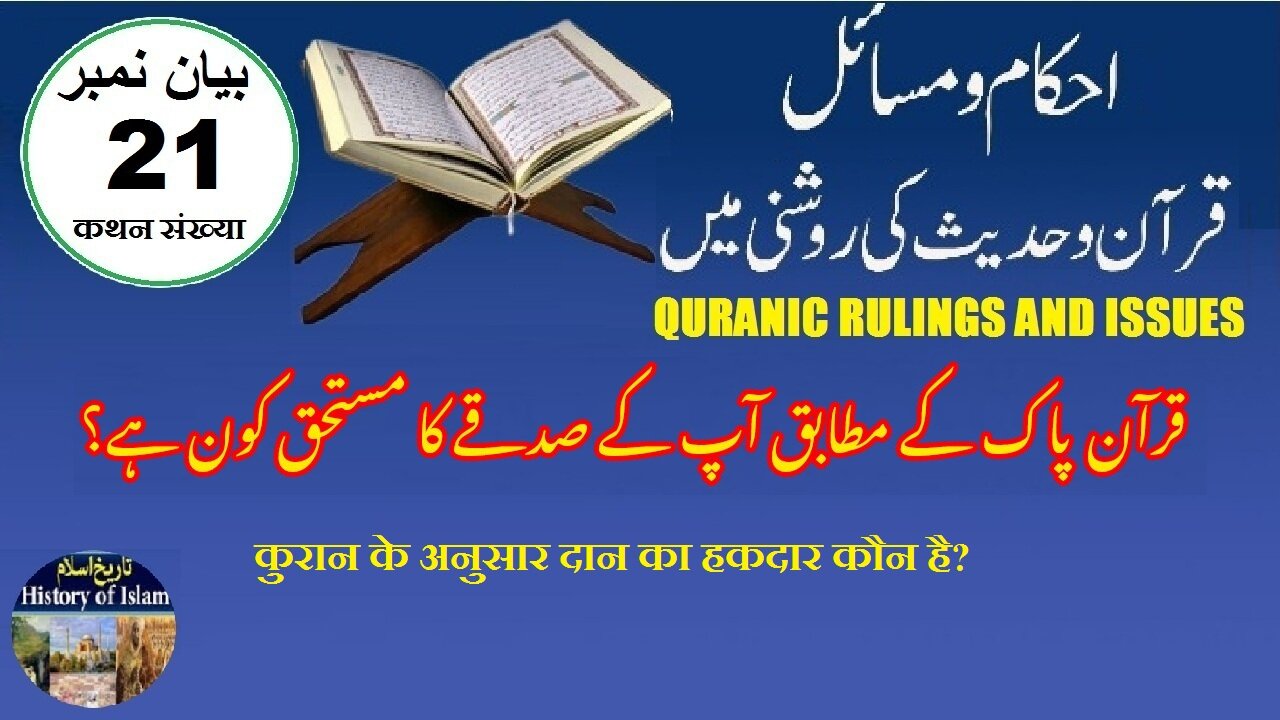
Who Deserves Charity According to the Qur’an قرآن کے مطابق صدقہ کا مستحق کون ہے؟
@islamichistory813 #who #deserves #your #charity #according #to #the #quran #islamicbayan
That Who Deserves Your Charity According to the Qur’an?
I begin in the name of Allah, the Most Gracious, the Most Merciful. , by the grace of Allah Almighty, today we are beginning Statement No. 21. and will be describe That Who Deserves Your Charity According to the Qur’an?, So sisters, brothers friends and elders, Our aim is to learn and teach from the Quran and Sunnah, understand the rulings, reflect on history, and seek solutions to problems with divine guidance. May Allah Almighty make this statement beneficial and a source of light for all hearts.
Charity (aadaqah and zakah) is one of the most important pillars of Islam. It purifies wealth, softens the heart, reduces poverty, and strengthens the bonds of the Muslim community. But Islam also teaches that charity must be given wisely. The Qur’an and Sunnah clearly define who deserves charity, ensuring that it benefits those most in need while preventing misuse.
The Qur’an provides a detailed list of who has the right to receive charity from zakah. Allah says in Surah At-Tawbah, verse 60:
“Indeed, zakah expenditures are only for the poor, the needy, those employed to collect it, those whose hearts are to be reconciled, to free captives, for those in debt, for the cause of Allah, and for the stranded traveler – an obligation imposed by Allah. And Allah is Knowing and Wise.”
This verse identifies eight categories of eligible recipients:
1. Al-Faqr (the poor) - Those who have no wealth or means of livelihood.
2. Al-Muskeen (the needy) - Those who may have some income but it is not enough for basic needs.
3. Al-Mal (zakat workers)- Those who are appointed to collect and distribute zakat.
4. Al-Mutala’ al-Qalb (those whose hearts are to be reconciled)- New Muslims or those whose faith needs to be strengthened.
5. Al-Riq’b (the freed captive/slave) - Helping freed slaves or unjustly imprisoned people.
6. Al-Ghrim (the debtor) - Those who cannot repay loans taken out for legitimate reasons.
7. Al-F? Sub-Lillah (All in the way of Allah)- Supporting religious, educational and defense efforts for Islam.
8. Ibn al-Sabil (the stranded traveler) – Someone who is deprived of resources while away from home.
Thus, Zakat is not random giving but a system of social justice that directs specific groups.
Charity begins at home. The Quran and Hadith emphasize helping relatives before others. Allah Almighty says in Surah al-Isra verse 26:
“And give to the relative his due, and to the needy and the traveler, and do not be extravagant.”
The Prophet (peace and blessings of Allah be upon him) also said:
“Giving charity to the poor is charity, but giving to the relative is two things: charity and maintaining kinship.”
(Sunan al-Tirmidhi, Hadith 658; Hasan)
Therefore, helping needy parents, siblings, or relatives not only fulfills the obligation of charity but also strengthens family ties, which Islam highly values.
A righteous person gives charity for the sake of Allah, not for praise. The Quran praises those in Surah Al-Baqarah, verse 271, who give secretly:
"If you reveal your charity, it is good, but if you conceal it and give it to the poor, it is better for you, and it will remove some of your evil deeds. And Allah is fully aware of what you do."
A Prophet ( The one who gives charity secretly** is among the seven types of people whom Allah will shade on the Day of Resurrection (Sahih Al-Bukhari, Hadith 1423; Sahih Muslim, Hadith 1031).
4. Avoiding Charity for the Wealthy and Powerful
Charity should go to those who are truly in need, not to those who are wealthy or able to earn. A Prophet (PBUH) Said:
(Sunan Abu Dawud, Hadith 1633; Sahih)
"Charity is not permissible for a rich person or for one who is strong and has the power to earn."
This ensures that charity serves its purpose of uplifting the weak, not subsidizing the comfortable.
The Quran describes charity as a purifier of wealth and soul. Allah commanded the Prophet in Surah At-Tawbah, verse 103:
"O Muhammad, take from their wealth alms, thereby purifying them and increasing them, and send blessings upon them. Indeed, your supplication is a comfort to them, and Allah is All-Hearing, All-Knowing."
This shows that giving charity not only helps others but also purifies the giver's heart from greed.
According to the Quran, those eligible for charity include the poor, the needy, the debtor, the traveler, and other groups mentioned in Surah At-Tawbah verse 60. Charity should begin with relatives, be given sincerely, and be directed to the truly needy. The Prophet (PBUH) reminded us that charity is not just financial assistance. It is also an act of worship that purifies the giver and strengthens the community. In Islam, charity is the right of the poor over the wealthy and is a means of keeping society balanced, compassionate, and united.
We conclude today's discourse with this humble supplication: O Allah, purify our hearts, accept our deeds, forgive our sins, and include us among Your grateful servants. Bless us in our time, our families, and our faith, and gather us under the shade of Your mercy on the Day of Judgment. Amen
#qurantafseer #hadithlessons #ilmdeen #quranwisdom #rozanabayan #sunnahteachings #imanibaatain #islamicknowledge #masailkaahal #quranstories #deenreminder #hadithseikhtalat #islamicsolutions #ilmokhikmat #dailybayan #sunnatseekhain #islamicevents #deenikahaniyan #quranmessage #islamiclessons #islamiwaqiat #bayanseries #quranreminder #islamicwisdom
-
 8:34
8:34
ISLAMIC HISTORY
16 hours agoGhazwah al-Abwa (Waddan) Episode 1 ग़ज़वाह अल-अब्वा (वद्दन) غزوہ العبواء (ودان) قسط 1
-
 18:14
18:14
Nikko Ortiz
11 hours agoMost Painful Internet Clips...
6.53K8 -
 2:08:21
Side Scrollers Podcast
17 hours agoHasan Dog Joke Gets Streamer BANNED + Great Reset 100% CONFIRMED + More | Side Scrollers
42.3K9 -
 11:35
11:35
MetatronGaming
3 days agoYou Won't Believe Your Own Eyes..
1.53K -
 20:22
20:22
The Pascal Show
7 hours ago $0.02 earnedARE THEY IGNORING HER?! Is The White House & FBI Ignoring Candace Owens' A**assination Claims?!
1.42K -
 1:24:49
omarelattar
2 days agoThe $100M Sales Expert: “The Psychology of Selling To Anyone!” (High Ticket, Phone & Ai Secrets)
25.4K3 -
 18:36
18:36
GritsGG
12 hours agoTrios is BACK! Slamming Lobby w/ Mr. Bobby Poff!
1.68K -
 LIVE
LIVE
Lofi Girl
3 years agolofi hip hop radio 📚 - beats to relax/study to
287 watching -
 2:48:21
FreshandFit
14 hours agoNarcissistic Mid European Got Called Out And THIS Happened...
207K73 -
 1:48:12
Badlands Media
13 hours agoBaseless Conspiracies Ep. 161: The Human Hunting Files
79.7K32